
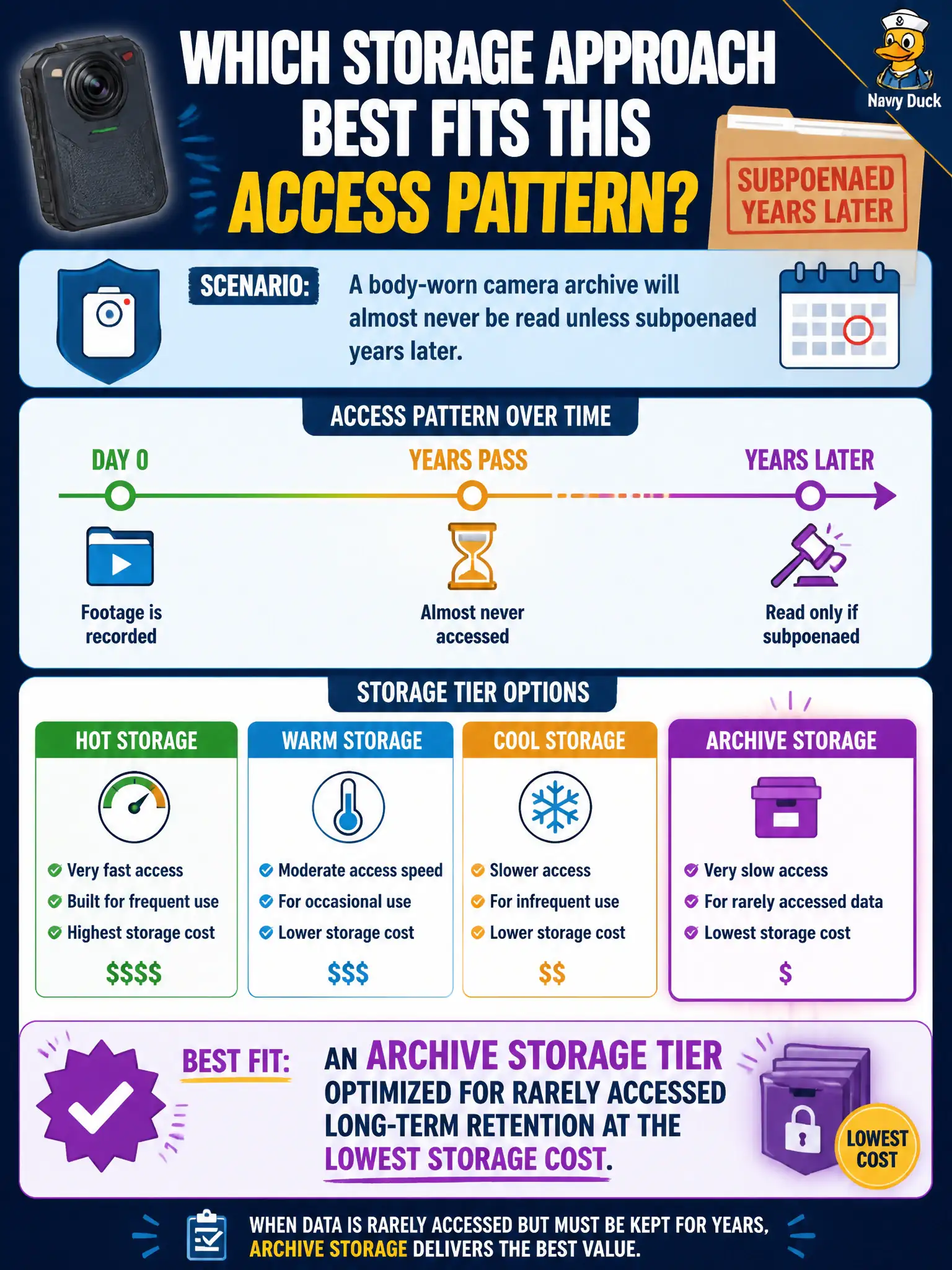
A body-worn camera archive will almost never be read unless subpoenaed years later. Which storage approach best fits that access pattern?
Select an answer to reveal the explanation.
Short Explanation
Videos that sleep for years until a subpoena wakes them belong in the deep archive closet, not on hot race-car disks. Archive tiers trade retrieval time for rock-bottom storage cost. Ephemeral disks and CDN edges are the wrong long-term evidence home.
Full Explanation
Archive storage classes are purpose-built for long-term retention of infrequently accessed objects at minimal storage cost, accepting longer retrieval times and sometimes retrieval fees when an object must be restored. A body-worn camera archive that is almost never read unless subpoenaed years later matches that access pattern and cost profile. Memory-optimized ultra-low-latency block volumes kept continuously hot for scrubbing every video are expensive overkill for multi-year dormant evidence. A real-time content delivery network edge cache is designed to accelerate frequently requested popular content, not to act as the durable system of record for multi-year legal holds. Ephemeral instance store disks vanish when virtual machines stop and cannot satisfy durable evidentiary retention. Exam caveat: archive tiers trade retrieval latency for storage savings—confirm legal and investigative access SLAs before placing evidence solely in the coldest class without a tested rehydration procedure. Operational check: store footage in archive with immutable object locks or legal-hold flags as policy requires, keep searchable indexes or catalogs without rehydrating every file, document hours-to-available for subpoena response, test a sample restore under chain-of-custody procedures, and alert when retention policies approach expiration or hold release.