
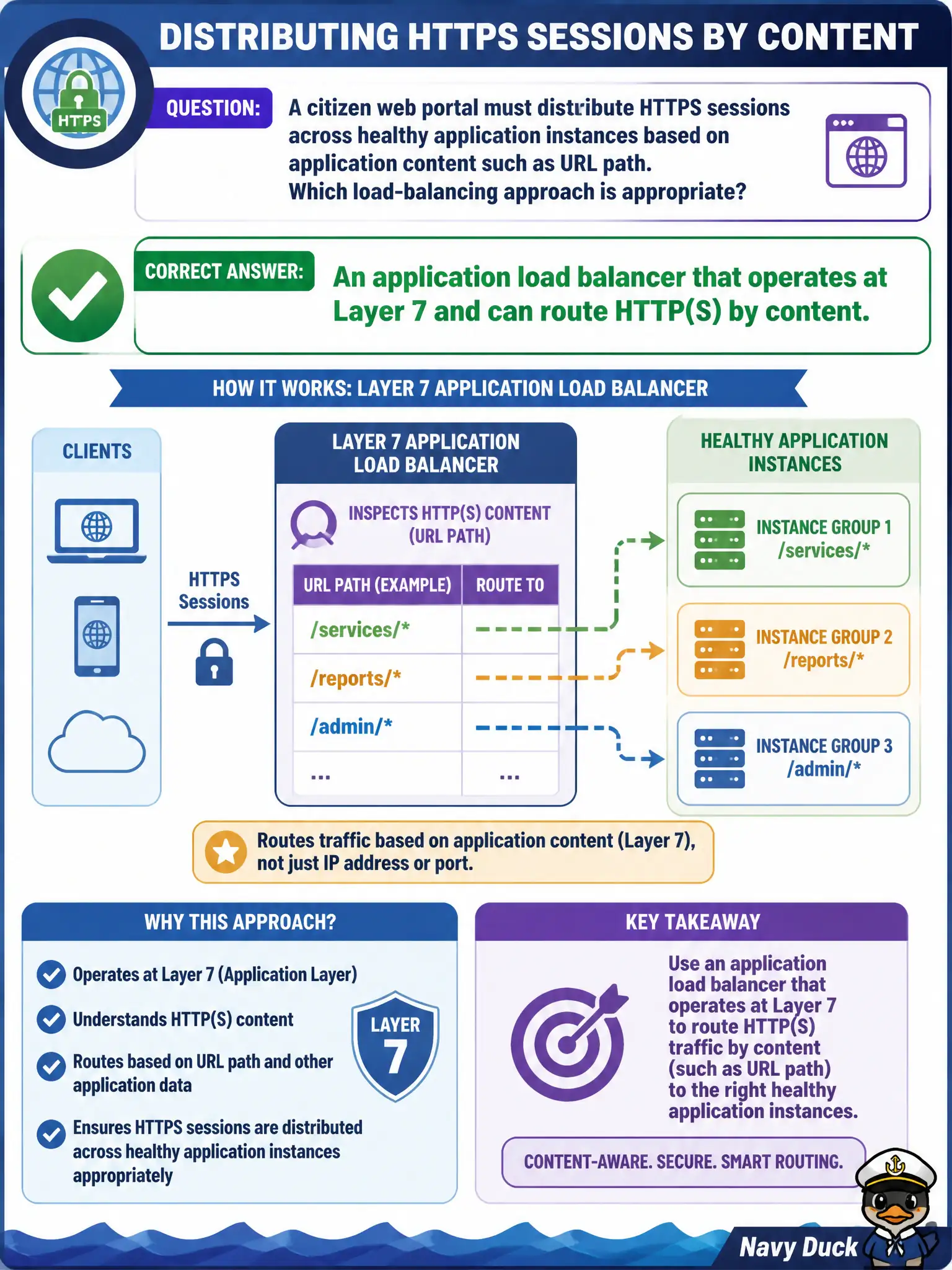
A citizen web portal must distribute HTTPS sessions across healthy application instances based on application content such as URL path. Which load-balancing approach is appropriate?
Select an answer to reveal the explanation.
Short Explanation
When you need the bouncer to read the URL on someone’s ticket before picking a door, that is Layer-7 application load balancing. It understands HTTPS content, not just IP and port. Plain L4 or DNS-only tricks cannot route by application path the same way.
Full Explanation
An application load balancer operates at Layer 7 and can distribute HTTPS sessions using application content such as URL path, host header, or cookies while integrating health checks that remove unhealthy instances from rotation. A citizen web portal that must route by application content across healthy instances therefore requires Layer-7 application load balancing rather than a purely connection-based distributor. A Layer-4 network load balancer that only hashes IP and port information cannot inspect HTTP content to implement path-based routing for portal microservices. Round-robin DNS alone typically lacks tight health integration and can continue sending citizens to failed endpoints after an instance dies. A cold-site facility lease is a disaster-recovery location strategy and does not distribute live production traffic among application instances at all. Exam caveat: Cloud+ load-balancing items hinge on matching OSI layer to the requirement—content-aware HTTP(S) routing implies an application load balancer. Operational check: define path or host rules for each portal service, attach health checks that reflect real application readiness, manage TLS certificates and cipher policy, drain instances before maintenance, and load-test failover so citizens are not pinned to a dead backend.