
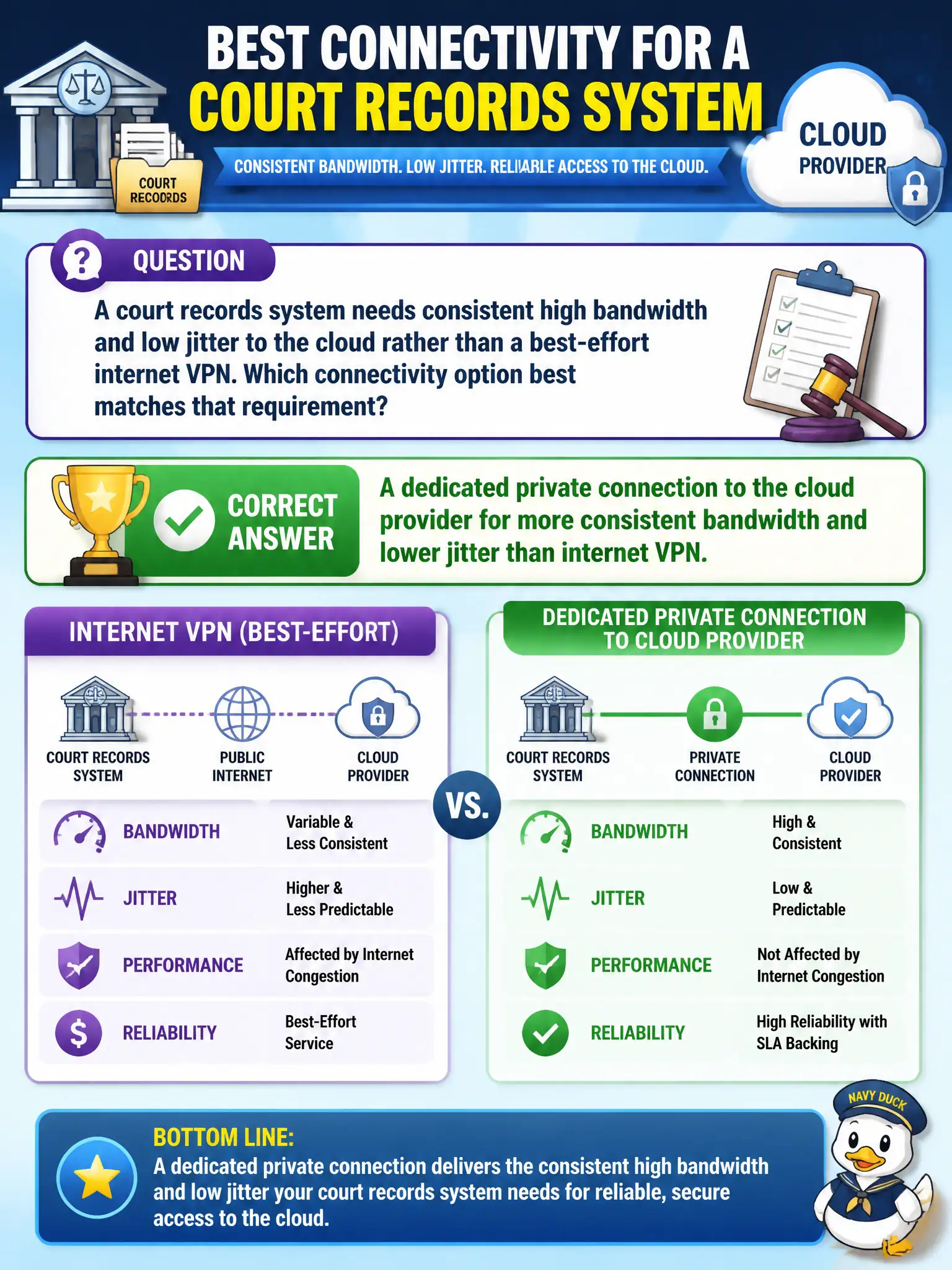
A court records system needs consistent high bandwidth and low jitter to the cloud rather than a best-effort internet VPN. Which connectivity option best matches that requirement?
Select an answer to reveal the explanation.
Short Explanation
When courts need a smooth, private pipe—not a bumpy shared highway—they look at dedicated cloud connections instead of best-effort internet VPN. Dedicated links trade cost for consistency and lower jitter. Coffee-shop Wi-Fi and weekly disk shipments will not meet interactive court-records needs.
Full Explanation
Dedicated private connections—often called interconnects or direct connects—provide a private path to the cloud provider with more consistent bandwidth and lower jitter than VPN tunnels that share the best-effort public internet. Court records platforms that need stable high throughput and predictable latency for interactive sealed-document workflows therefore commonly prefer a dedicated circuit for the primary path while retaining a VPN or secondary circuit for backup. Consumer broadband with no service-level agreement that terminates on shared coffee-shop Wi-Fi cannot meet judicial performance, confidentiality, or accountability expectations. Store-and-forward sneakernet that physically ships disks each week cannot support interactive queries by clerks or attorneys. Public HTTP without TLS is inappropriate for sealed court documents because it provides neither confidentiality nor integrity on the wire. Exam caveat: dedicated connectivity improves predictability and can reduce egress surprises, but it is not a substitute for encryption, identity, authorization, or a rehearsed failover path when the private circuit fails. Operational check: validate committed bandwidth and latency against court SLAs, apply encryption and strong auth even on private links when policy requires, configure monitored failover to VPN or a second interconnect, and alert on error rates, congestion, and jitter continuously.