
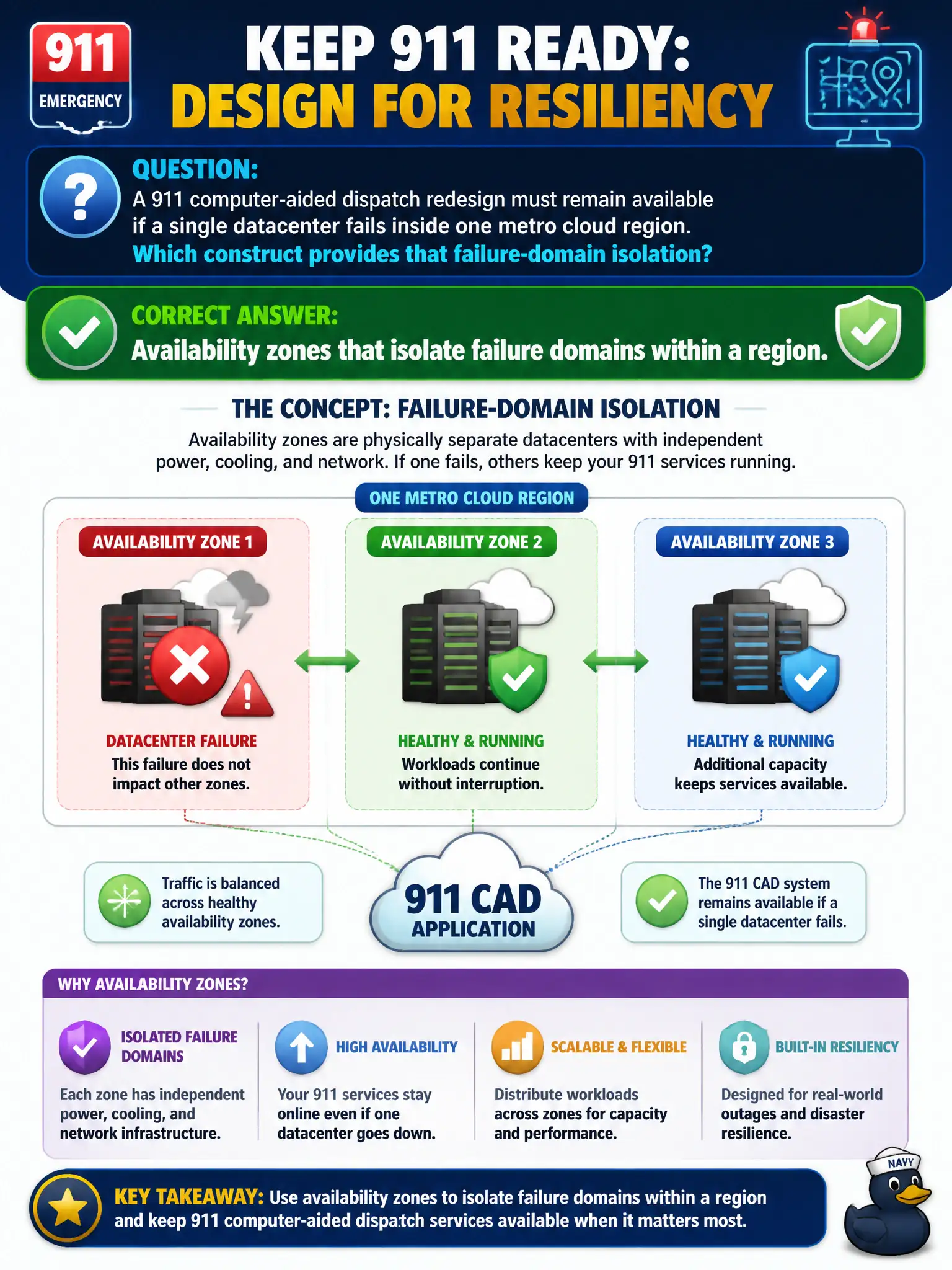
A 911 computer-aided dispatch redesign must remain available if a single datacenter fails inside one metro cloud region. Which construct provides that failure-domain isolation?
Select an answer to reveal the explanation.
Short Explanation
Availability zones are like separate fireproof wings in the same metro campus—if one wing goes dark, the others can keep CAD alive. Spreading across AZs beats parking everything in one datacenter. Versioning files or thin clients will not save you from a building outage.
Full Explanation
Availability zones isolate failure domains—typically separate facilities with independent power and networking—within a single cloud region. A 911 computer-aided dispatch redesign that must survive loss of one datacenter inside a metro region therefore distributes critical components across multiple availability zones rather than concentrating them in one facility. A single public subnet with no cross-facility redundancy provides no datacenter failure isolation. Object versioning protects against accidental deletes or overwrites but does not keep compute available when a facility fails. A desktop thin-client pool that stores CAD state only on laptops fails both central availability and controlled municipal operations for emergency dispatch. Exam caveat: regions provide geographic separation; availability zones provide intra-region facility isolation—do not confuse the two when the stem stays inside one metro region. Operational check: deploy redundant CAD application and data tiers in at least two zones, test failover of load balancers and data replication, confirm latency between zones meets dispatch SLAs, and document zone placement in the emergency-services architecture diagram.