
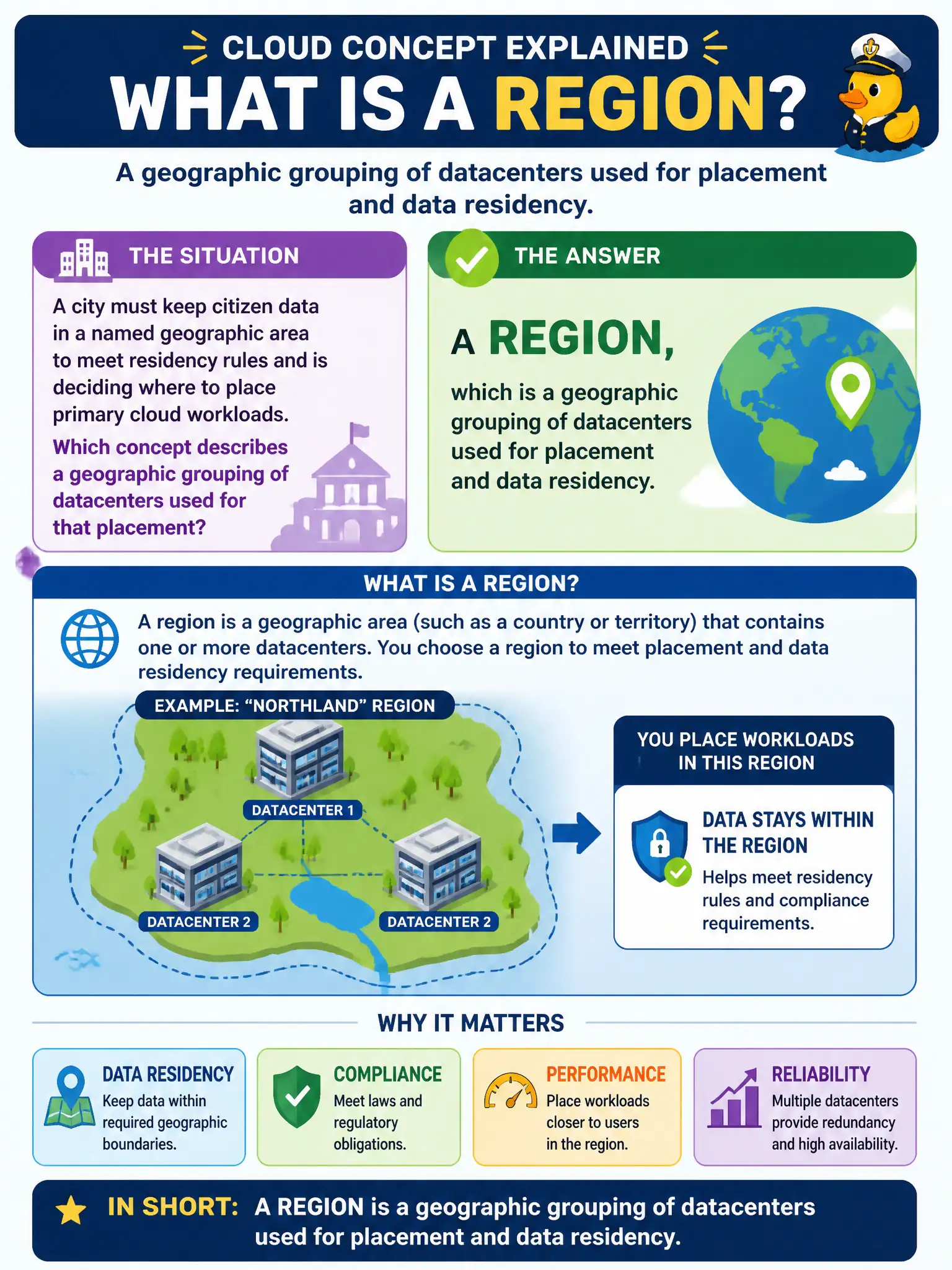
A city must keep citizen data in a named geographic area to meet residency rules and is deciding where to place primary cloud workloads. Which concept describes a geographic grouping of datacenters used for that placement?
Select an answer to reveal the explanation.
Short Explanation
Think of a region like picking which metro area keeps the city’s filing cabinets. It is a geographic bundle of datacenters you choose for residency and latency—not a single rack and not a CDN cache. When rules say data must stay in a named area, you start by picking the right region.
Full Explanation
A cloud region is a geographic grouping of datacenters that providers expose as a placement boundary for workloads and data. Cities that must keep citizen data inside a named geographic area to meet residency rules therefore select an appropriate region as the primary control for where primary cloud workloads live. An availability zone is not merely a single rack; it is an isolated failure domain within a region, and it does not by itself define the broad geographic residency boundary. A content delivery network edge cache improves delivery of static content near users but is not the system of record for placing primary databases under residency mandates. A cold site is empty or minimally equipped disaster-recovery facility space and is unrelated to choosing a live cloud geography for production data. Exam caveat: residency and sovereignty discussions on Cloud+ almost always start with region selection; zones address availability inside that geography. Operational check: map each citizen dataset to an allowed region list, configure resource policies or landing-zone guards that block undeclared regions, verify backup and replica targets remain in-region unless legally approved, and record the residency decision in the city’s data inventory.