
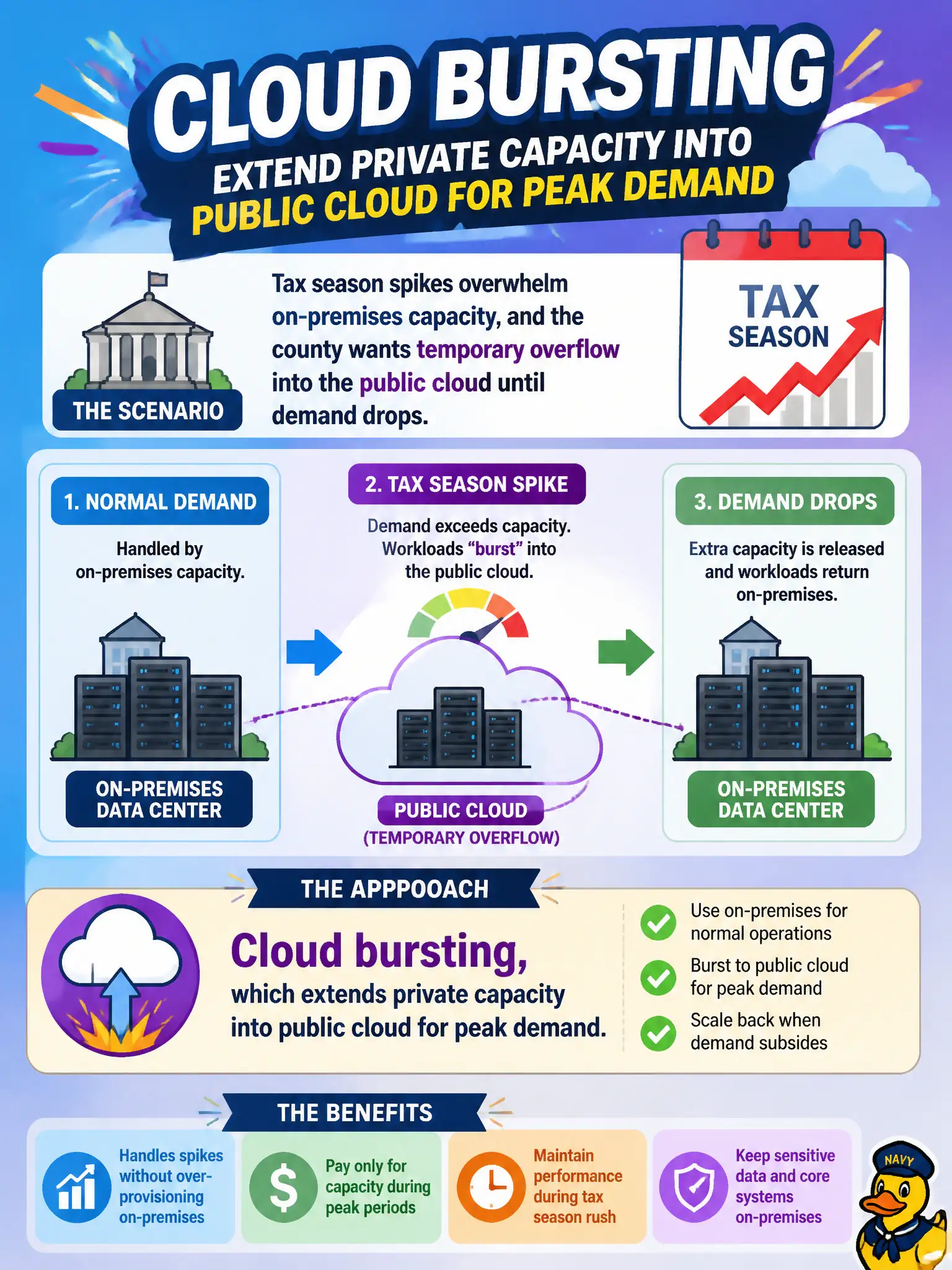
Tax season spikes overwhelm on-premises capacity, and the county wants temporary overflow into the public cloud until demand drops. Which approach describes that pattern?
Select an answer to reveal the explanation.
Short Explanation
Cloud bursting is the overflow valve on a water heater—when tax season pressure spikes, extra work spills into public cloud, then settles back. The county keeps its private baseline and borrows peak capacity. That is not the same as moving everything permanently or renting empty cold-site floor space.
Full Explanation
Cloud bursting extends a private or on-premises capacity envelope into the public cloud when demand spikes, then retracts when load returns to baseline. A county overwhelmed by tax-season traffic that wants temporary overflow without permanently retiring every on-premises system is describing bursting. Permanent all-in public cloud migration with immediate retirement of on-premises capacity is a full migration strategy, not temporary peak overflow. A cold-site reservation supplies empty facility space for disaster recovery and does not provide elastic compute during filing spikes. Synchronous stretched clusters that require identical capacity in two regions year-round contradict the goal of temporary, cost-aware overflow. Exam caveat: Cloud+ treats bursting as a hybrid elasticity pattern—keep steady-state local, spill peaks to public cloud—distinct from multicloud or permanent relocation. Operational check: define burst triggers (CPU, queue depth, or concurrent sessions), pre-stage images and network routes into the public landing zone, test identity and data-path latency under burst, and set auto-scale and budget alarms so tax-season overflow does not become an uncontrolled permanent footprint.