
A municipal snow-plow lead wants a single stopwatch reading from one lucky GenAI generation to prove time savings. What is the soundest response regarding metrics?
Select an answer to reveal the explanation.
Short Explanation
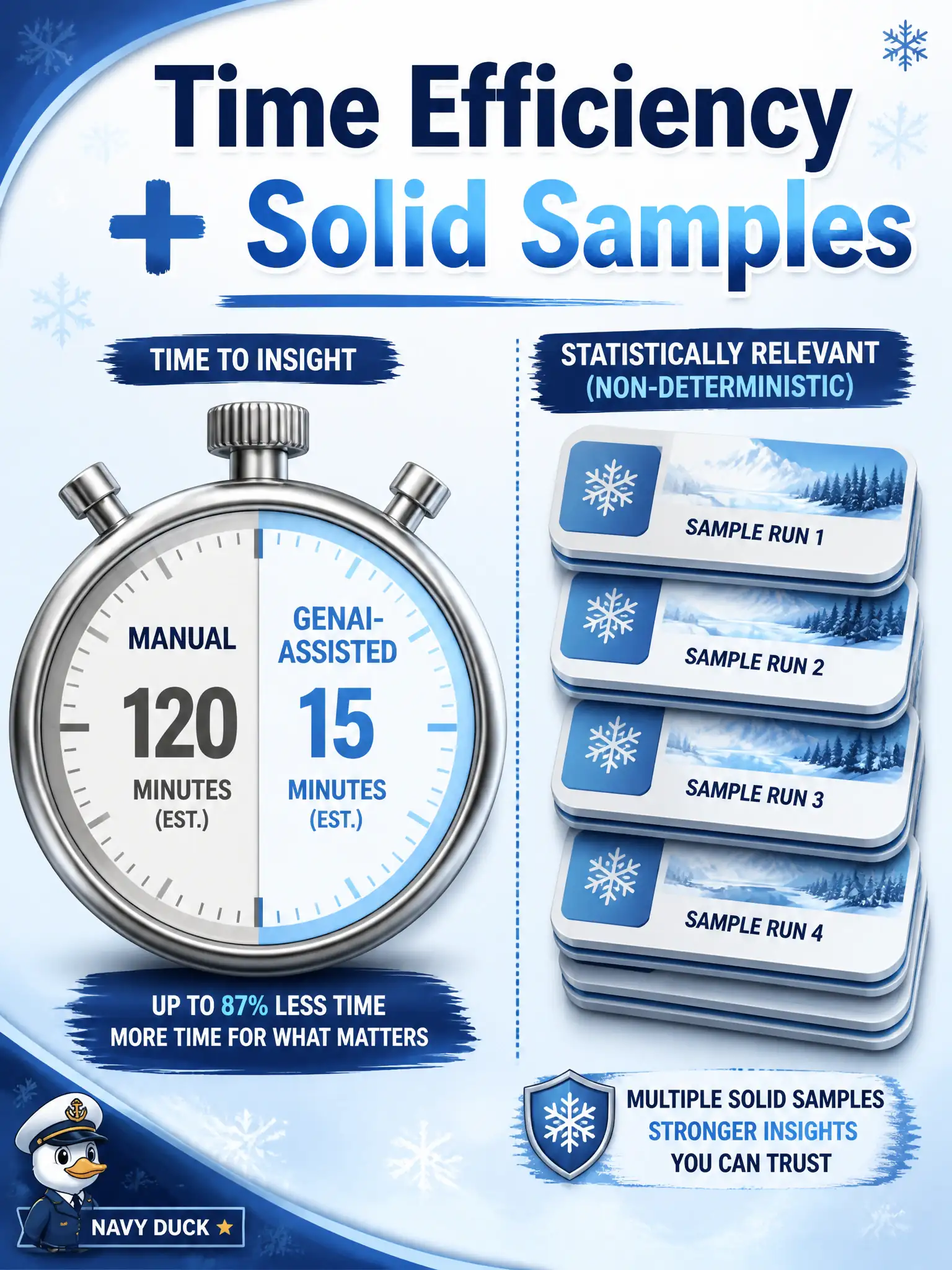
One lucky stopwatch click isn’t a study. Measure time saved against manual work—and sample enough runs, because GenAI answers wobble.
Full Explanation
A municipal snow-plow lead who wants a single stopwatch reading from one lucky GenAI generation to prove time savings should instead track time efficiency as time saved versus manual effort and base conclusions on statistically relevant samples because GenAI outputs are non-deterministic. Civic winter-operations decisions need honest productivity evidence, not anecdote. Accepting one lucky run as proof and never collecting further timing data fails sampling rigor. Replacing timing metrics with neuron coverage of a plow-routing model fails by concept: white-box model coverage is not a time-efficiency measure for testware work. Equating time efficiency to a vendor’s marketing latency claim fails because marketing latency is not measured savings on the city’s suite. Exam caveat: non-determinism implies sample-based timing, not single-run trophies. Operational check: time paired manual versus GenAI-assisted tasks across multiple civic plow stories, record variance, and report efficiency ranges to leadership rather than a single stopwatch screenshot. Retain the municipal audit note so later testers can see why the decision protects public service quality and fairness. Retain the municipal audit note so later testers can see why the decision protects public service quality and fairness.