
A little-league field-lights pipeline runs the full regression suite on every merge, and the suite grows with each sprint. Why is this situation a strong fit for GenAI-assisted creation, maintenance, and optimization of regression tests?
Select an answer to reveal the explanation.
Short Explanation
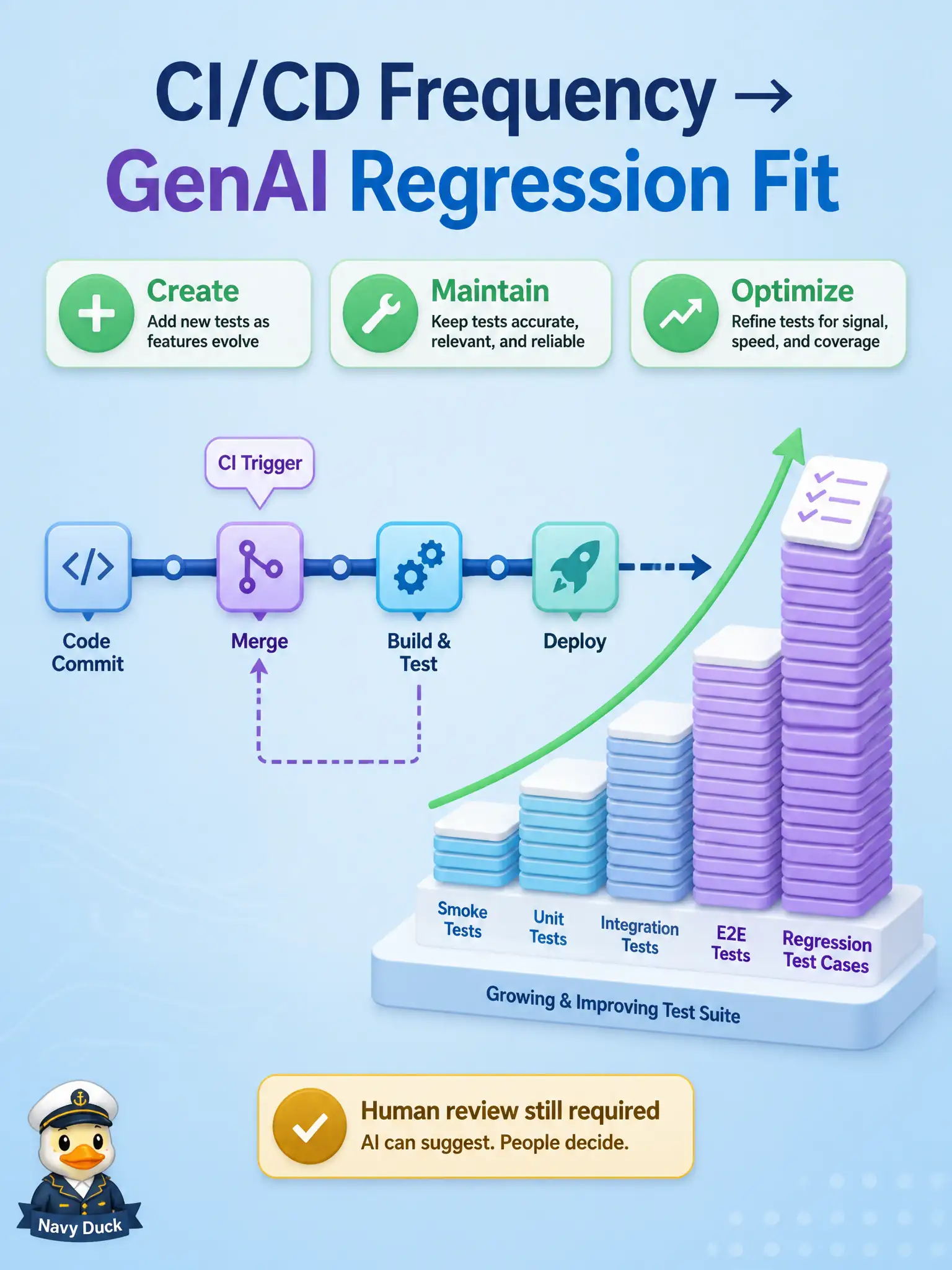
Picture a conveyor belt that never stops: every merge dumps another box on it. GenAI can help build, fix, and trim the growing regression pile—but a person still checks the labels.
Full Explanation
A little-league field-lights pipeline that runs the full regression suite on every merge while the suite grows each sprint is a strong fit for GenAI-assisted creation, maintenance, and optimization of regression tests because frequent CI/CD runs make a growing set costly to tend by hand—yet human review remains required. Civic youth-sports facilities cannot afford unchecked suite bloat or unreviewed generated tests that miss lighting safety interlocks. Claiming high-frequency pipelines remove the need for human review fails because fluency and green builds do not guarantee correct civic oracles. Saying only metamorphic testing of the LLM itself can keep pace fails by concept: the pipeline exercises the field-lights application, and GenAI assists application regression assets, not solely model metamorphic evaluation. Switching entirely from automated regression to ad-hoc manual smoke on merges fails as a retreat from scalable feedback needed for frequent civic deliveries. Exam caveat: CI/CD frequency plus suite growth motivates GenAI help, with mandatory review. Operational check: use GenAI to draft new lights cases, heal brittle steps, and suggest suite pruning; require coach/tech review of diffs; and keep merge gates dependent on reviewed civic automation rather than unattended generation.