
A wastewater lab sample-log team maintains two automated suites: one GUI suite that fails when page locators shift after a redesign, and one API suite that fails when the JSON response schema changes. Which GenAI-assisted regression approach best matches each suite?
Select an answer to reveal the explanation.
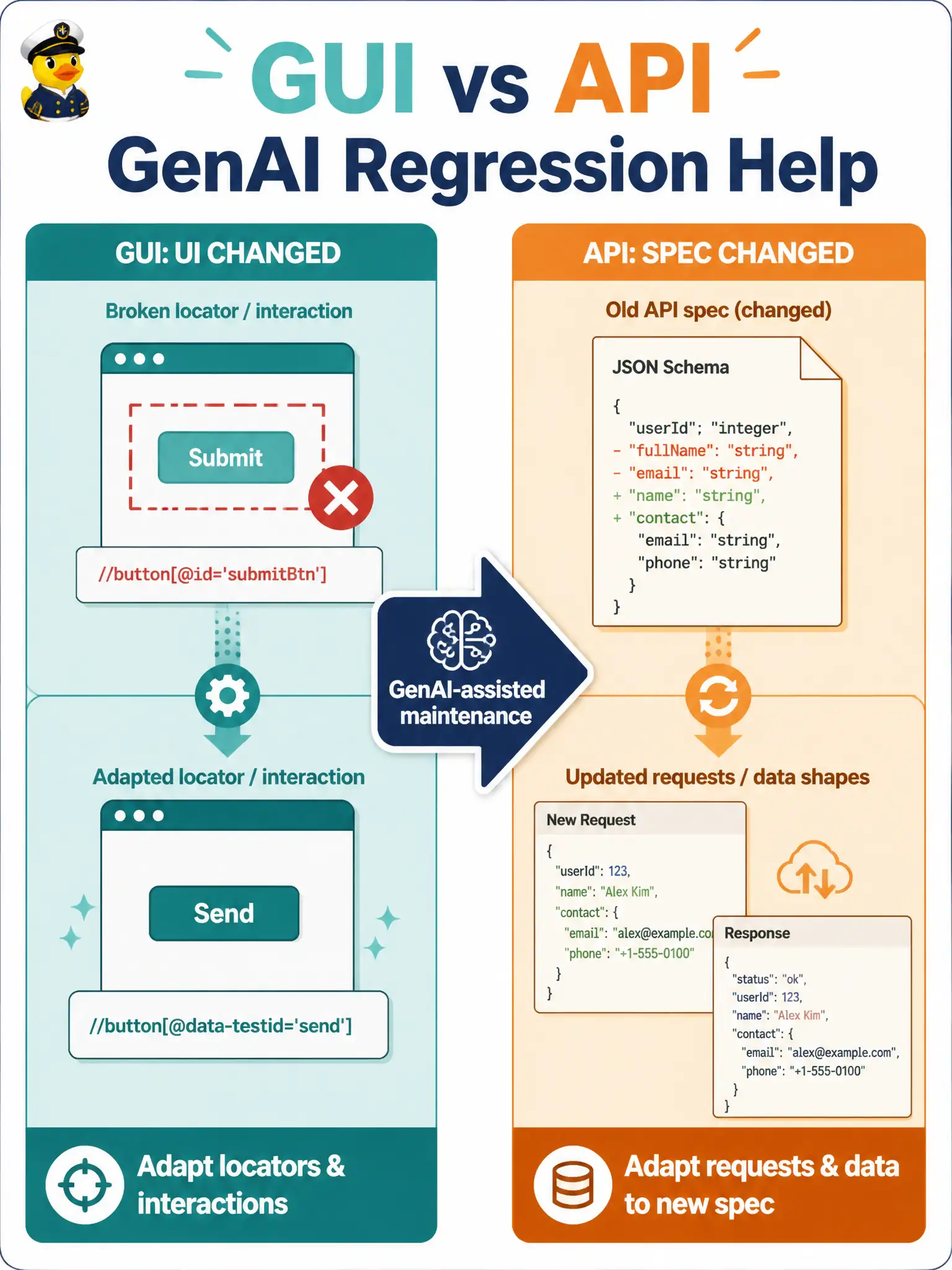
Short Explanation
Think of GUI flakiness like a moving desk label and API breaks like a changed shipping form. GenAI helps rewrite the locator steps for the screen, and rewrite the request payloads for the new contract.
Full Explanation
A wastewater lab sample-log team with a GUI suite that breaks on locator shift and an API suite that breaks on JSON schema change should prompt GenAI to adapt locators and interactions for the GUI suite, and to adapt requests and test data to the new specification for the API suite. Civic laboratory integrity depends on keeping both interface layers green after redesigns and contract updates so public environmental data flows remain trusted. Regenerating neuron-coverage suites as if the model were the SUT fails by concept for both layers: the maintenance target is application automation, not LLM white-box coverage. Replacing both suites with a single zero-shot exploratory checklist fails because it discards valuable automated regression and under-specifies GUI versus API repair tactics. Inventing a new microservice architecture so neither suite needs maintenance fails as scope escape—the question is GenAI-assisted suite adaptation, not replatforming the lab. Exam caveat: match GenAI maintenance tactics to failure mode—locators/interactions versus requests/data/schema. Operational check: for the municipal lab, feed UI diffs to a locator-adaptation prompt and schema diffs to an API-adaptation prompt, run both suites in staging, and require dual steward sign-off before the next public sample-log release.