
A dog-park day-pass run failed on the late-renewal path. Which GenAI ask best supports enhanced defect reporting?
Select an answer to reveal the explanation.
Short Explanation
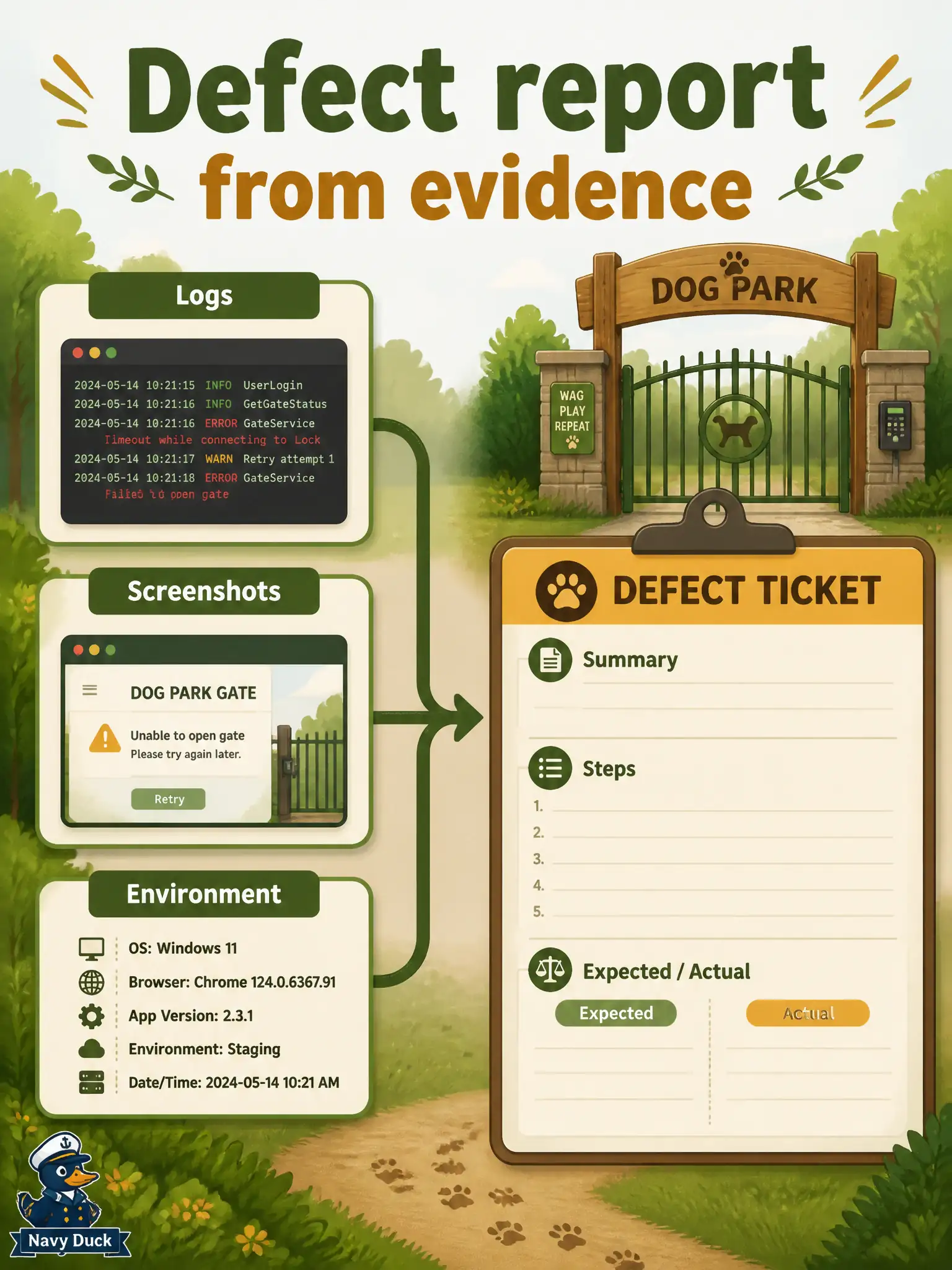
A failed late-renewal path leaves a pile of clues—logs, screenshots, environment notes. Ask GenAI to compile those into a defect report the tester still reviews. Evidence in, structured report out—not a blank ticket or an exploit.
Full Explanation
When a dog-park day-pass run fails on the late-renewal path, the GenAI ask that best supports enhanced defect reporting is to compile a defect report from test logs, screenshots, and environment data for tester review. Civic parks revenue and access fairness improve when defects are reproducible and evidence-rich rather than anecdotal. Publishing an exploit PoC that attacks the park’s production payment API fails ethically and by syllabus scope—practice items must not pivot into real attack enablement against live systems. Filing a blank defect with no logs fails because evidence-free tickets slow municipal remediation and obscure severity. Replacing defect reports with neuron-coverage charts of the LLM under test fails by concept: model coverage charts do not document an application late-renewal failure. Exam caveat: GenAI may assemble defect narratives from execution evidence, but humans still review before filing. Operational check: gather late-renewal logs, screenshots, and environment notes; prompt GenAI for a structured defect draft; verify steps against the civic day-pass system; strip sensitive cardholder data; and submit only after a parks tester reproduces the failure once.