
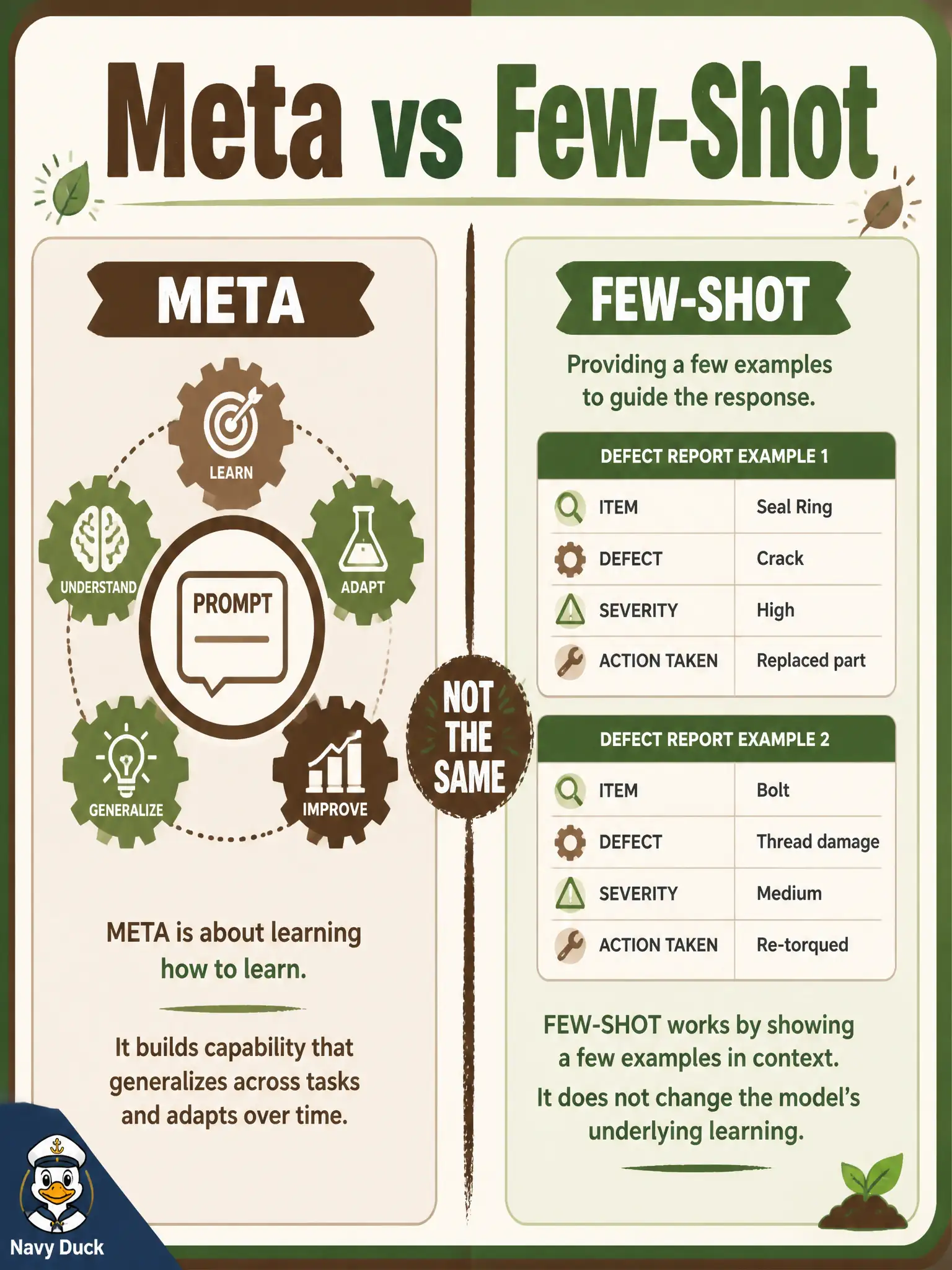
A compost-drop weekend tester asks the model to propose a better prompt. Another tester adds two sample defect-report rows to the ask. How do these techniques differ?
Select an answer to reveal the explanation.
Short Explanation
Prompt-about-a-prompt is meta. Two sample defect rows teaching the desired testware shape is few-shot. Better replies alone do not make two techniques the same.
Full Explanation
Asking the model to propose a better prompt is meta prompting; adding two sample defect-report rows to the ask is few-shot prompting. Compost-drop weekend testers may use both techniques in one week, but they are not the same move: one improves the prompt artefact, the other supplies more than one output exemplar so defect-report shape consolidates. Civic compost programs should name techniques accurately so training and reviews stay aligned with CT-GenAI.
Calling both few-shot because each improves the model’s reply quality uses a results heuristic instead of definitions. Calling “ask for a better prompt” chaining and “add sample rows” meta prompting reverses the labels. Calling sample rows zero-shot and “better prompt” one-shot contradicts exemplar counts and meta’s definition.
Exam caveat: meta = generate or refine the prompt; few-shot = more than one example in the ask. Quality improvement alone does not classify the technique.
Operational check: run a meta step to draft a compost defect-report prompt; separately build a few-shot ask with two sample defect-report rows; compare outputs; document both techniques with side-by-side examples in the municipal compost testing prompt catalog.