
A wastewater lab sample-log tester asks for equivalence-partition conditions from a story and includes no sample row. Which prompting technique is this?
Select an answer to reveal the explanation.
Short Explanation
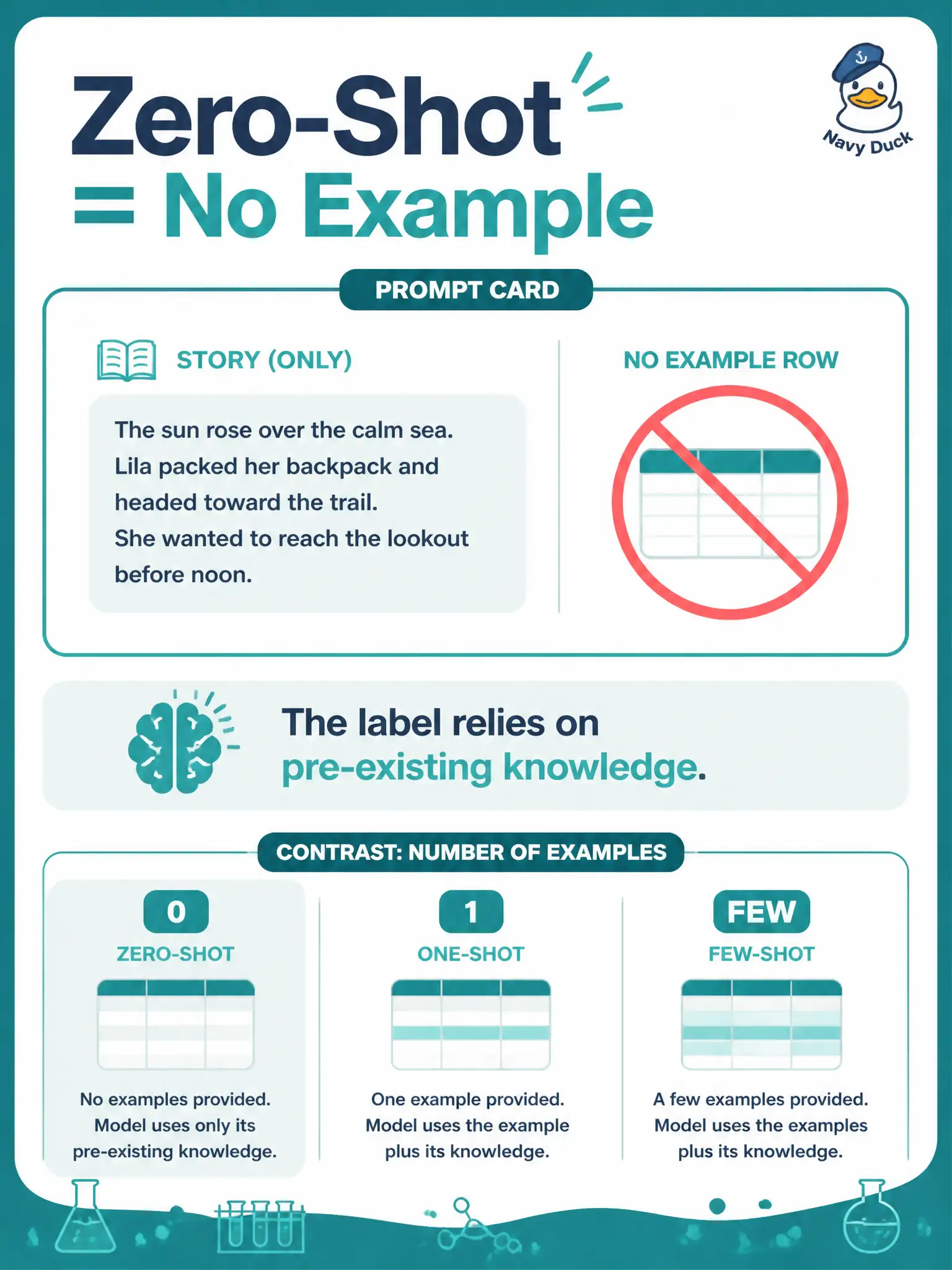
Zero-shot means no worked example in the prompt — not merely “keep it short.” Asking for equivalence-partition conditions from a story with no sample row is zero-shot. The story is the basis, not a demonstration of the desired output pattern.
Full Explanation
Zero-shot prompting includes no example and relies on the model’s pre-existing knowledge—matching a wastewater lab sample-log tester who asks for equivalence-partition conditions from a story and includes no sample row. Civic lab testing can start zero-shot for speed, then add examples if partition quality is weak. The story as basis is Input data; it is not automatically a “worked example” of the desired output pattern.
Few-shot claiming the story itself counts as multiple examples confuses basis text with output exemplars. One-shot claiming a user story is always treated as one worked example similarly mislabels Input data as a shot example. Prompt chaining is a multi-step checked series; a single equivalence-partition ask is not chaining by definition and does not require three sequential asks.
Exam caveat: shots count output-pattern examples, not merely whether a story is present. No sample row and no exemplar → zero-shot.
Operational check: run the zero-shot equivalence ask on the sample-log story; if partitions are weak, add one sample row (one-shot) or several (few-shot); record which technique produced acceptable municipal lab conditions and keep that note with the suite.