
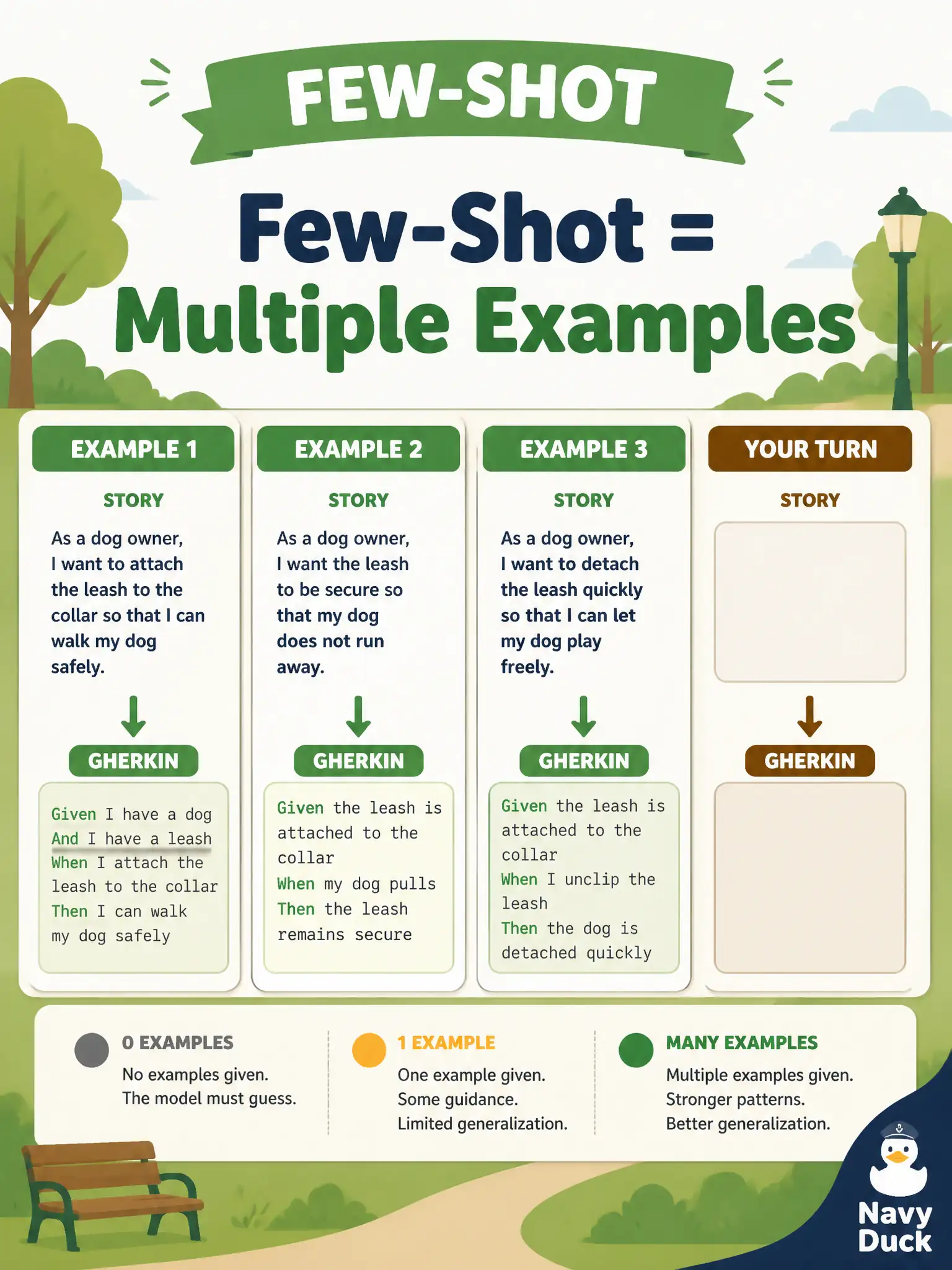
A dog-park day-pass tester pastes three worked story→Gherkin pairs before asking for a fourth. Which prompting technique is this?
Select an answer to reveal the explanation.
Short Explanation
Three worked pairs before the real ask is few-shot — more than one example teaching the pattern. One example would be one-shot; none would be zero-shot. Meta would ask for a better prompt, not Gherkin.
Full Explanation
Few-shot prompting supplies more than one example to consolidate desired response behavior—here, three worked story→Gherkin pairs before asking for a fourth on a dog-park day-pass story. Civic Gherkin style converges faster when multiple exemplars show the house pattern for Given/When/Then wording, tags, and table habits. Few-shot is a technique you combine with prompt structure; it is defined by exemplar count, not by whether a story exists as Input data.
Zero-shot relies only on pre-existing knowledge with no examples; three pairs disqualify zero-shot. One-shot uses exactly one example; three pairs exceed one-shot. Meta prompting asks the model to write the prompt rather than emit Gherkin from worked examples of the desired output pattern.
Exam caveat: count output-pattern examples—zero, one, or more than one—to classify shot techniques. Three worked pairs before a new ask = few-shot on CT-GenAI.
Operational check: keep a curated set of three story→Gherkin exemplars for day-pass; paste them before new stories; spot-check style adherence on the fourth; refresh exemplars when house style changes in the municipal dog-park suite and retrain seasonal staff on the count rule. Park program coaches should drill the three-example count until staff stop calling any multi-sentence prompt few-shot by habit.