
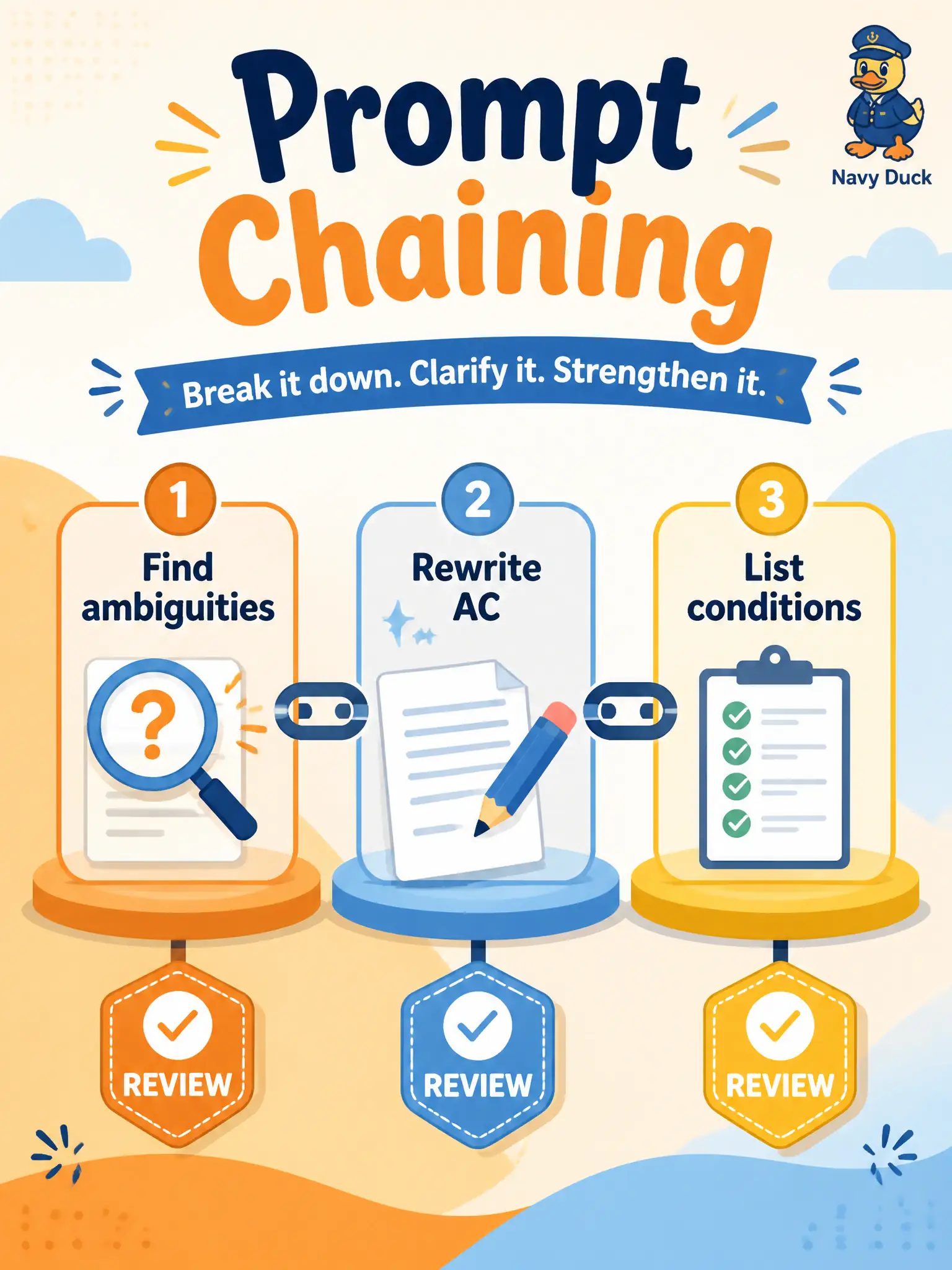
A senior-center meal-route tester splits work into “find ambiguities, then rewrite acceptance criteria, then list conditions,” and a person checks each reply before the next ask. Which prompting technique is being used?
Select an answer to reveal the explanation.
Short Explanation
Chaining is a relay race: each leg finishes and gets checked before the baton moves. Find ambiguities → rewrite AC → list conditions, with a human gate between steps, is prompt chaining — not stuffing examples into one ask.
Full Explanation
Prompt chaining is a series of intermediate prompts whose results are checked before the next step—exactly the senior-center meal-route pattern of “find ambiguities, then rewrite acceptance criteria, then list conditions,” with a person checking each reply. Civic meal-route work benefits from staged human gates so errors do not cascade into unsafe or irrelevant conditions. Chaining is a technique layered on prompts; it is not another name for the six-part structure.
Few-shot prompting would place multiple meal-route examples in one message; that is not what staged, checked asks describe. Zero-shot is a single ask with no examples, not a multi-step checked series. Meta prompting asks the model to invent or refine the prompt itself, not to execute the ambiguity→acceptance-criteria→conditions pipeline as working steps.
Exam caveat: chaining = sequenced prompts with intermediate review. Do not relabel chaining as few-shot merely because multiple sentences or steps appear.
Operational check: run the three meal-route steps as separate prompts; require human acceptance before the next; archive intermediate artefacts; document chaining with a checklist in the senior-center municipal prompting playbook.