
A food-coop membership prompt appears as six labeled blocks: “you are a tester,” “this is the produce-share desk,” “draft conditions,” the pasted story, “no medical data,” and “table with id / condition / priority.” Which mapping correctly names all six official prompt-structure components?
Select an answer to reveal the explanation.
Short Explanation
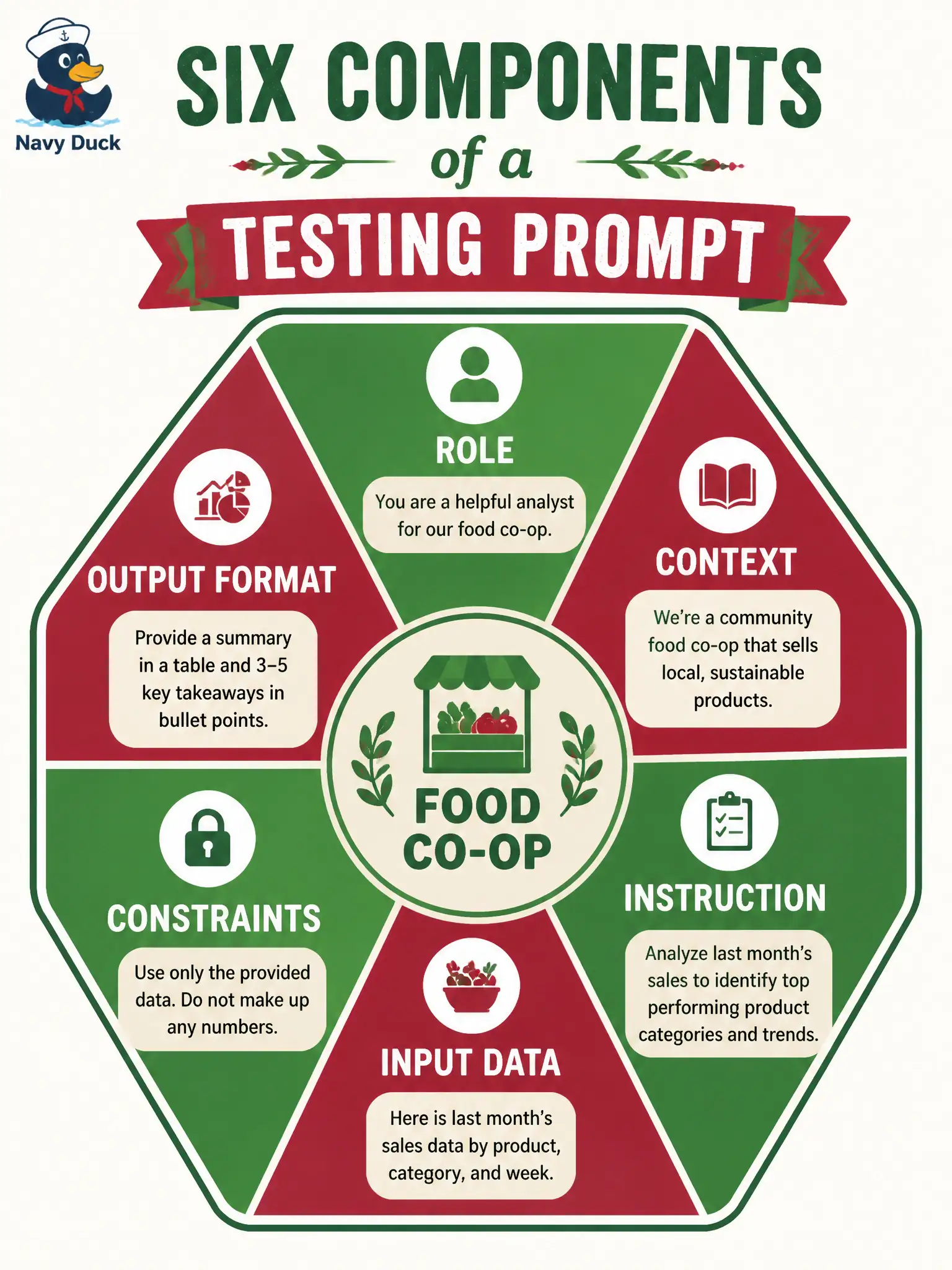
Match each block to its job: persona, setting, imperative, artefacts, limits, and reply shape. “You are a tester” is role; the desk is context; “draft conditions” is instruction; the story is input; “no medical data” is a constraint; the table is output format.
Full Explanation
The correct six-component mapping for the food-coop membership prompt is: Role = “you are a tester”; Context = “this is the produce-share desk”; Instruction = “draft conditions”; Input data = the pasted story; Constraints = “no medical data”; Output format = table with id / condition / priority. That mapping matches CT-GenAI’s official prompt-structure components for civic produce-share testing and keeps each block’s function distinct.
Mappings that assign Role to the produce-share desk or to “draft conditions” scramble persona with setting or task. Treating “no medical data” as Role or Input data misfiles a restriction as identity or artefact. Treating the pasted story as Output format or Constraints breaks the artefact-versus-limit distinction. Any permutation that swaps those blocks fails the syllabus structure skill.
Exam caveat: memorize the six—Role, Context, Instruction, Input data, Constraints, Output format—and map examples by function, not merely by the order blocks happen to appear.
Operational check: label each of the six blocks on the food-coop prompt; verify against the mapping above; use the labeled template for the next membership release; quiz the team on a deliberately scrambled mapping to prevent regressions in municipal prompt reviews.