
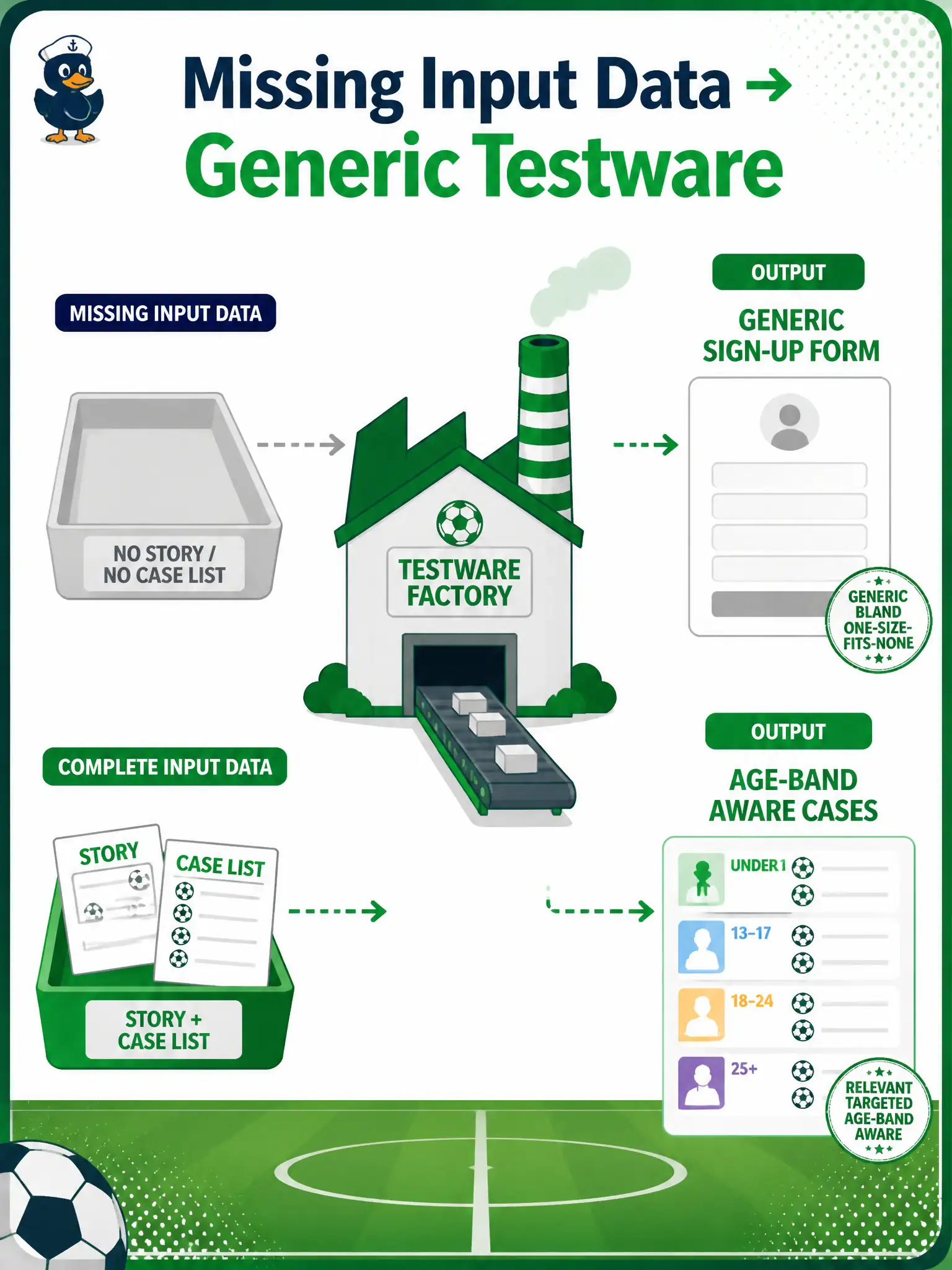
A youth-soccer registration prompt is fully structured except it never attaches the age-band story or last season’s case list. The model invents a generic sign-up form. Which missing component most likely caused the generic testware?
Select an answer to reveal the explanation.
Short Explanation
Without the age-band story or last season’s cases, the model fills blanks with a generic sign-up form. Input data is the specific basis that keeps results context-aware. Structure elsewhere cannot replace the missing artefacts.
Full Explanation
Missing Input data most likely caused generic testware when a youth-soccer registration prompt was fully structured except it never attached the age-band story or last season’s case list, so the model invented a generic sign-up form. Stories, acceptance criteria, or existing cases must be supplied for context-aware, basis-bound results. Civic registration age bands live in those artefacts; structure without them still hallucinates plausible but wrong forms.
Role gaps do not explain generic forms when structure was otherwise complete; soccer does not “always” require a coach persona to avoid generics. Missing Output format might affect shape, not inventing an unrelated form from whole cloth. Constraints are not a substitute for attaching age-band stories—age bands belong in Input data (with supporting Context) as basis content.
Exam caveat: without Input data, even pretty prompts yield generic testware. Attach the basis before blaming other components on the exam or in municipal reviews.
Operational check: attach the age-band story and prior case list; regenerate; confirm age-band edges appear and generic sign-up filler drops; enforce Input data attachment in the soccer municipal prompt gate before any suite import.