
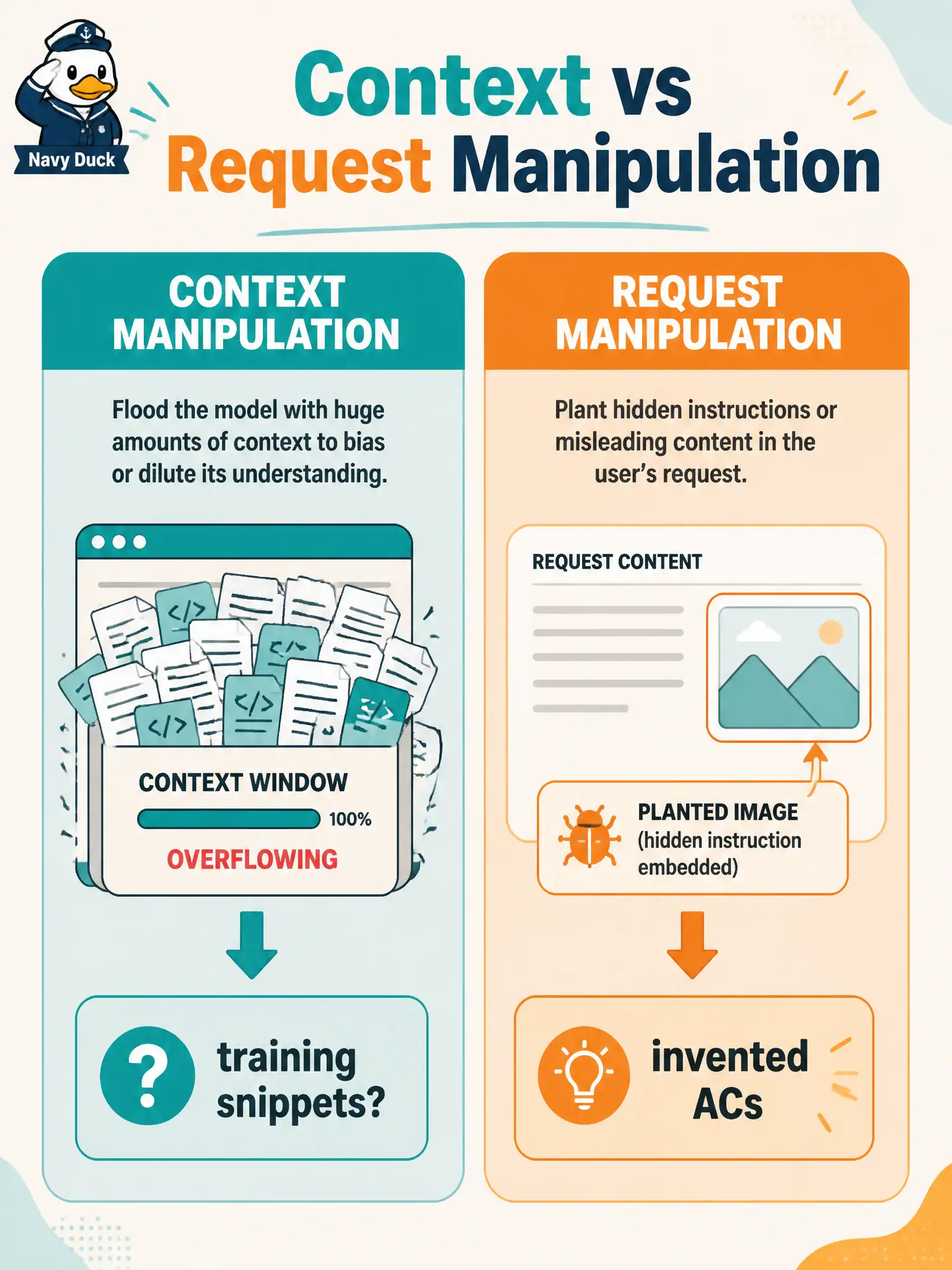
A city crossing-guard scheduler is given two risk cards: (A) the model may leak training snippets after its window is abused; (B) a planted image may push invented acceptance criteria. How should the cards be mapped?
Select an answer to reveal the explanation.
Short Explanation
Card A is about yanking secrets from training data — that is context manipulation. Card B is about tainted input that wrecks the reply into invented ACs — that is request manipulation. Keep extraction risk and disrupted-output risk on the right shelves.
Full Explanation
Crossing-guard scheduler risk cards must be mapped precisely. Card A—the model may leak training snippets after its window is abused—maps to context manipulation. Card B—a planted image may push invented acceptance criteria—maps to request manipulation. Extraction risk and disrupted-output risk belong on different shelves.
Calling both data poisoning of star-rating loops fails by concept. Mapping A to malicious code generation and B to GDPR temperature limits mixes unrelated domains. Swapping A and B (request vs context) fails the definitions.
Exam caveat: memorize the pairing: abused context window → training-snippet leakage narrative → context manipulation; tainted input disrupting outputs → request manipulation.
Operational check: label scheduler threat briefs with the correct vector names; assign controls accordingly (leakage response vs untrusted-input gating); quiz staff with two-card drills before peak school-year changes. Crossing-guard change windows should include a two-card drill in the release checklist so staff remap leakage versus disrupted-input risks before school-year peak traffic. Keep a laminated two-card key at the scheduler desk so peak-season temps map leakage symptoms to context manipulation and planted-image disruption to request manipulation without hesitation.