
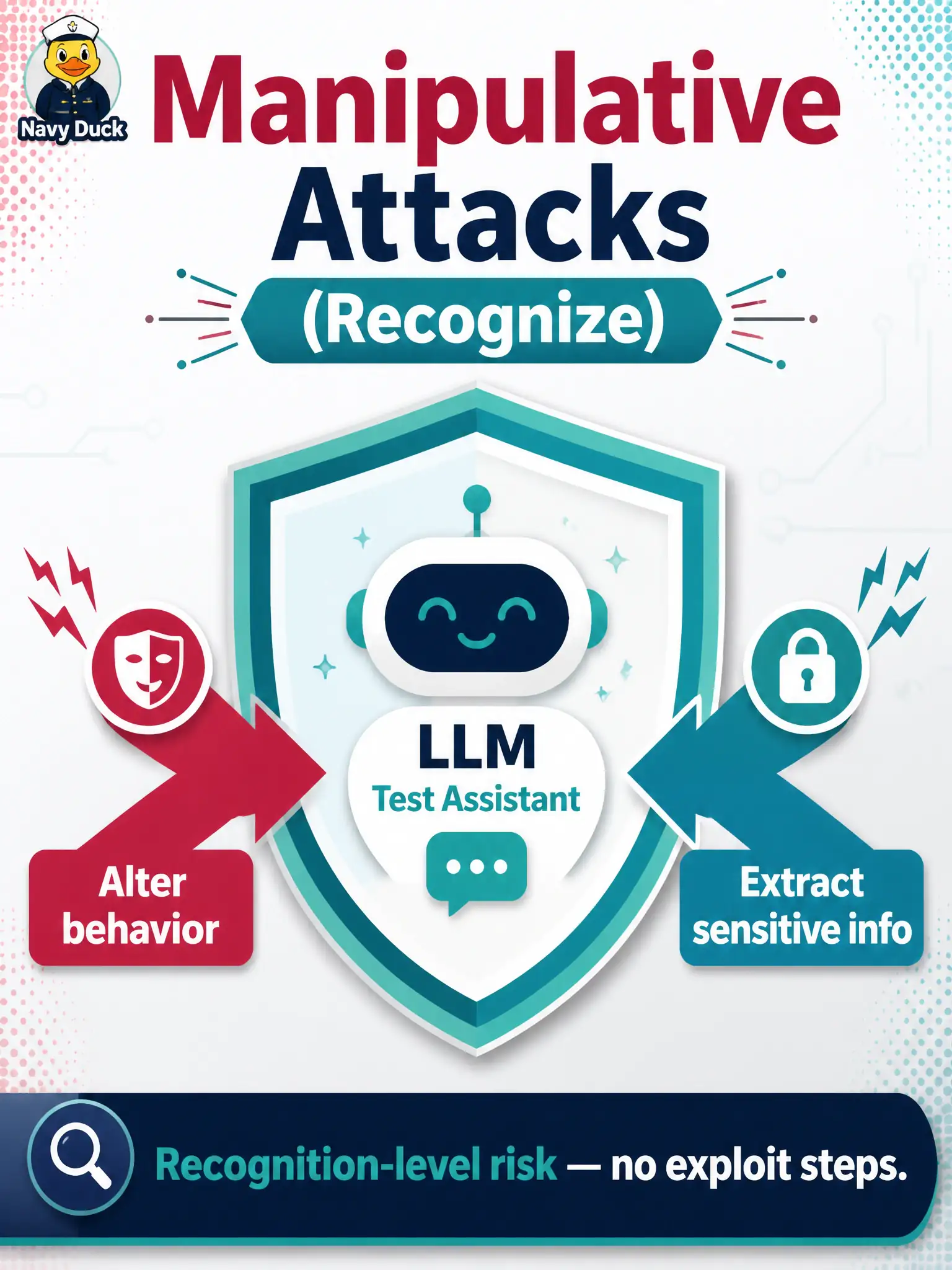
A public-boat-ramp kiosk team is briefed that someone might try to alter the test assistant’s behavior or pull sensitive slip-holder data through crafted input. Which risk class does this briefing describe?
Select an answer to reveal the explanation.
Short Explanation
Think of manipulative attacks as someone yanking the assistant’s steering wheel or fishing for secrets through the chat window. The briefing is about recognizing that risk class. It is not a how-to for writing attack payloads.
Full Explanation
Public boat-ramp kiosks that brief staff about altered assistant behavior or extracted slip-holder data through crafted input are naming manipulative attacks: adversaries attempt to alter LLM behavior or extract sensitive information. The briefing is recognition of a risk class, not a recipe for writing exploits.
Low-temperature repetition fails by concept: stable wording does not extract holder data by itself. Output-format constraints fail because templates are not a substitute for security controls against manipulation. Role prompting fails because assigning a tester persona is a prompt pattern, not an automatic data breach.
Exam caveat: syllabus discussion of manipulative attacks is about awareness and defense posture. Do not treat exam stems as instructions to craft attack payloads against live civic systems.
Operational check: define untrusted-input handling for the ramp assistant; restrict tools that can read slip-holder PII; monitor for anomalous extraction-style prompts; escalate suspected manipulation to security without reproducing sensitive exfiltration in shared tickets. Ramp operators should separate public FAQ chats from tools that can read slip-holder records so manipulative prompts cannot reach the sensitive store through one pane.