
A public-art mural-permit pack still drifts on long scripts even after the team uses a low temperature and a seed. What should the team remember about reproducibility and verification?
Select an answer to reveal the explanation.
Short Explanation
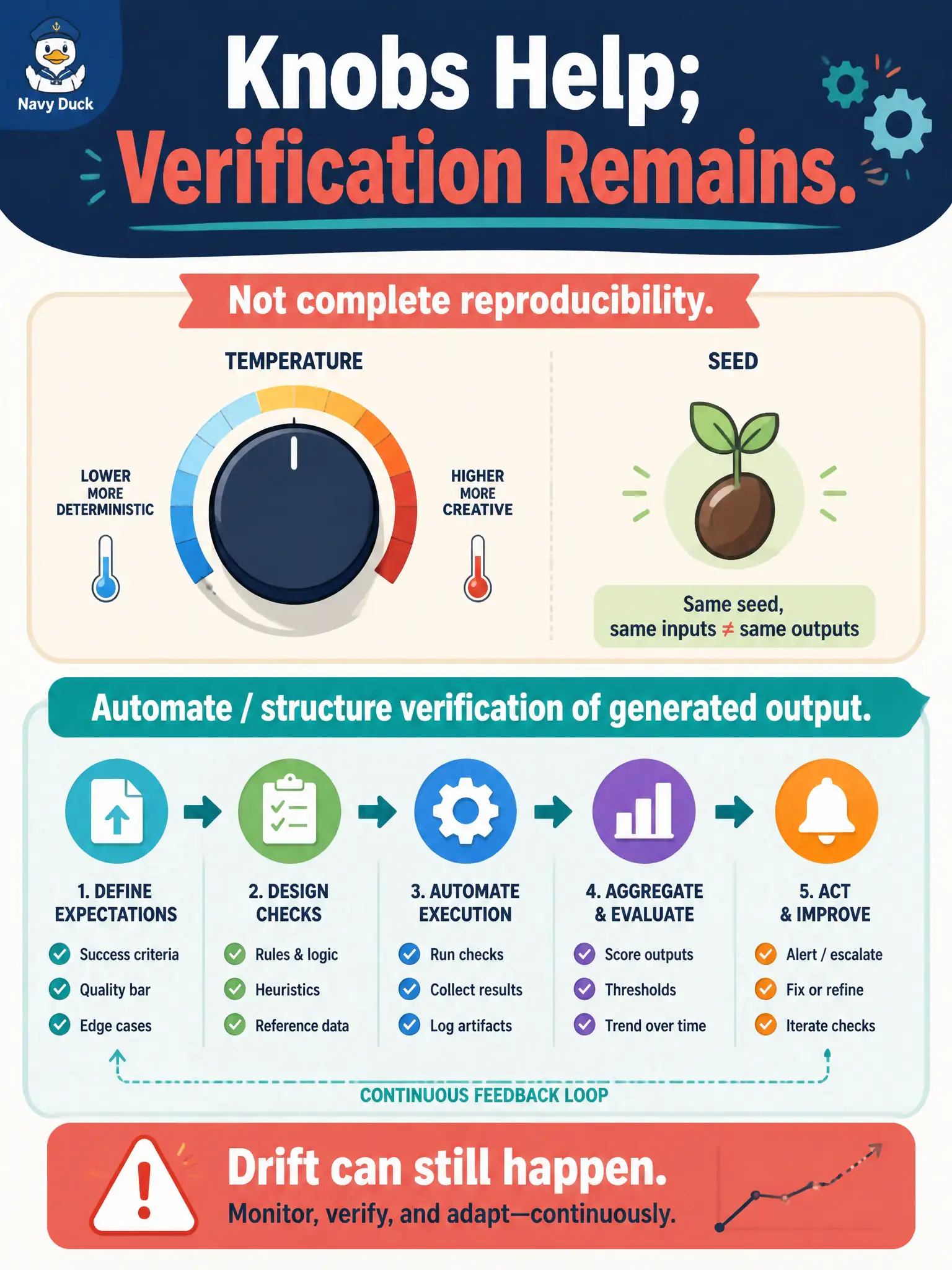
Even with the knobs turned carefully, GenAI can still wander on long packs — like a GPS that usually repeats a route but not always. Low temperature and a seed help, they do not finish the job. Structured verification still belongs in the workflow.
Full Explanation
Public-art mural-permit packs can still drift on long scripts even with low temperature and a seed. Teams must remember that complete reproducibility cannot be guaranteed, so they still automate or structure verification of generated output. Sampling controls help; they do not finish quality assurance for civic testware.
Claiming complete reproducibility is guaranteed so manual checks can stop fails by concept and by safety practice. Claiming drift means temperature must always be raised fails because raising temperature usually increases variation. Claiming seeds convert GenAI into a rule engine so verification is optional fails the seed concept and invites unreviewed mural-permit defects into production tooling.
Exam caveat: “still verify” is the durable rule even when knobs are optimally set. Reproducibility aids are mitigations, not certificates of correctness.
Operational check: keep automated diffing or structured review in the mural-permit pipeline regardless of temperature/seed settings; treat unexplained long-script drift as a verification trigger; never disable checks because “we set both knobs.” Mural-permit pipelines should keep a golden script corpus and fail the build when generated long scripts diverge beyond an agreed threshold even under fixed knobs.