
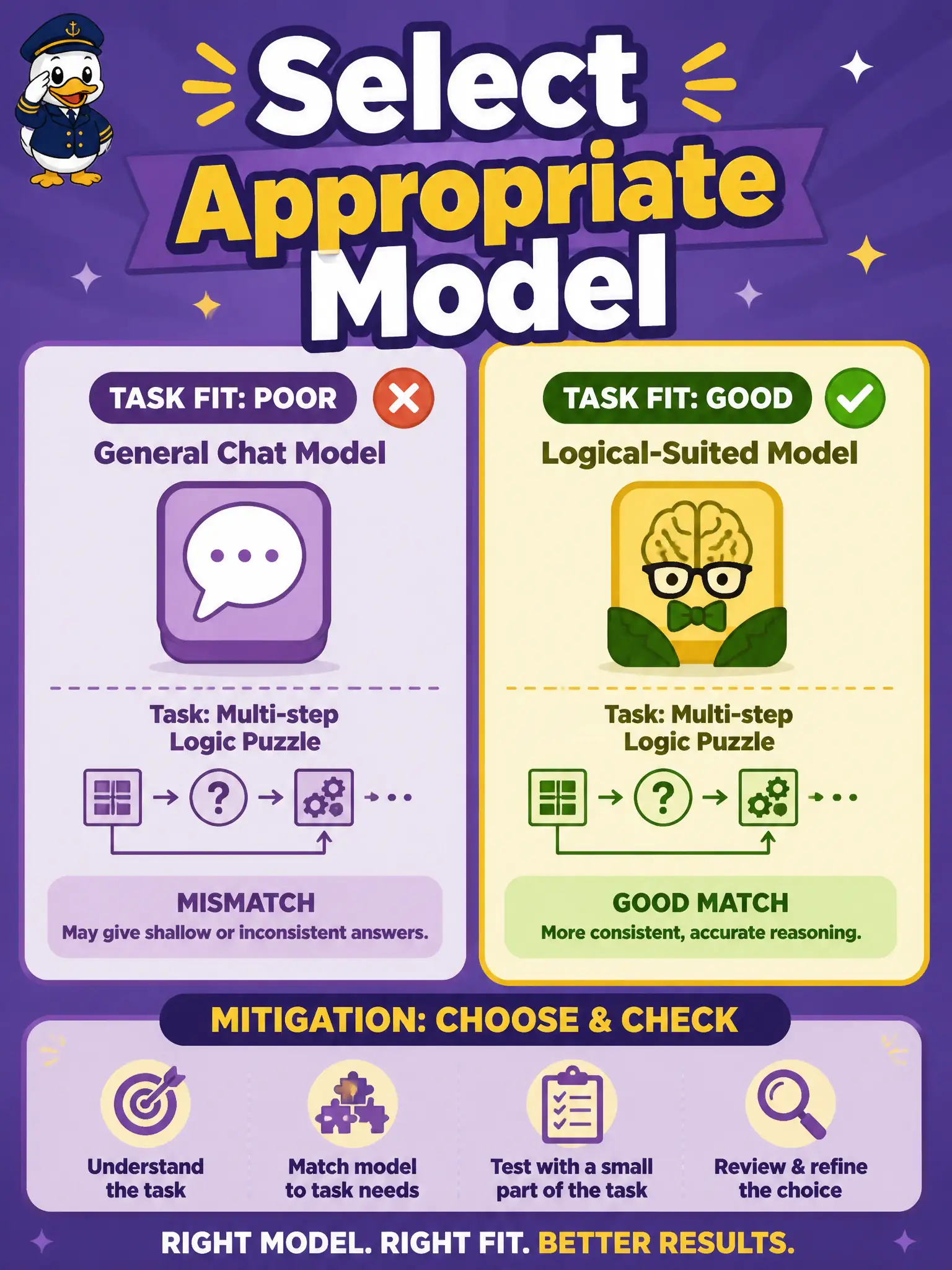
A municipal wedding-license desk uses a general chat model for a multi-step waiting-period calculation and keeps getting the order wrong. Switching to a model suited to that logical task is proposed. Which Chapter 3 mitigation is this?
Select an answer to reveal the explanation.
Short Explanation
A general chatter is not always the right tool for a waiting-period ladder. Picking a model that fits the logical task is the named mitigation.
Full Explanation
Wedding-license waiting-period calculations are ordered logical tasks, not casual chat. When a general chat model keeps getting the sequence wrong, switching to a model suited to that logical task is selecting the appropriate GenAI model for the task—the Chapter 3 mitigation focused on model-to-task fit rather than deeper LLMOps or red-team work.
Relying on vendor SKU marketing claims alone fails by concept: brochure labels are not evidence of suitability for multi-step municipal logic. Removing all context to simplify the prompt fails because stripping basis material increases invention and reasoning failures instead of curing order errors. Red-teaming with jailbreak payloads fails because that probes adversarial robustness; it is not the named Chapter 3 mitigation for task–model mismatch on waiting-period math.
Exam caveat: “appropriate model” means fitness for the testing task’s reasoning and format needs in this chapter—not a mandate to always pick the largest or most expensive SKU, and not a Chapter 5 cost deep-dive.
Operational check: for each desk workflow (waiting periods, fee ladders, eligibility trees), pilot two candidate models on the same golden scenarios, score sequence and arithmetic correctness, document the chosen model and why, and re-evaluate when ordinance steps change.