
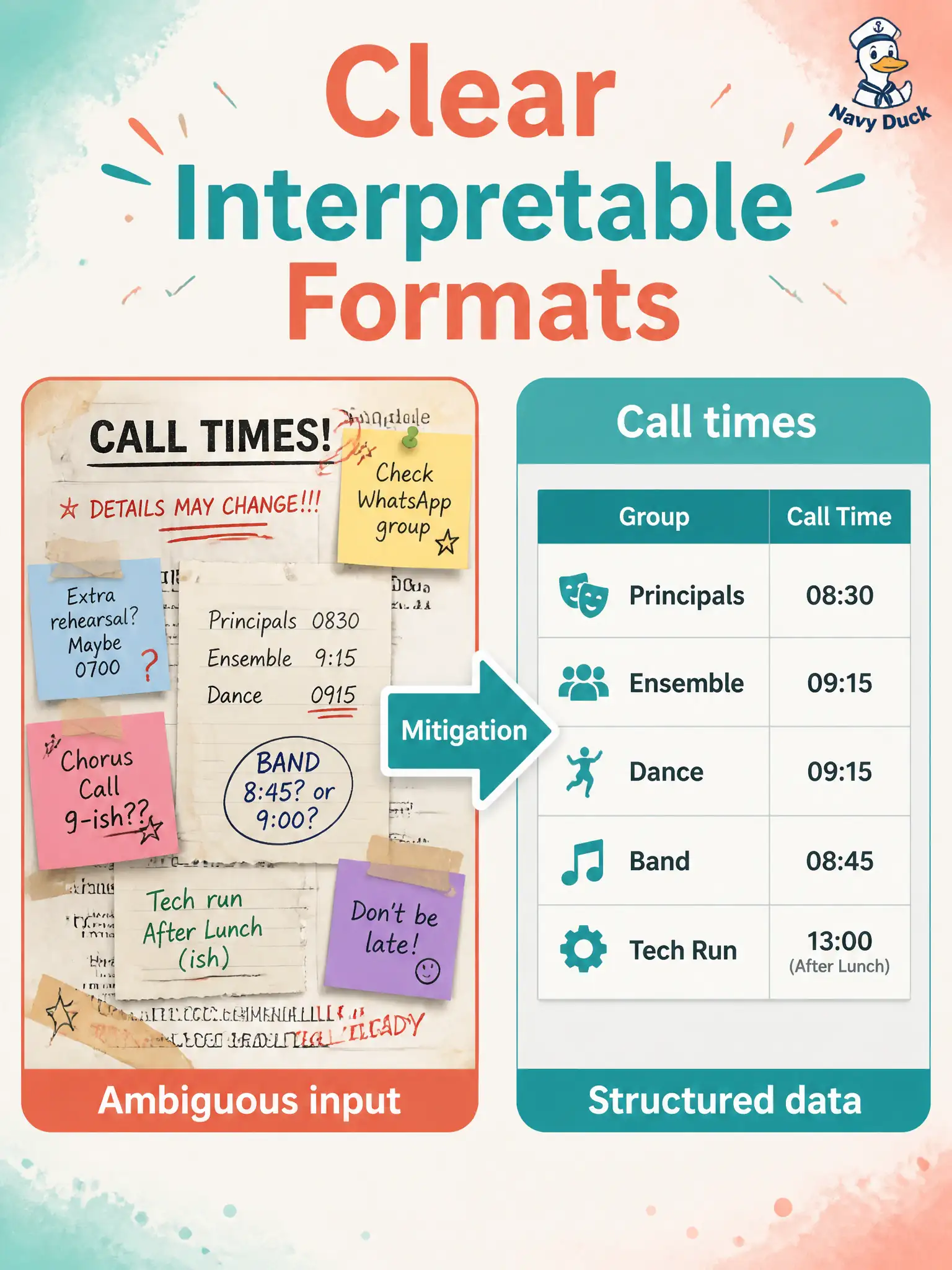
A community-band rehearsal-hall brief arrives as a scanned poster with overlapping notes; the LLM mixes call times. The tester re-supplies the same facts as a simple table. Which mitigation does this illustrate?
Select an answer to reveal the explanation.
Short Explanation
A messy poster is hard for the model to parse; a clean table is not. Clear, interpretable formats are the mitigation when input confusion causes errors.
Full Explanation
Community-band rehearsal schedules fail when call times scramble. A scanned poster with overlapping notes is hard for a model to parse cleanly; re-supplying the same facts as a simple table illustrates using clear, interpretable data formats in the prompt input. Structured, unambiguous formats reduce parsing mistakes that become jumbled times, invented rules, or hallucinated constraints even when the underlying facts were available.
Selecting a larger general chat model only fails by concept: capacity alone does not fix illegible input structure, and model swap is a different mitigation (task fit). Increasing temperature for more creative call times fails because creativity widens sampling and makes schedule wording less stable, which is the opposite of fixing mixed times. Skipping review because a table looks official fails because format clarity aids generation; it never replaces verification against the posted brief.
Exam caveat: “clear formats” means machine-interpretable structure (tables, labeled fields, consistent units)—not merely prettier prose. A neat paragraph can still bury conflicting times.
Operational check: convert civic briefs from scans and annotated PDFs into labeled tables before GenAI drafting; standardize time zones and field names; regenerate after format cleanup; spot-check every time and venue field against the source schedule before publishing rehearsal packs.