
Municipal leaf-collection routing is safety-visible: a wrong skip-day case could strand a street. Which mitigations does the syllabus name for agent risk on such work?
Select an answer to reveal the explanation.
Short Explanation
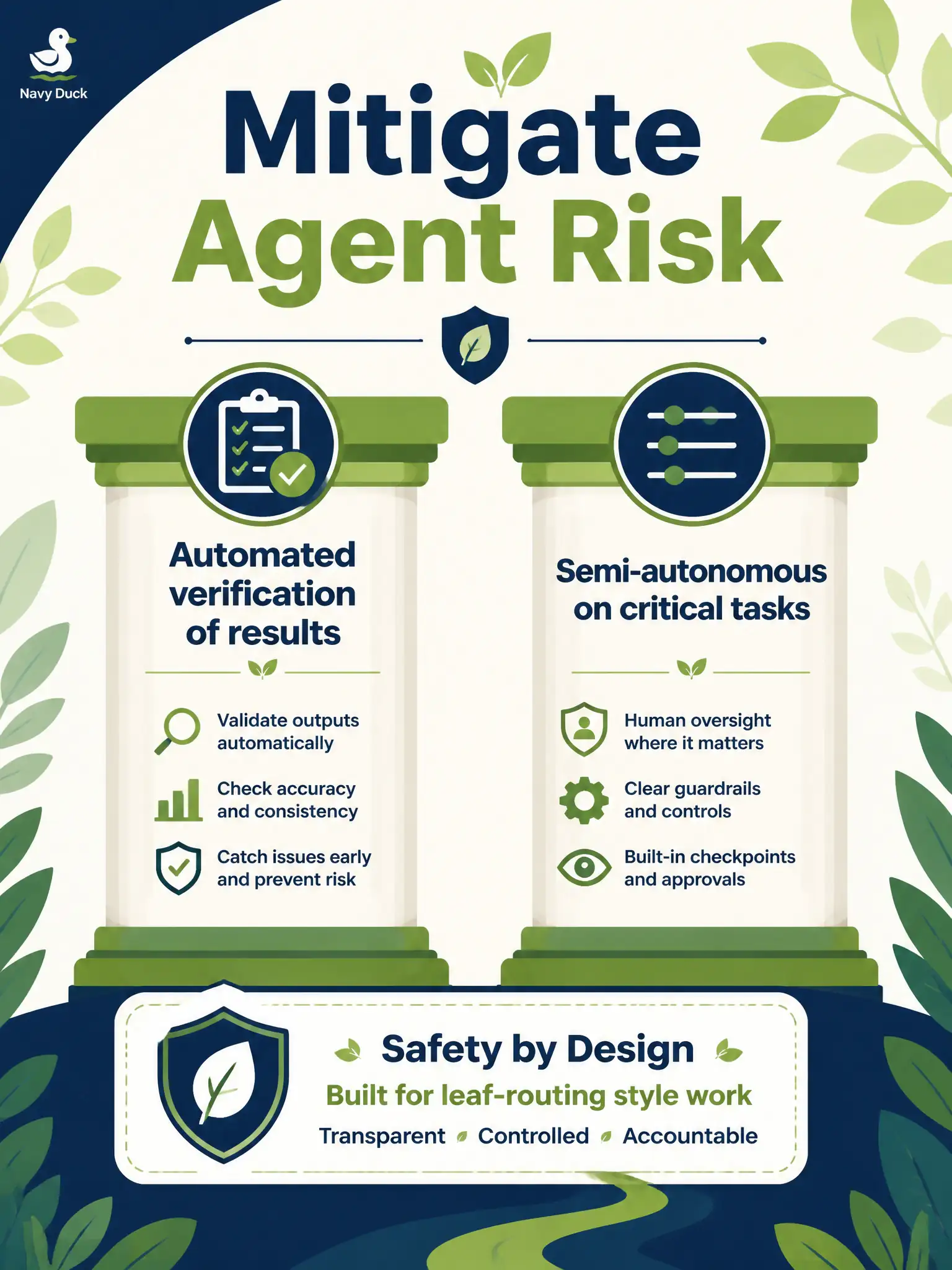
When a wrong skip-day strands a street, you verify results or keep a human in the loop. Automated checks on agent output, or semi-autonomous agents for critical work, are the named mitigations. Attack recipes are out of scope.
Full Explanation
For safety-visible municipal work such as leaf-collection routing, where a wrong skip-day case could strand a street, the syllabus names mitigations that include automated verification of the agent’s results and retaining semi-autonomous operation for critical tasks. Those controls reduce the impact of inherited LLM defects—hallucination, reasoning error, bias—on visible civic workflows where residents depend on correct schedules. Disabling all verification and always running fully unsupervised overnight removes both named mitigations and increases harm potential when a bad case reaches the street. Publishing attack payloads so testers can jailbreak the agent on purpose is outside exam scope and is not a risk mitigation for public services. Replacing human oversight with anonymous public model hosting only weakens organizational control and does not verify agent results before they affect routes. Exam caveat: the written exam asks for named mitigations—it does not ask for attack or exploit content, and detection technique catalogs remain Chapter 3 topics. Operational check: on critical leaf-routing packs, either run automated verification on the agent’s proposed cases or keep a human sign-off (semi-autonomous) before the municipal schedule is trusted in production.