
A community quilt-guild booth shop has a generic model that writes cases in a public textbook style and wants it to learn guild wording after a further training pass on labeled house examples. What is fine-tuning here?
Select an answer to reveal the explanation.
Short Explanation
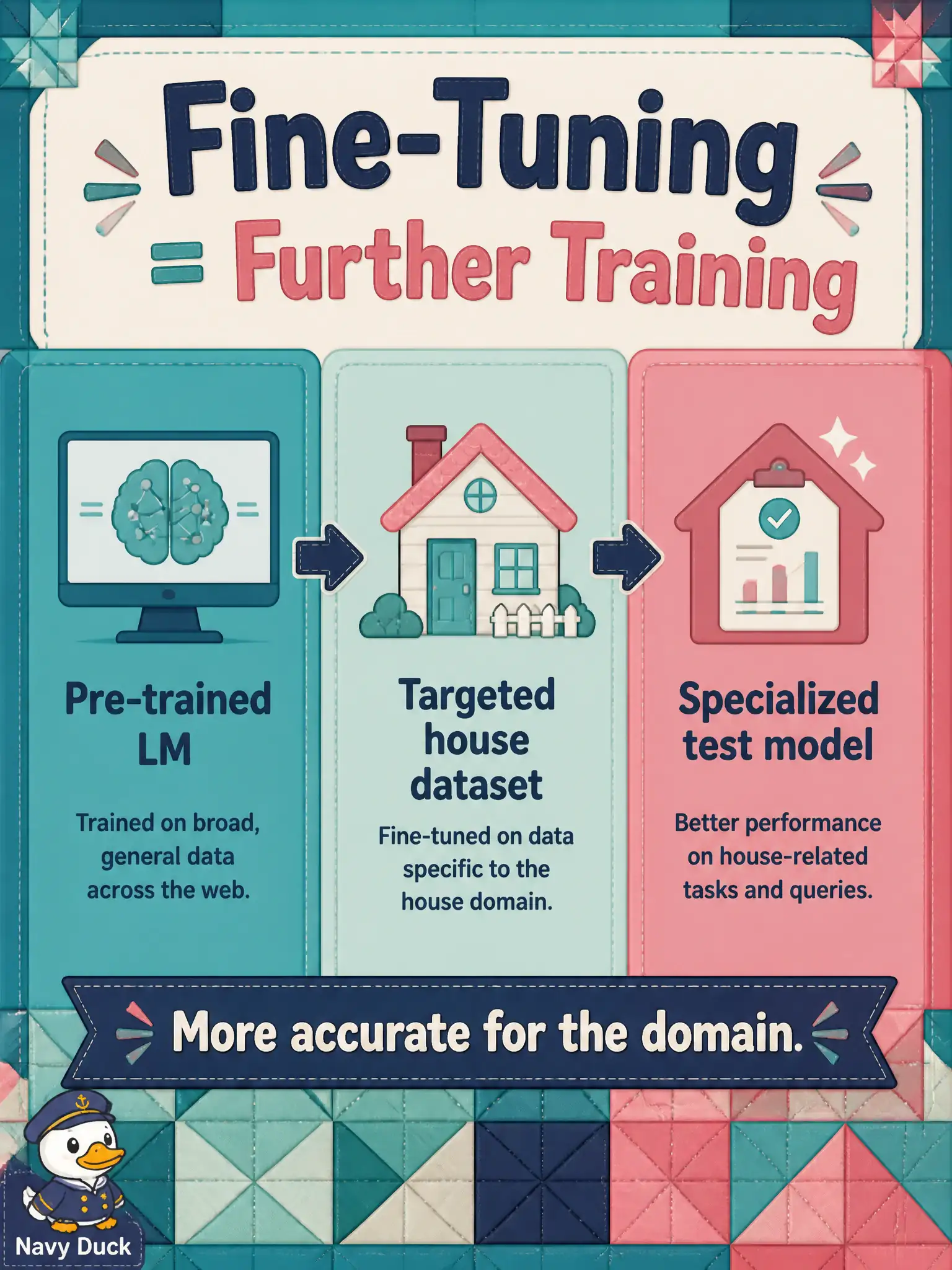
Fine-tuning is a second lesson with the guild’s own scrapbook after the general class. The pre-trained model gets further training on targeted house examples. That is more than “use the base model as-is.”
Full Explanation
Fine-tuning means further training a pre-trained LLM or SLM on a focused dataset so outputs become more accurate and relevant for a specialized testing domain or task. The community quilt-guild booth shop’s additional pass on labeled house examples so the model learns guild wording after a generic textbook style is exactly that further-training step for civic craft-shop testware. The base model’s general knowledge is retained as a starting point; the targeted set reshapes phrasing and structure toward local process. Applying a pre-trained model with no extra training and no house examples is plain inference, not fine-tuning. Chunking a handbook into roughly 256–512 token pieces for RAG is a retrieval preparation step used to stay inside context windows, not continued training. Measuring neuron coverage of the model as the system under test is a CT-AI SUT concern, not fine-tuning for GenAI-in-testing infrastructure. Exam caveat: testers explain the purpose of fine-tuning at K2 depth; they are not examined as ML engineers who configure and run the training job. Operational check: if the shop runs an additional training pass on labeled guild stories and cases so terminology matches house process, call it fine-tuning; if it only prompts the base model unchanged, it is not fine-tuning.