
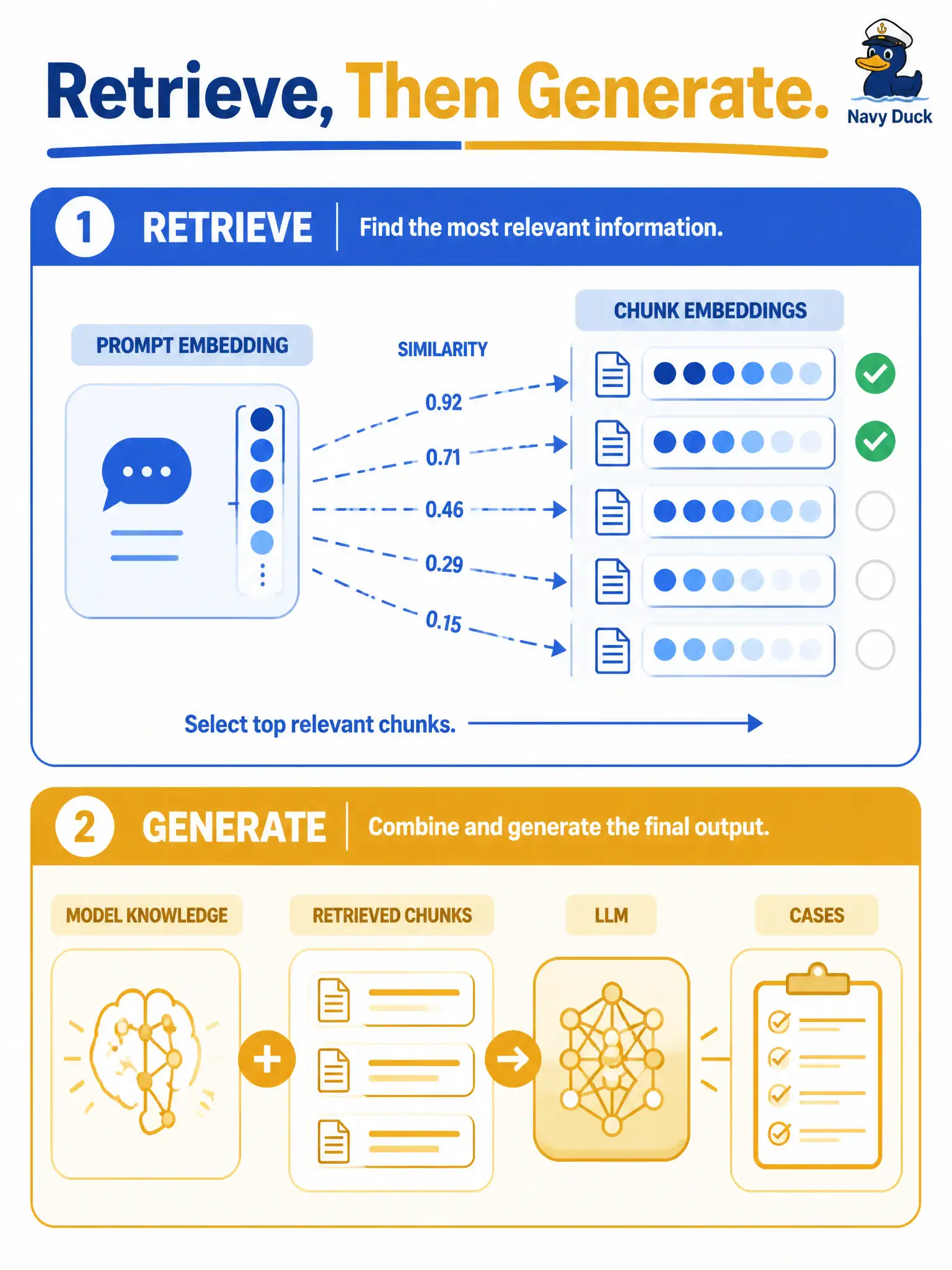
A municipal yard-waste bag-tag tester asks for cases about “late-set-out on a holiday.” The suite encodes that ask, pulls nearby handbook chunks, and only then writes cases. Which pair names those runtime steps?
Select an answer to reveal the explanation.
Short Explanation
First find the matching handbook pages by meaning, then write the cases. Runtime RAG is retrieval by semantic similarity, then generation with that context. Fine-tuning a new base model is a different activity.
Full Explanation
Yard-waste bag-tag testers asking for cases about “late-set-out on a holiday” exercise runtime RAG: retrieval by semantic similarity of prompt versus chunk embeddings, then generation that combines model knowledge with retrieved data. Find matching pages by meaning, then write cases.
Fine-tuning then deploying a new base model fails as the runtime pair. Post-processing then relational schema migration fails. Front-end theming then cost optimization fails.
Exam caveat: runtime = retrieve-by-similarity then generate-with-context; fine-tuning is a separate activity.
Operational check: log retrieved chunk ids with each yard-waste pack; require generation to ground holiday exceptions in retrieved text; alert when retrieval returns empty for known handbook topics. Yard-waste runtime logs should record retrieved chunk ids beside generated holiday cases and alert when similarity retrieval returns empty for known handbook topics. Do not relabel fine-tuning projects as the retrieve-then-generate pair. Attach retrieved chunk identifiers to each yard-waste holiday case in the export so reviewers can open the exact handbook span the generator used. Retain the civic test basis as the authority whenever fluent model wording conflicts with posted rules, and document who accepted any residual risk.