
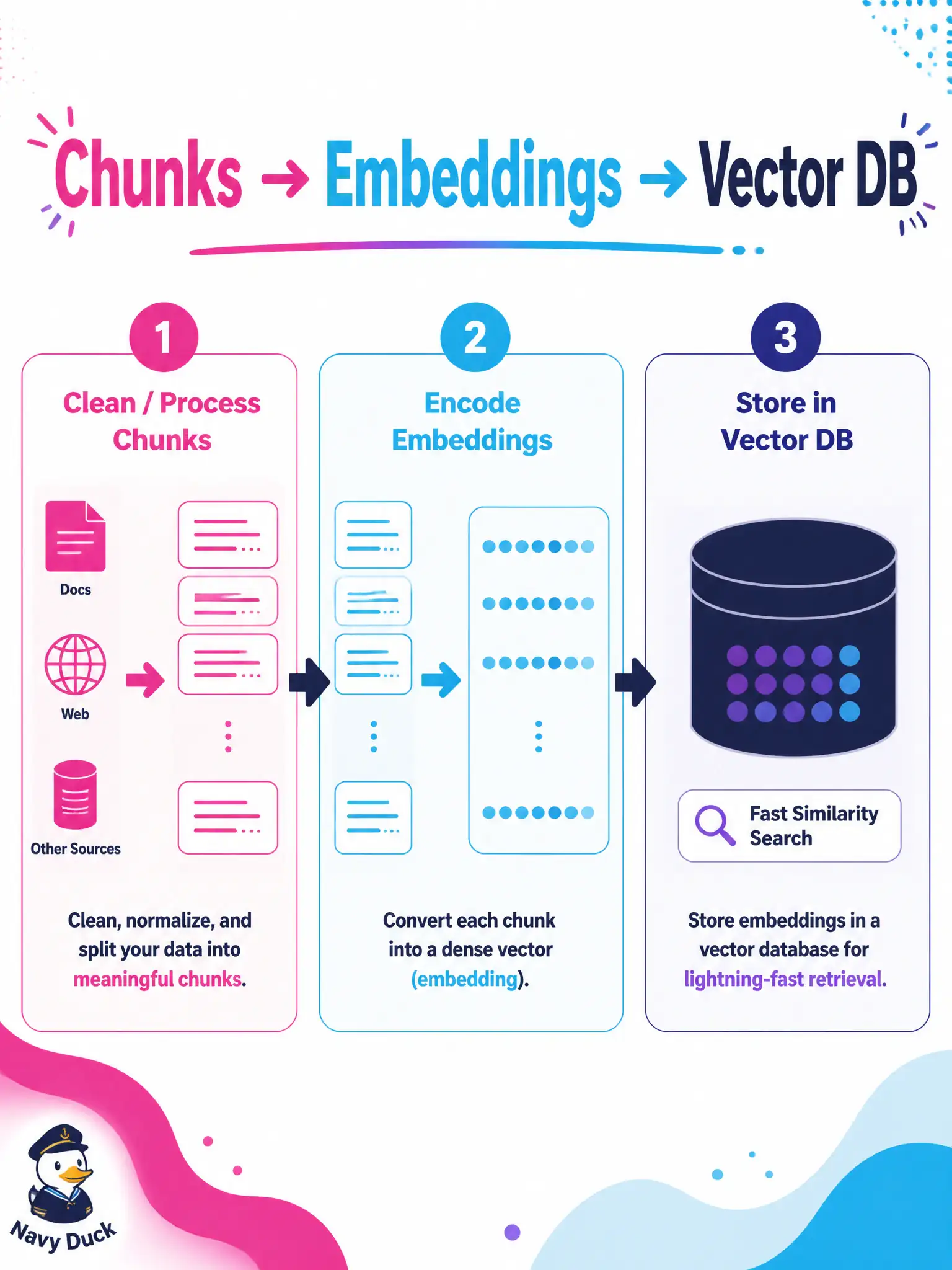
A community-fridge leftover-share handbook is tidied, turned into high-dimensional vectors with a pre-trained embedder, and saved for later lookup. Which sequence best summarizes that preprocess path?
Select an answer to reveal the explanation.
Short Explanation
First tidy the text, then stamp each piece with a meaning vector, then file the stamps. Clean and process, encode as embeddings, store in a vector database — that is the RAG preprocess path. Chat-first invention or dumping raw PDFs into a case table skips the store that semantic search needs.
Full Explanation
Community-fridge leftover-share handbooks that are tidied, turned into high-dimensional vectors with a pre-trained embedder, and saved follow the preprocess path: clean and process the text, encode it as embeddings, then store them in a vector database. Tidy → stamp → file.
Calling the LLM first then inventing embeddings from the chat reply only fails the preprocess order. Storing raw PDFs in a relational case table without cleaning or encoding fails both store choice and encoding. Skipping storage and re-uploading the full binder every request fails the point of a persistent vector index.
Exam caveat: preprocess builds the semantic store before runtime retrieval; do not confuse with generation-first shortcuts.
Operational check: run a documented clean→embed→store pipeline for fridge handbooks; version the index; smoke-test retrieval after each refresh; forbid “raw PDF in SQL cases table” as a RAG substitute. Fridge handbook preprocess jobs must run clean→embed→store with versioned indexes and forbid raw-PDF-in-SQL shortcuts that skip encoding. Smoke-test retrieval after every refresh before testers rely on leftover-share semantic search. Version fridge embedding indexes with date stamps and keep the previous index restorable if a clean→embed→store run corrupts semantic neighbors.