
A paratransit-booking policy binder will not fit in one prompt, so the shop breaks it into pieces of about 256–512 tokens. Why is that chunking done?
Select an answer to reveal the explanation.
Short Explanation
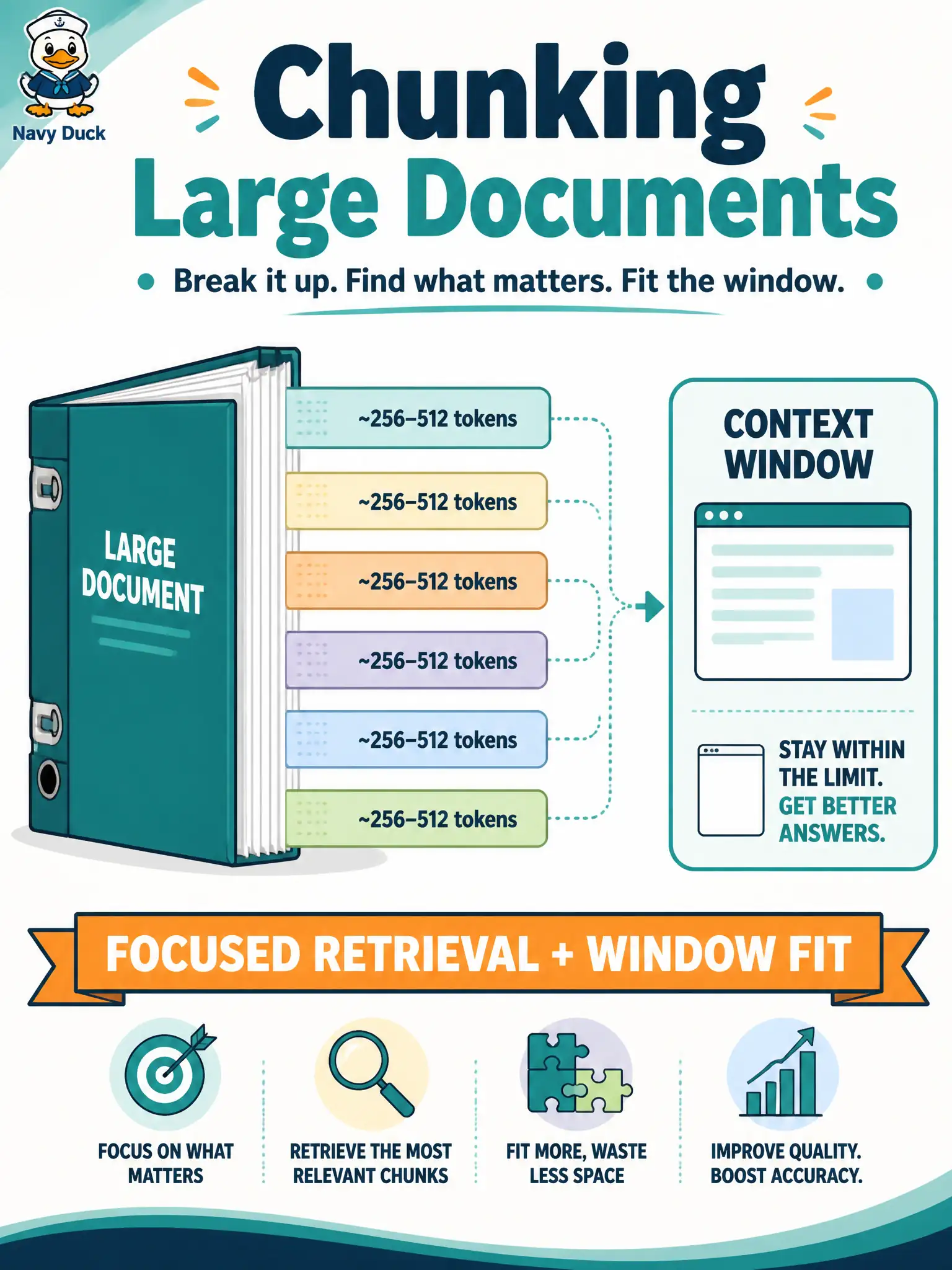
A fat binder will not fit through a narrow mail slot — so you mail chapters. Chunking splits large documents into pieces (often about 256–512 tokens) for focused retrieval and context-window fit. It is preparation for RAG, not a token-counting lab exercise.
Full Explanation
Paratransit-booking policy binders that will not fit in one prompt are chunked into pieces of about 256–512 tokens to split large documents for focused retrieval and context-window compatibility. Mail chapters through the slot; do not force the whole binder.
Replacing the LLM with a fixed decision tree fails by concept. Fine-tuning on every ordinance overnight fails as the reason for chunking. Measuring neuron coverage of the LLM as SUT fails CT-GenAI tool-context here.
Exam caveat: chunking prepares documents for RAG/retrieval and window fit; typical sizes are illustrative, not a lab ritual.
Operational check: chunk paratransit policies with overlap where needed; store chunk embeddings; validate that holiday booking rules retrieve the correct chapter; revisit chunk size if retrieval precision drops. Paratransit chunking pipelines should use documented sizes with overlap as needed, validate holiday-rule retrieval, and revisit chunk boundaries when precision drops—without turning chunk size into a written-exam ritual. Keep neuron-coverage experiments out of this RAG preparation path. Document paratransit chunk overlap and size in the RAG runbook for operators, while keeping written-exam items focused on why chunking exists—not on typing the numbers.