
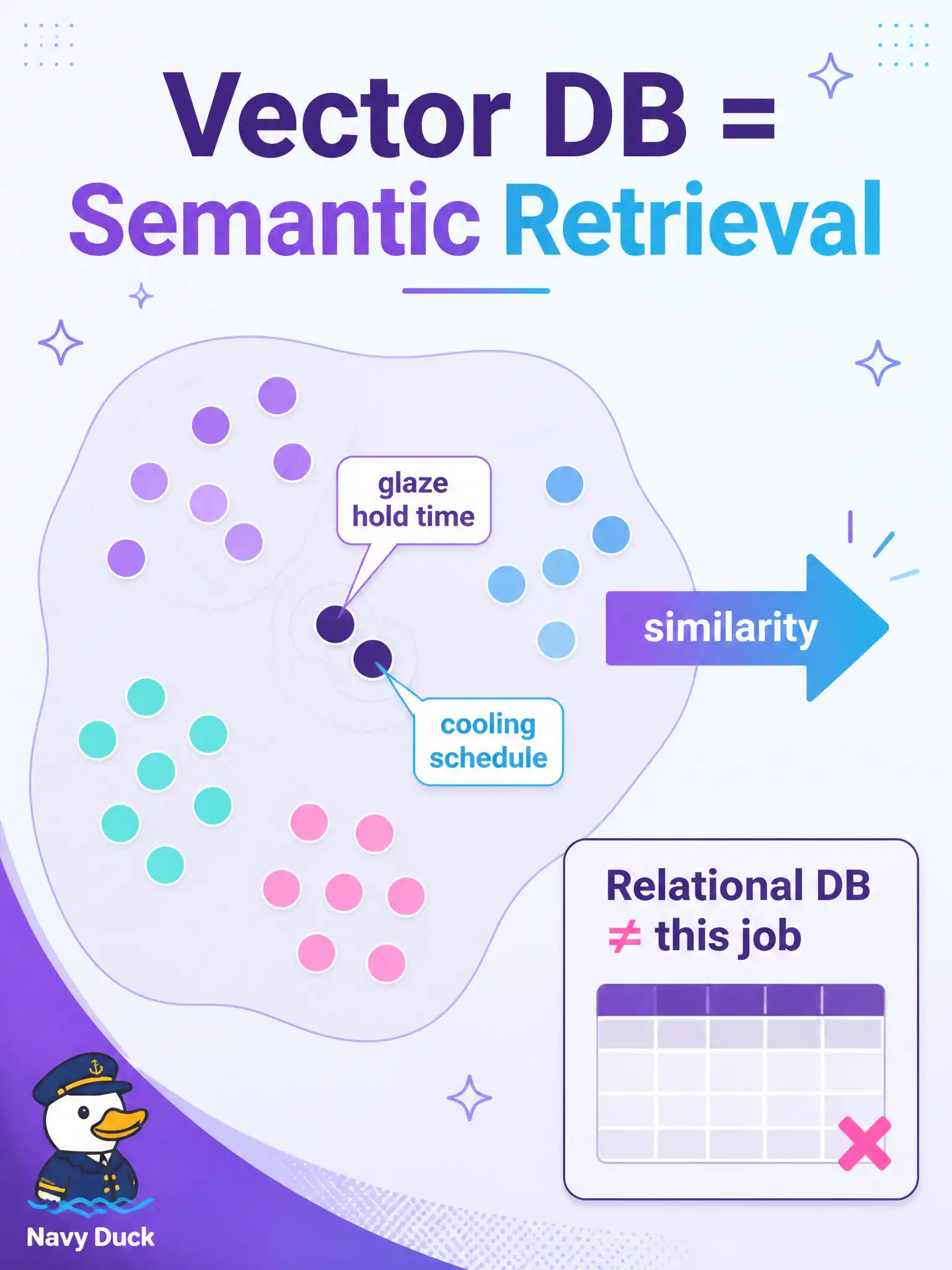
A community-kiln booking handbook is stored as meaning vectors so “glaze hold time” can surface a nearby “cooling schedule” note. Which store supports that semantic retrieval?
Select an answer to reveal the explanation.
Short Explanation
Embeddings are like map pins for meaning — nearby ideas sit close together. A vector database holds those pins so “glaze hold time” can pull a related “cooling schedule” note. That is not the same as a relational case table.
Full Explanation
Community-kiln booking handbooks stored as meaning vectors so “glaze hold time” surfaces a nearby “cooling schedule” note need a vector database holding embeddings for semantic retrieval of related content. Nearby meanings, not exact column matches, power that lookup.
A relational table of approved cases with exact column matches only fails the semantic job. A spreadsheet of pass/fail counts with no document text fails. A print queue that reprints without search fails.
Exam caveat: vector DB ↔ embeddings ↔ semantic similarity; relational DB ↔ structured cases.
Operational check: embed kiln handbook chunks into the vector store; verify similarity queries return related procedure notes; keep case execution records relational; document both stores on the architecture diagram. Kiln handbook chunks should be embedded and smoke-tested so glaze-hold queries return cooling-schedule neighbors; keep pass/fail tallies out of the vector path. Diagram both stores so new engineers do not query SQL for semantic neighbors. After each kiln handbook embed job, run three golden similarity queries (including glaze hold → cooling schedule) and block release if neighbors look wrong. Retain the civic test basis as the authority whenever fluent model wording conflicts with posted rules, and document who accepted any residual risk.