
A municipal dog-park-pass suite stores approved cases in rows and columns and wants the back-end to pull those rows when it builds a prompt. Which store is appropriate for that structured testing data?
Select an answer to reveal the explanation.
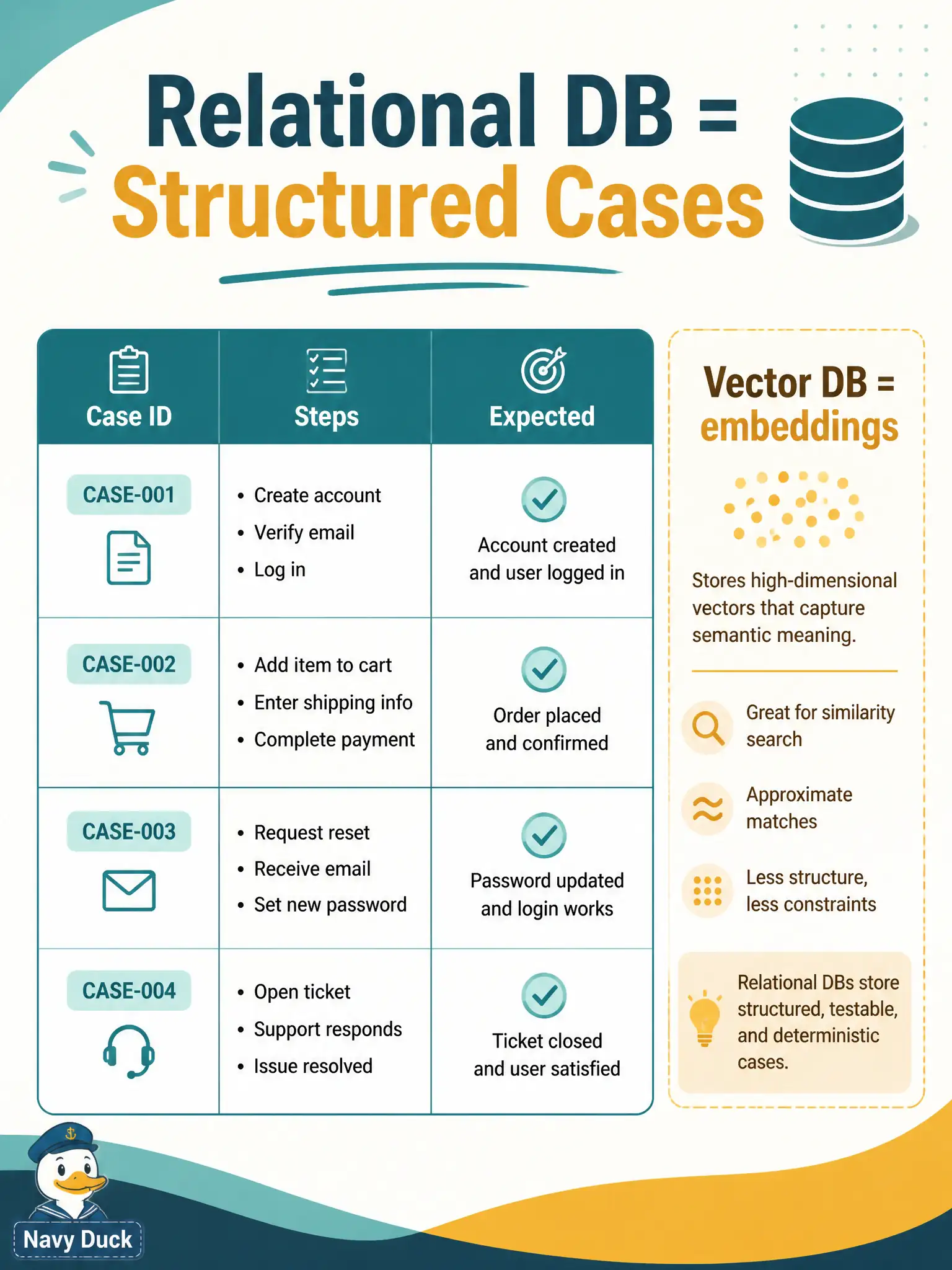
Short Explanation
Rows and columns are a filing cabinet with labeled drawers — perfect for approved test cases. A relational database holds that structured testing data. Semantic embeddings live in a vector store, which solves a different job.
Full Explanation
Dog-park-pass suites storing approved cases in rows and columns for prompt assembly need a relational database holding structured testing data such as test cases. Labeled drawers fit tabular cases; semantic stores solve a different job.
A vector database used only for semantic handbook lookup fails as the structured case store. An unstructured chat log with no schema fails. A model weight file replacing stored cases fails because weights are not a case repository.
Exam caveat: relational = structured cases; vector = embeddings/semantic retrieval—do not swap.
Operational check: keep approved dog-park cases in relational tables with keys the back-end can query; sync exports to the prompt builder; do not dump case rows into the vector DB as a substitute schema. Dog-park approved cases belong in relational tables with stable keys for prompt assembly; vector stores remain reserved for semantic handbook retrieval. Do not “simplify” by stuffing case rows into embeddings as a substitute for a schema. Grant the dog-park prompt builder read access to relational case tables only, and deny it write access to the vector handbook index to preserve store roles. Retain the civic test basis as the authority whenever fluent model wording conflicts with posted rules, and document who accepted any residual risk.