
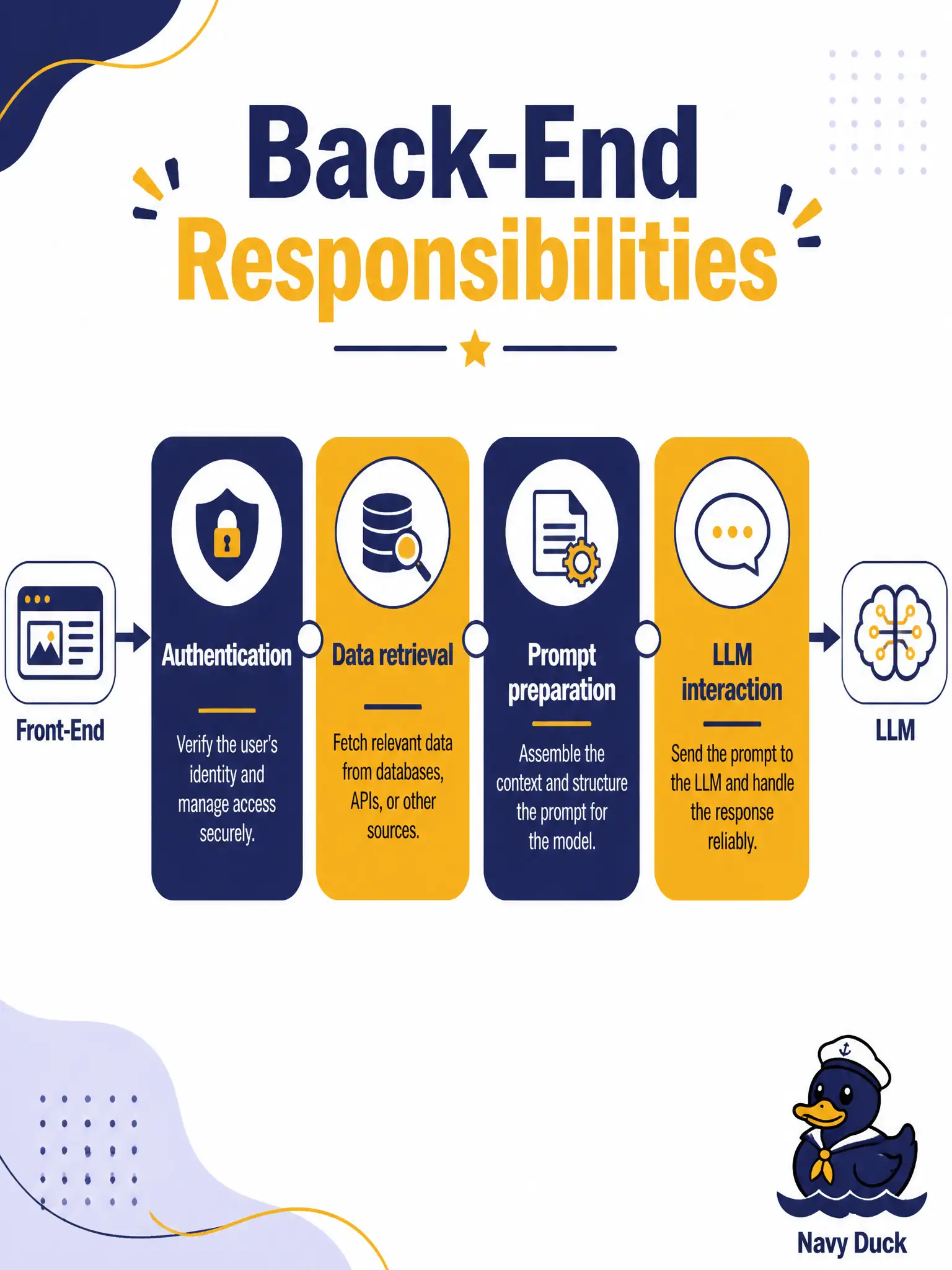
A county-fair livestock-registration suite must log who asked, fetch last year’s weigh-in cases, wrap them in a house prompt, and only then call the model. Which component typically handles authentication, data retrieval, prompt preparation, and interaction with the LLM?
Select an answer to reveal the explanation.
Short Explanation
The back-end is the kitchen that takes the order, checks credentials, pulls ingredients, writes the recipe card, and talks to the cook. Authentication, retrieval, prompt prep, and the model call live there — not in the form alone or a single store.
Full Explanation
Livestock-registration suites that must log who asked, fetch last year’s weigh-in cases, wrap them in a house prompt, and only then call the model place those duties in the back-end—processing input and managing authentication, retrieval, prompt preparation, and the LLM call. The kitchen, not the counter alone, runs that workflow.
The front-end form that only captures ticket id and command fails by under-scoping. The vector database alone authenticating users and calling the model fails by assigning application responsibilities to a store. The relational case table formatting prompts without an application service fails similarly.
Exam caveat: back-end orchestrates auth, retrieval, prompt prep, and model interaction—even when stores hold the data.
Operational check: implement livestock suite orchestration in a service layer; never expose raw model keys in the form; audit logs for who requested which weigh-in pack; keep stores specialized and the back-end responsible for sequencing. Livestock registration services must orchestrate auth, weigh-in retrieval, house-prompt wrapping, and LLM invocation in the back-end, never placing model keys in the form. Audit who requested which pack and keep stores specialized while the service owns sequencing.