
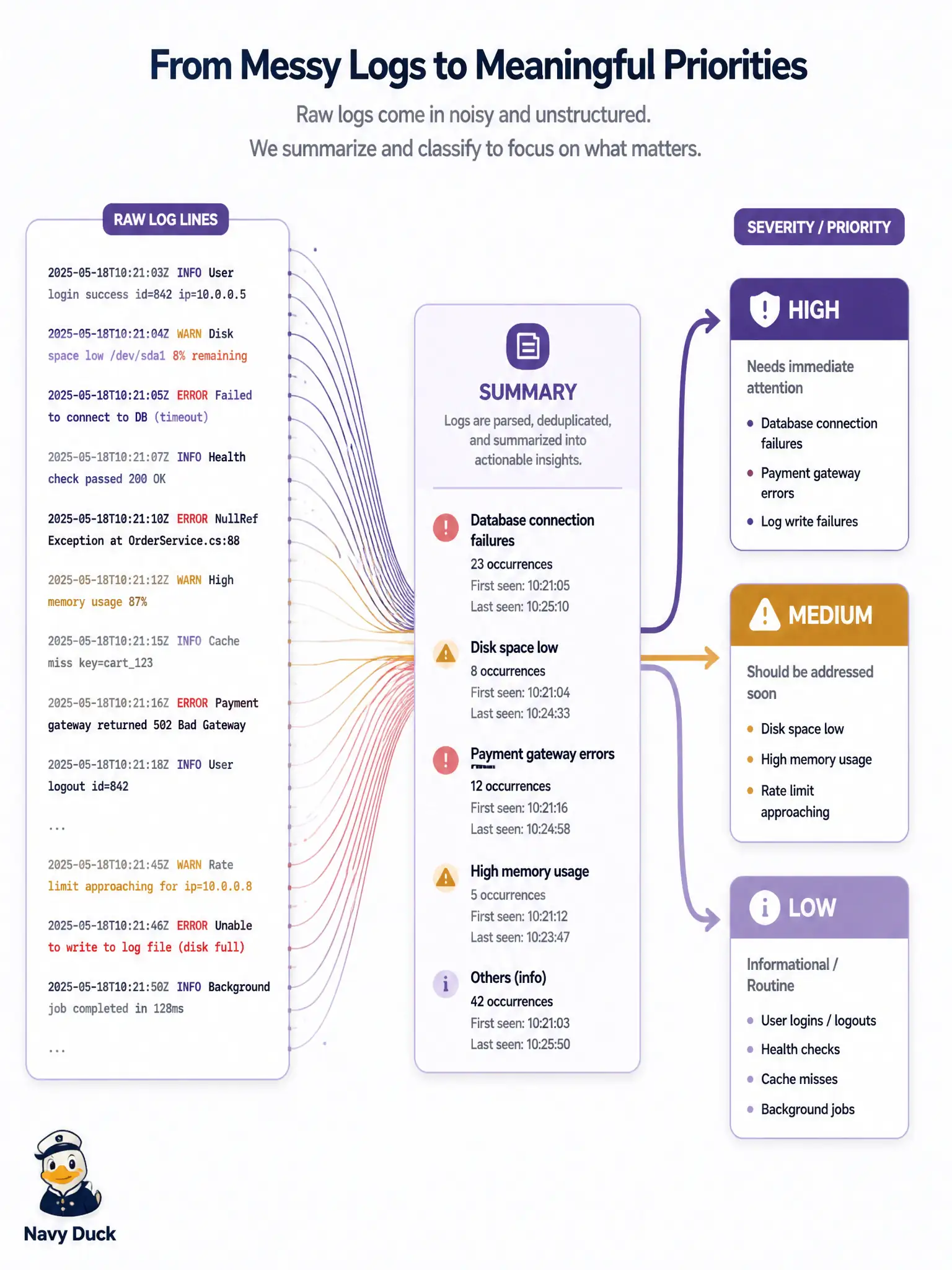
After a recycling-route regression, a tester pastes a noisy log into an LLM and asks for a short summary plus severity and priority buckets. Which capability does this represent?
Select an answer to reveal the explanation.
Short Explanation
A noisy log is a junk drawer; asking for a short summary and severity buckets is result analysis. You are making sense of what already ran—not rewriting requirements or retraining a city-wide model. Keep the buckets as a draft for human triage.
Full Explanation
Pasting a noisy recycling-route regression log into an LLM and asking for a short summary plus severity and priority buckets represents test-result analysis: summarize outcomes and classify anomalies. Civic overnight routing jobs produce noisy telemetry and mixed INFO/WARN/ERROR lines; draft triage accelerates humans without replacing confirmation before defects, reroutes, or rollbacks are authorized.
Requirements cleanup that rewrites the original routing user stories is basis improvement, not result analysis. Foundation-model pretraining on the city’s entire GIS database is an MLOps-scale activity outside this capability and far beyond a log paste. Replacing the defect tracker with unattended production rollbacks is operations automation, not classification support from GenAI.
Exam caveat: result analysis works on execution evidence already produced; it does not retrain city-wide models or auto-remediate production from a chat summary alone.
Operational check: obtain the summary and severity/priority buckets; spot-check high-severity items against raw log lines and route IDs; open defects only for confirmed anomalies; keep the municipal defect tracker as the system of record for recycling-route failures.