
A municipal dog-license tester waits on a reasoning model only to change the word “owner” to “guardian” throughout a template case. What is the best assessment of that model choice?
Select an answer to reveal the explanation.
Short Explanation
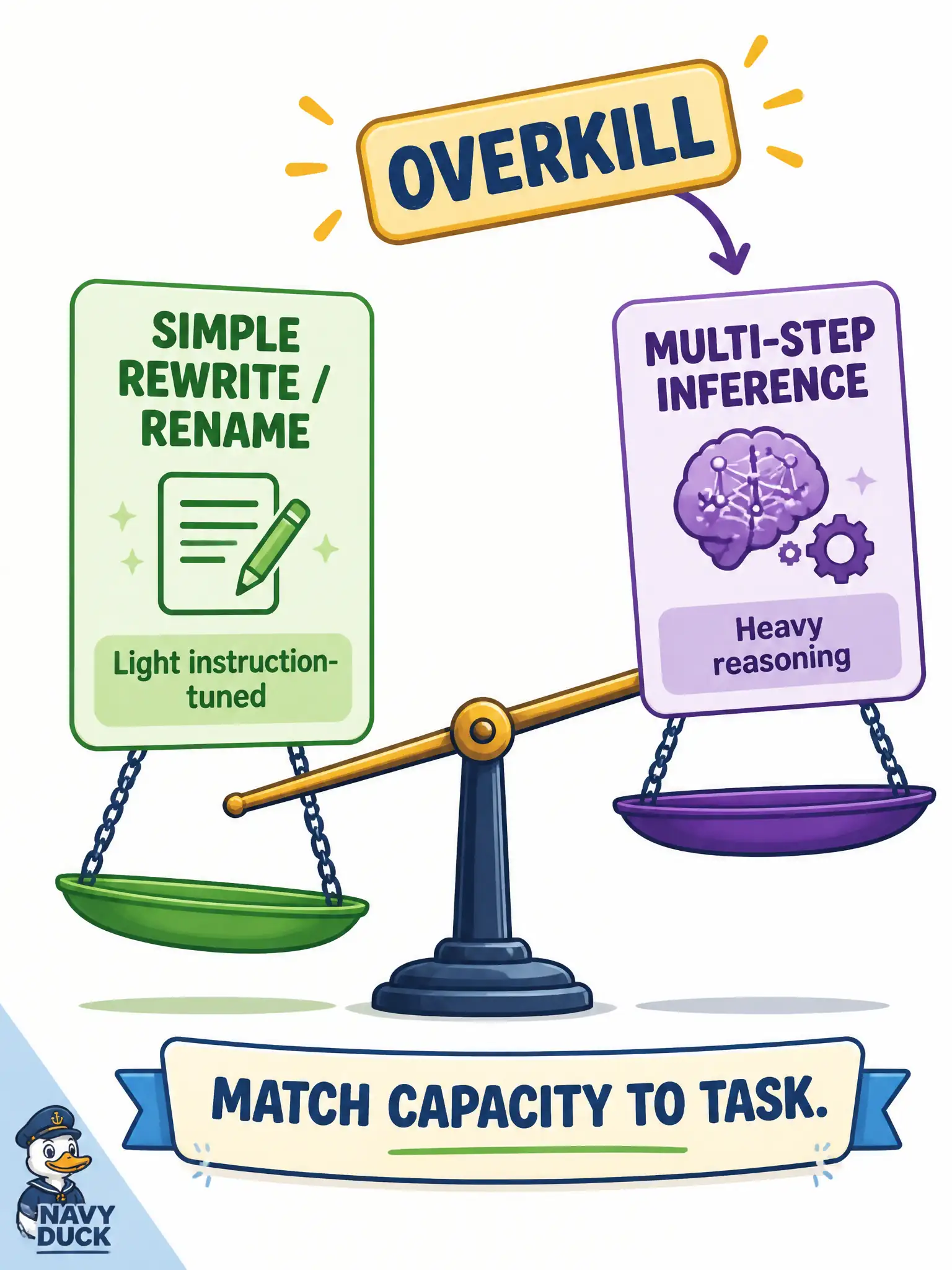
Using a reasoning model for a one-word find-and-replace is like calling a city planner to swap a street sign. Simple instruction-following fits an instruction-tuned model—or a smaller one—just fine. Save reasoning capacity for tasks that actually need multi-step inference.
Full Explanation
Simple instruction-following does not justify reasoning-model overhead. Changing “owner” to “guardian” throughout a municipal dog-license template case is a clear find-and-replace style instruction; an instruction-tuned model—or even a small language model—is enough. Reasoning models add latency and cost for multi-constraint or multi-step inference civic teams should reserve for tasks that need that depth.
Claiming a reasoning model is always required whenever any wording in a case changes invents a universal rule that wastes capacity. Waiting on multimodal analysis of a license photo before any text edit adds an unnecessary visual modality to a pure text rename. Claiming only a foundation model without instructions can safely rename fields ignores that instruction-tuned models are built to follow such directives.
Exam caveat: match model capability to task complexity. Renames and boilerplate ≠ default reasoning tier.
Operational check: perform the owner→guardian rename with an instruction-tuned or SLM prompt; measure time and cost versus a reasoning model on the same tiny edit; adopt the lighter path in the dog-license municipal style guide; escalate to reasoning only when multi-step policy inference appears.