
A community-orchestra seat-map tester is told to “test the reasoning model with neuron coverage.” For CT-GenAI work, what is the appropriate focus?
Select an answer to reveal the explanation.
Short Explanation
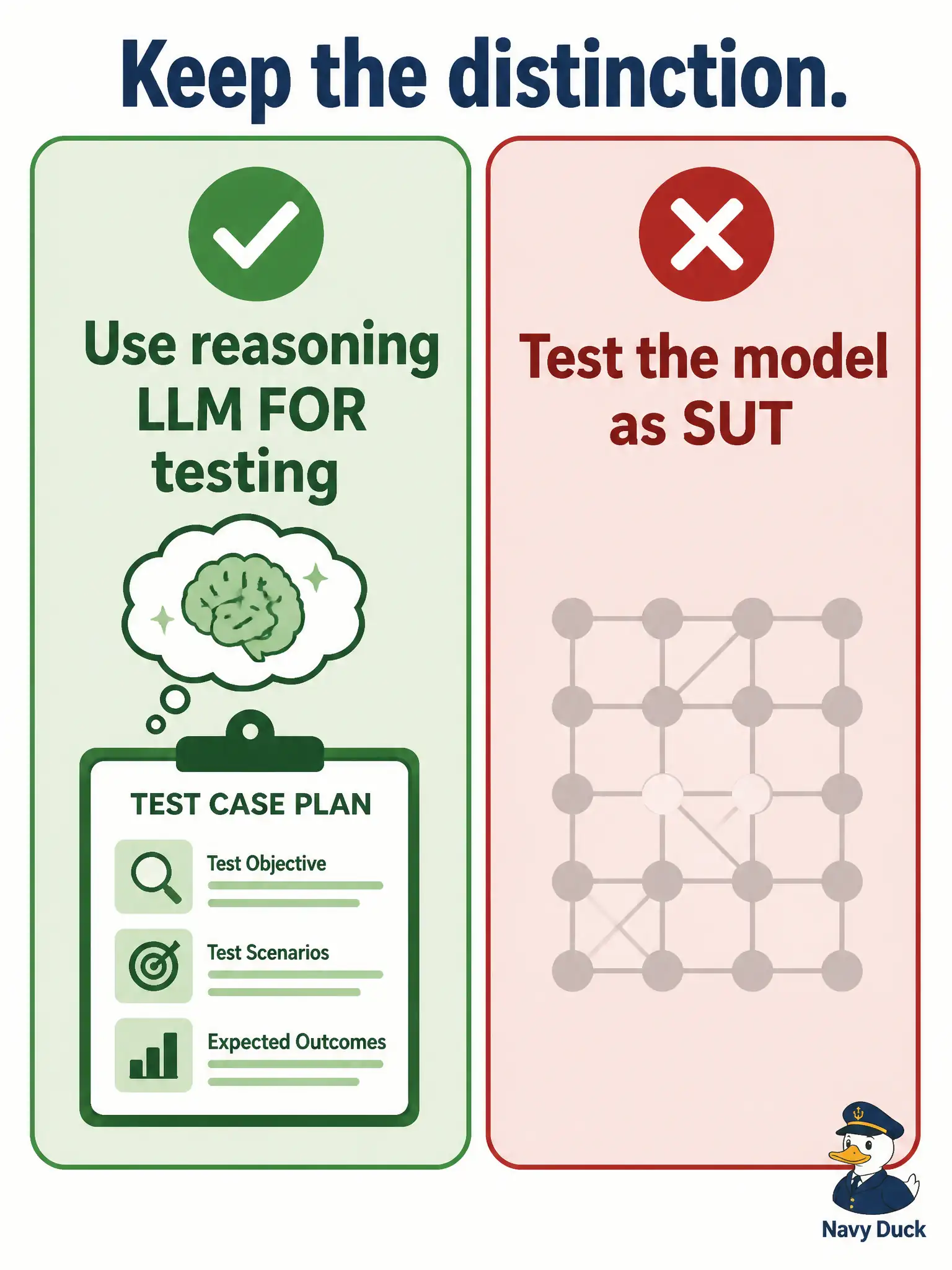
This exam is about using GenAI to help test something else—like a seat-map app—not about dissecting the model as the product. Neuron coverage and model-as-SUT belong on a different syllabus. Pick the reasoning model to help plan cases, then review its advice like any other draft.
Full Explanation
CT-GenAI addresses generative AI as a testing aid for products under test. For a community-orchestra seat-map tester told to “test the reasoning model with neuron coverage,” the appropriate focus is to choose a reasoning model to help plan and justify test cases for the seat-map product—not to treat the LLM as the system under test. Neuron coverage and related white-box model evaluation belong to AI testing (CT-AI), a different certification scope.
Designing neuron-coverage experiments on the reasoning model as SUT fails the GenAI-as-aid framing of this exam. Replacing all human review with metamorphic oracles that score hidden layers likewise treats the model as product and removes tester ownership of seat-map testware. Jailbreaking the reasoning model so red-team payloads become the only valid cases misdirects into attack-centric work rather than seat-map case planning.
Exam caveat: CT-GenAI = use GenAI to help test something else. CT-AI-style model-as-SUT techniques (neuron coverage, etc.) are out of scope as the primary focus here.
Operational check: pick a reasoning model; ask it to help plan and justify seat-map cases from the civic orchestra stories; review every suggested case against the basis; refuse project plans that substitute neuron-coverage labs on the LLM for application test design.