
A municipal water-meter coach tells the team to “use the non-reasoning model for the boilerplate case list.” In this syllabus, which model type does that label refer to?
Select an answer to reveal the explanation.
Short Explanation
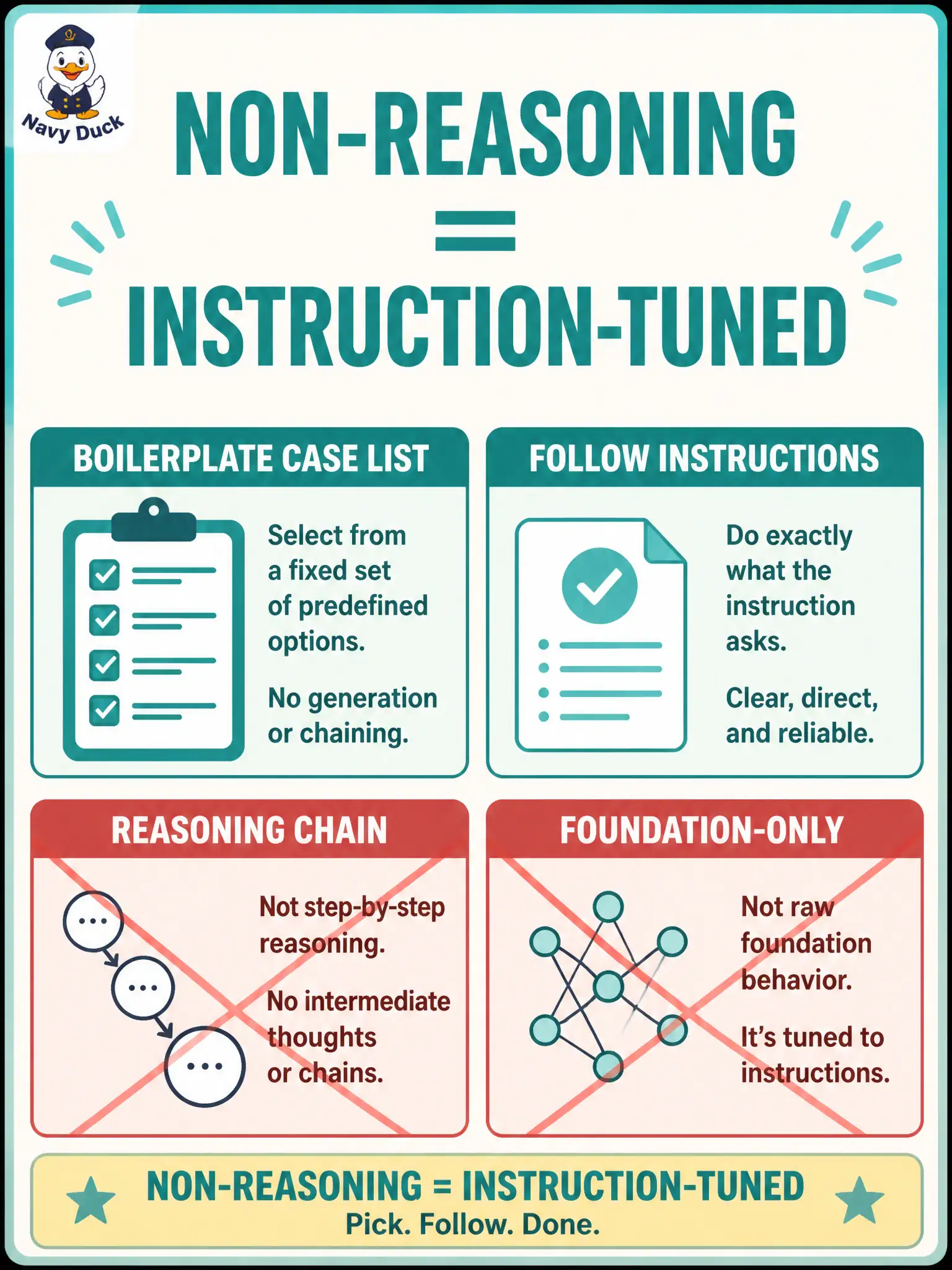
In this syllabus, “non-reasoning” is simply another name for instruction-tuned—great for boilerplate lists when the recipe is clear. It is not a sneaky label for “raw foundation only,” and it is not the multi-step reasoning model. Hear “non-reasoning” and think “follow the instructions.”
Full Explanation
In this syllabus, “non-reasoning model” refers to an instruction-tuned model suited to following clear formatting instructions—exactly the right class for a municipal water-meter coach’s boilerplate case list. Instruction-tuned and non-reasoning are treated as synonyms when choosing a testing aid for template-shaped work. Civic meter programs should hear “non-reasoning” as “follow the instructions,” not as an insult or as “raw foundation only.”
Equating the label with a reasoning model reserved for multi-step risk prioritization only inverts the synonym. Treating it as a foundation-only model that must never receive instruction-style prompts confuses the unadapted base with instruction-tuned aids. Treating it as a vision-language model that scores neuron coverage on meter photos mixes multimodal modality with CT-AI evaluation goals foreign to this item.
Exam caveat: non-reasoning = instruction-tuned for CT-GenAI model-choice language. Boilerplate lists with clear recipes belong there; nested prioritization belongs with reasoning models.
Operational check: when the coach says “non-reasoning for boilerplate,” select an instruction-tuned text model; feed the water-meter case template; confirm format adherence without invoking reasoning-tier cost; note the synonym in the municipal coaching cheat sheet.