
An interlibrary-loan tester pastes raw user stories into a foundation model and receives long essays instead of given-when-then cases. What best explains this outcome for test artefact generation?
Select an answer to reveal the explanation.
Short Explanation
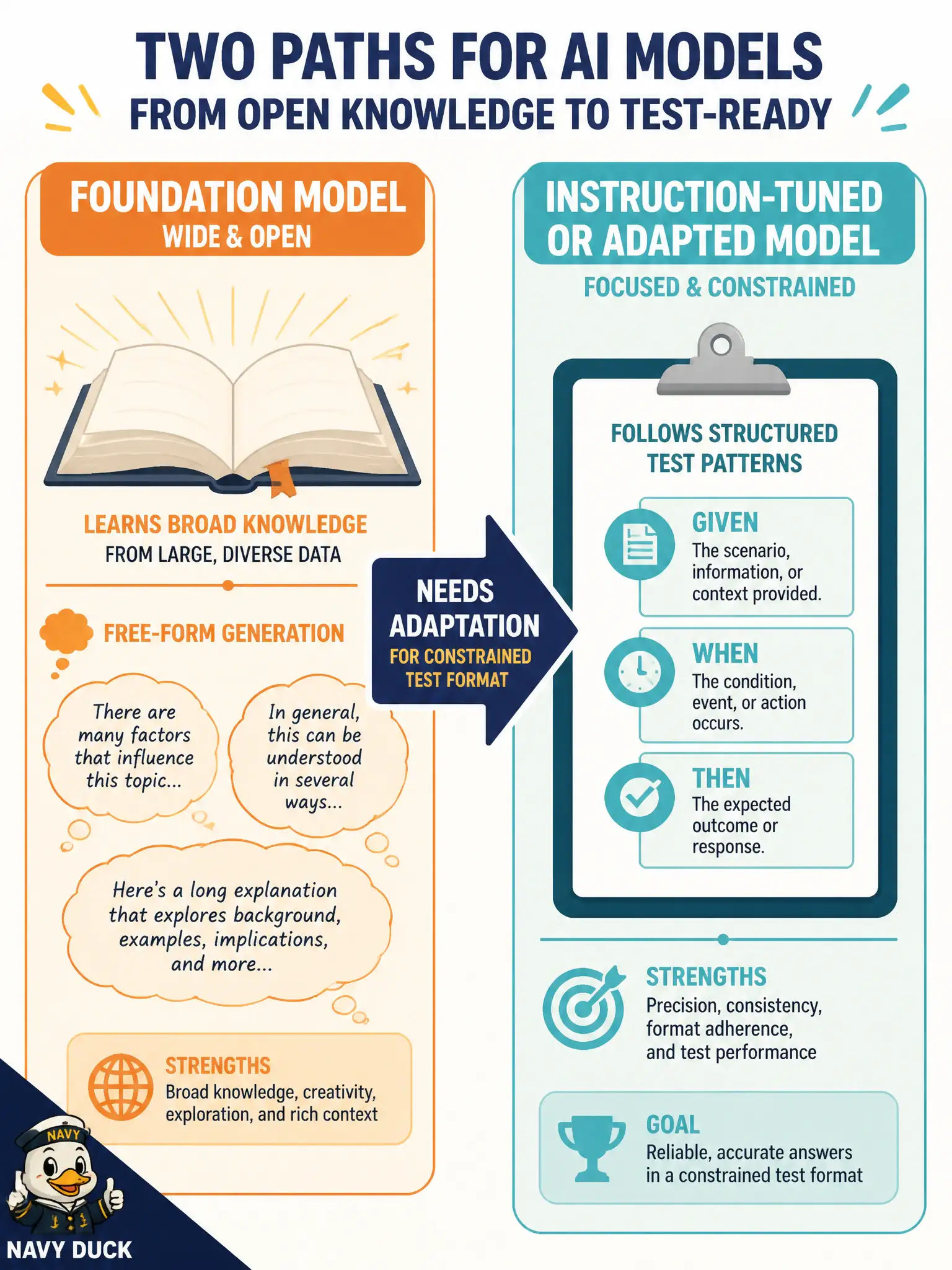
A foundation model is like a talented writer who never saw your house style guide—creative, but not locked to given-when-then. For a constrained test format, you usually add adaptation or reach for an instruction-tuned model that expects those instructions. Flexibility alone does not guarantee the artefact shape you need.
Full Explanation
Foundation models are flexible next-token predictors without a strong bias toward a particular test template, so an interlibrary-loan tester who pastes raw user stories into a foundation model and receives long essays instead of given-when-then cases is seeing an expected outcome. Constrained test formats usually need further adaptation, an instruction-tuned wrapper, or carefully structured prompting. Civic libraries still benefit from GenAI drafting—after the format constraint is imposed.
Claims that foundation models cannot generate any testing-related text fail because essays about stories are generative text; the gap is format control, not total inability. Treating rambling essays as proof the model is already instruction-tuned reverses the signal—poor format adherence suggests missing adaptation. Treating rambling as a neuron-coverage failure that bans any testing aid imports CT-AI model-as-SUT metrics into the wrong syllabus.
Exam caveat: foundation flexibility ≠ house-style test artefacts. Essay output after raw dumps points to need for instruction tuning or adaptation, not to “GenAI cannot help testing.”
Operational check: retry the same interlibrary stories with an instruction-tuned model or a prompt that hard-requires given-when-then columns; compare artefact shape; document that foundation-alone dumps are a format risk in the municipal loan test guide.