
A food-truck permit tester needs an LLM for two jobs: (a) rewrite one user story into a simple case table, and (b) justify a risk-based case order from several competing constraints. Which pairing best matches model type to task?
Select an answer to reveal the explanation.
Short Explanation
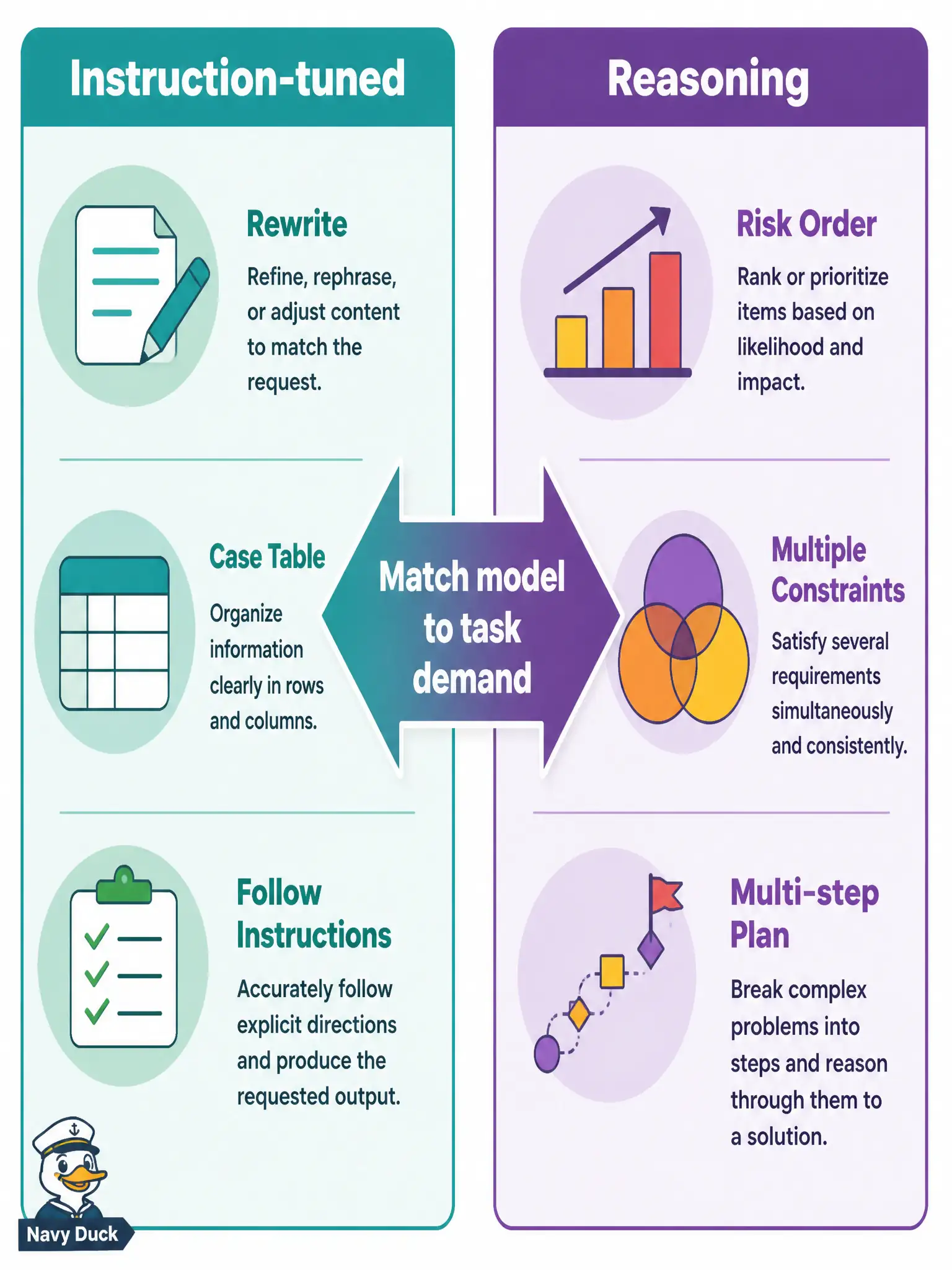
Think of instruction-tuned models as careful clerks who follow a clear recipe, and reasoning models as planners who weigh several rules at once. Rewriting one story into a table is mostly follow-the-instructions work, while ranking cases under many constraints needs deeper multi-step thinking. Match the model to that demand.
Full Explanation
Match model type to cognitive demand: use an instruction-tuned model for rewriting one food-truck permit user story into a simple case table, and use a reasoning model for justifying a risk-based case order under several competing constraints. Instruction-tuned (non-reasoning) models excel when the tester supplies a clear format and the work is mainly following instructions. Multi-constraint planning needs structured inference that reasoning models are further trained to support. Civic permit testing often mixes both job types in one sprint—keep the pairing honest.
Using a reasoning model for the simple rewrite and an instruction-tuned model for multi-constraint ordering reverses the fit and wastes latency where a clerk-like follower would do. Using a foundation model alone for both tasks because “raw models always follow constrained formats” ignores that foundation bases typically need adaptation for tight templates. Using only a small language model for both tasks so neuron coverage of the LLM can be measured first misreads CT-GenAI: the focus is GenAI as a testing aid for the permit product, not model-as-SUT neuron experiments.
Exam caveat: instruction-tuned for follow-the-format drafting; reasoning for multi-step constraint justification. Do not invert the pair or smuggle CT-AI model-evaluation goals into this certification’s aid-selection items.
Operational check: run the story→table rewrite on an instruction-tuned model; run the risk-order justification on a reasoning model; compare quality and cost; record the municipal pairing rule so teams stop defaulting one model to every food-truck permit task.