
A credit-union wire-transfer tester gets cleaner case drafts after switching to a model further trained on prompt–expected-response pairs so it obeys “list three boundary cases.” Which LLM category is that?
Select an answer to reveal the explanation.
Short Explanation
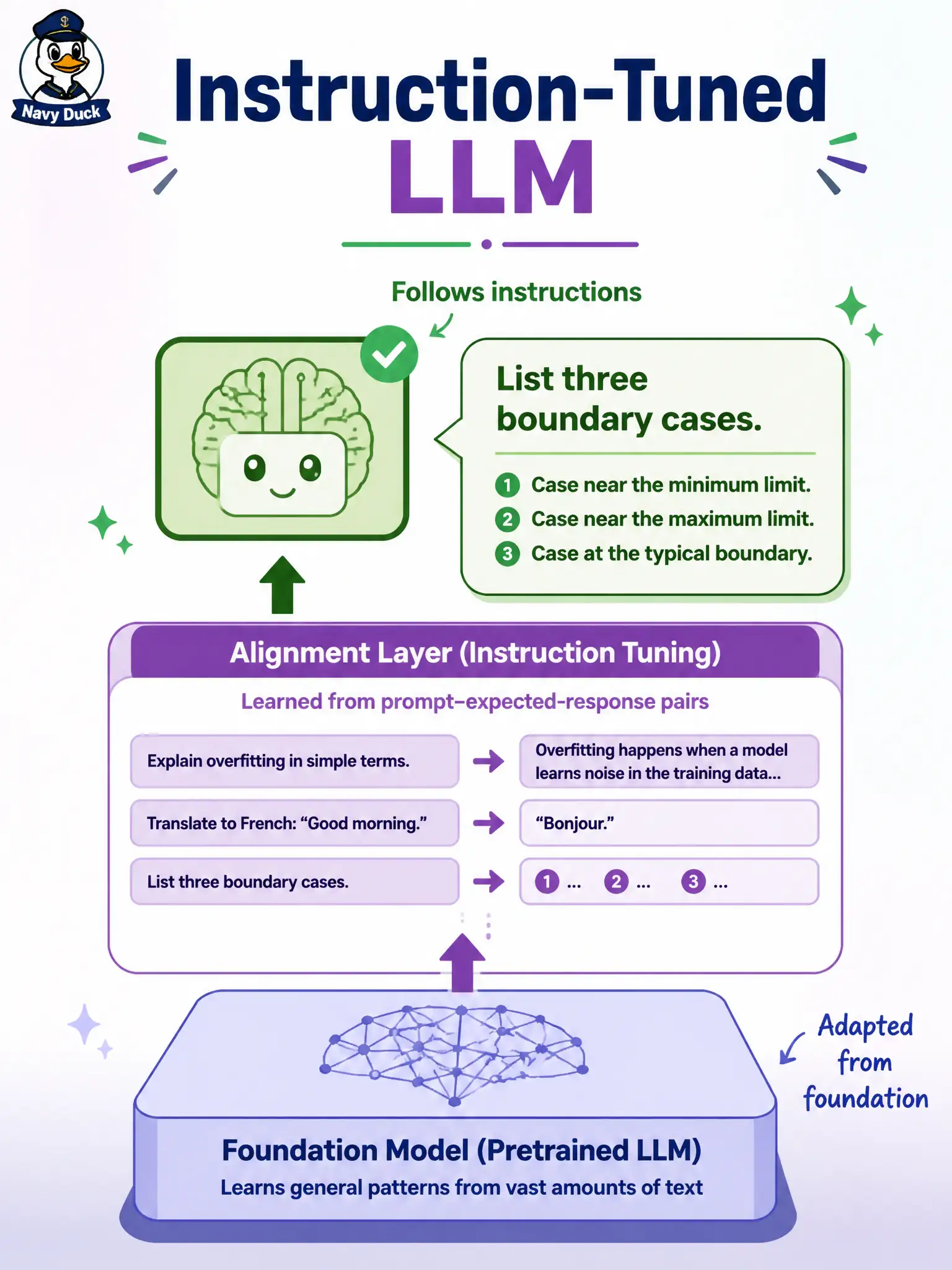
First you build a general student, then you coach them to follow directions. Instruction-tuned LLMs start from foundation models and are further aligned on prompt–response pairs. That is why “list three boundary cases” lands more cleanly.
Full Explanation
An instruction-tuned LLM is a foundation model later aligned on prompt–expected-response style data so it better follows human instructions. Cleaner credit-union wire-transfer case drafts after switching to a model that obeys “list three boundary cases” match that category: further alignment, not raw pre-training alone. Civic finance testers often see the practical difference as instruction obedience and format adherence on drafting tasks.
A foundation LLM with no further alignment beyond raw pre-training on mixed data fails because the stem describes further training on prompt–response pairs. A symbolic AI engine that stores wire rules without using prompts fails the LLM category entirely. A reasoning LLM used only for image-spine recognition in libraries misplaces both reasoning specialization and modality relative to instruction-following text drafts.
Exam caveat: instruction tuning = follow-instructions alignment after foundation pre-training. It is not symbolic rules, not “foundation with no alignment,” and not automatically a reasoning model for multi-step inference.
Operational check: compare drafts from a foundation base versus an instruction-tuned model on the same wire-transfer “list three boundary cases” prompt; keep the better-obedient model for boilerplate drafting; reserve heavier reasoning models for nested eligibility or multi-constraint prioritization work.