
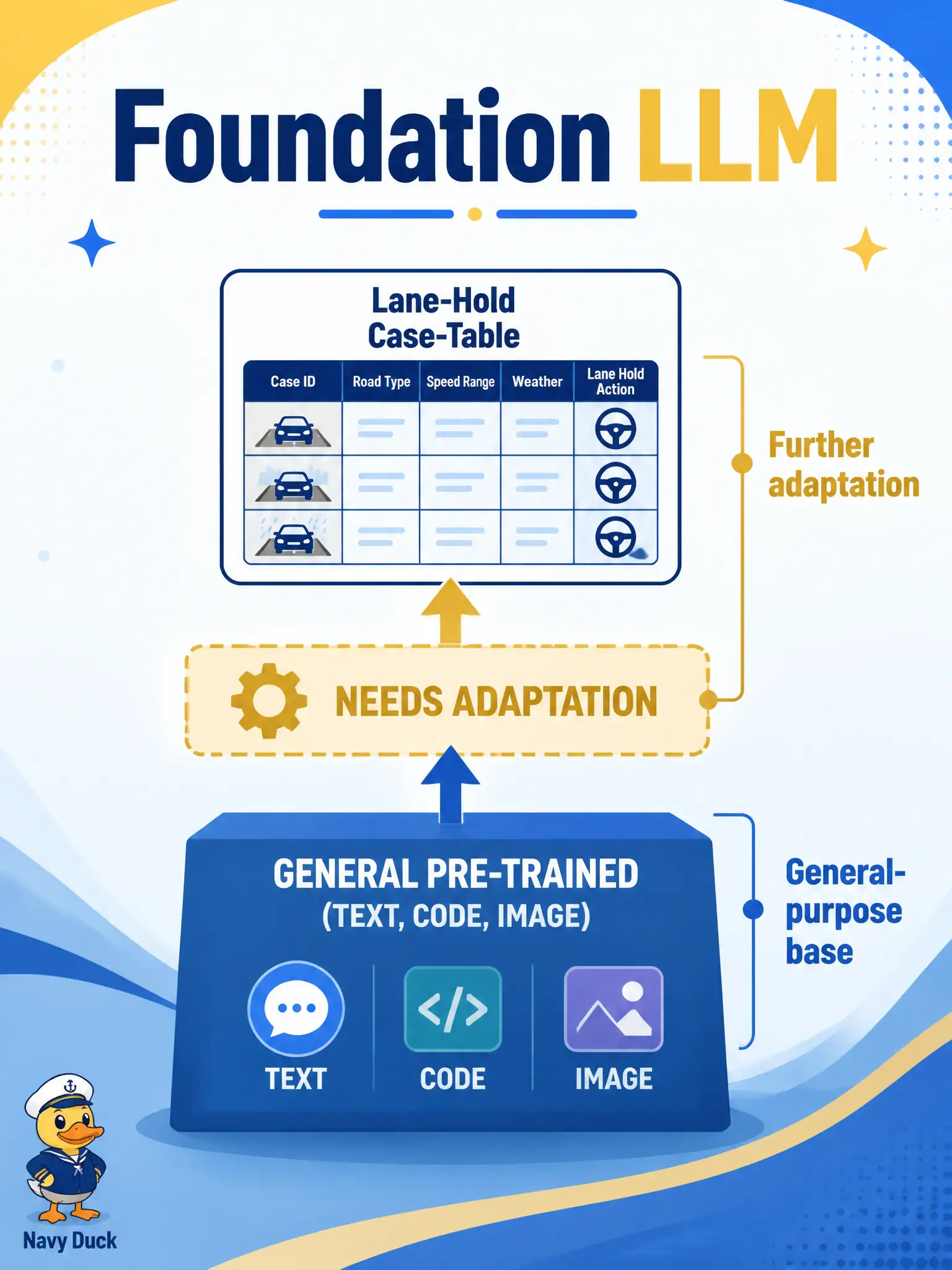
A city-pool lane-booking team is offered a general model trained on huge mixed text, code, and image data that still needs adaptation before it will emit their lane-hold case table. Which LLM category is that?
Select an answer to reveal the explanation.
Short Explanation
A foundation is a broad base layer, not the finished kitchen cabinets. A foundation LLM is general-purpose and pre-trained on vast mixed data. It usually still needs adaptation before it reliably emits a specific case-table format.
Full Explanation
A foundation LLM is a general-purpose pre-trained base—often trained on huge mixed text, code, and image data—that typically needs further adaptation before it reliably emits a specific test format such as a city-pool lane-hold case table. Civic teams offered a “general model” should hear foundation base, not finished instruction specialist. Adaptation (instruction tuning, fine-tuning, or strong wrappers) is the usual next step.
An instruction-tuned LLM already aligned only to follow “list three boundary cases” describes a later specialization, not the general base offer. A reasoning LLM further trained for nested multi-step eligibility logic is another specialized category. Calling the pitch a classical ML model that cannot be adapted for language generation denies both the generative family and adaptivity.
Exam caveat: foundation → (often) instruction-tuned → (sometimes) reasoning. Do not skip categories when the stem emphasizes general pre-training still needing adaptation for a format.
Operational check: try the offered base on the lane-hold table format; if essays appear, move to an instruction-tuned option or add adaptation; record foundation-vs-adapted choice in the pool booking tool decision log.