
A community-radio pledge tester asks the model to rewrite a fuzzy donor story into clearer acceptance language. What should they understand about LLM language help?
Select an answer to reveal the explanation.
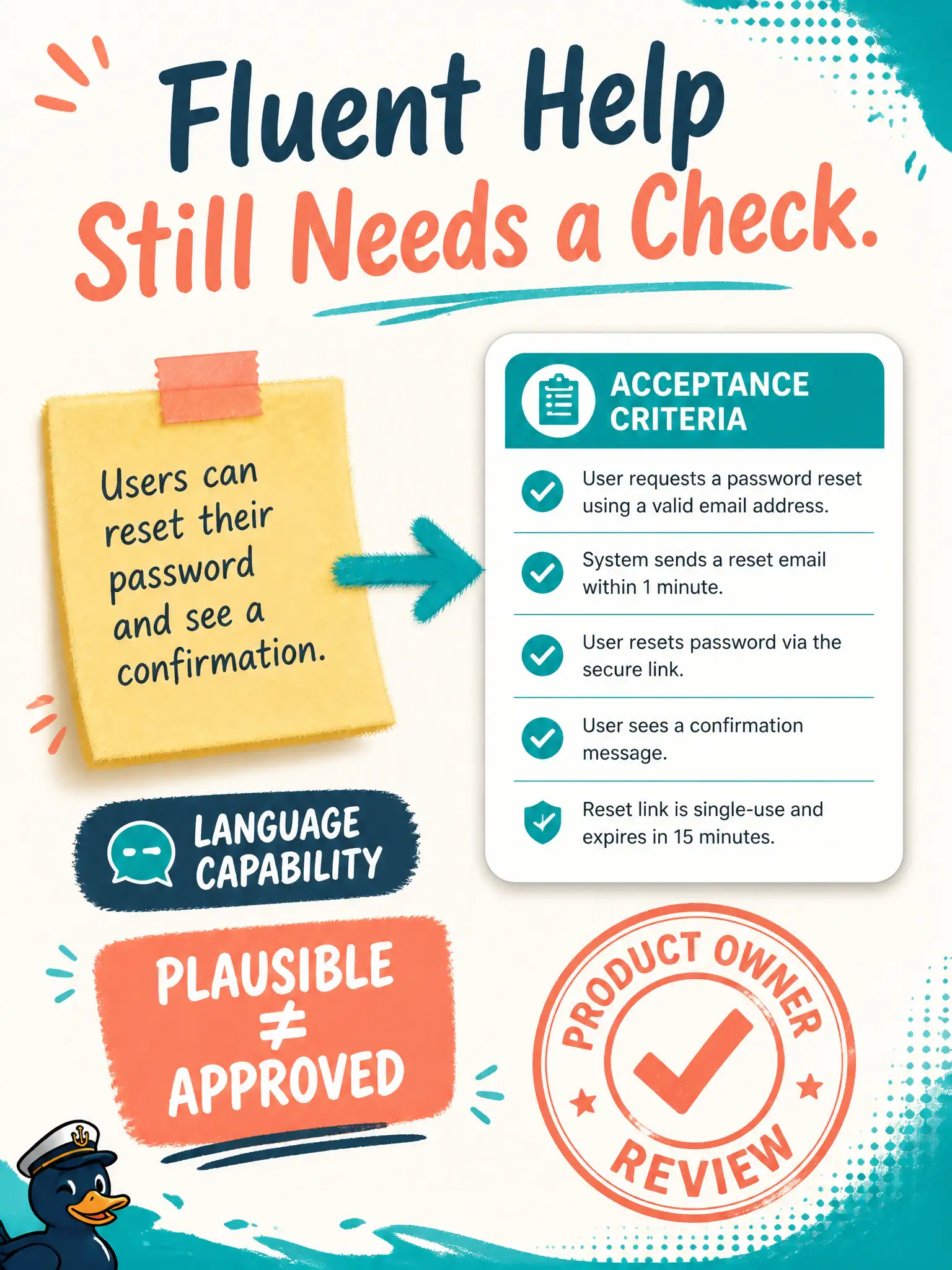
Short Explanation
A smooth rewrite is a helpful draft, not a signed contract. LLMs are strong with language nuance and coherent text. Fluency still does not prove the acceptance language matches what the product owner meant.
Full Explanation
LLMs can draft coherent language and handle nuance in requirements wording, but fluency is not proof a rewrite matches the product owner’s intent. A community-radio pledge tester who asks the model to turn a fuzzy donor story into clearer acceptance language should treat the result as a helpful draft for stakeholder confirmation. Civic product owners still own meaning and policy; the model owns phrasing suggestions that may drift.
Treating fluent rewrites as automatically approved acceptance criteria fails the review requirement and can quietly change pledge rules. Claiming LLMs cannot handle nuance so only symbolic rule engines may touch user stories understates language capability and misassigns the tool. Linking clearer wording to a disabled context window invents a false mechanism unrelated to acceptance quality.
Exam caveat: Chapter 1 pairs LLM language strength with the plausible-not-correct limit on testware. Capability without owner confirmation is incomplete tester practice for public-media systems.
Operational check: present the rewritten acceptance language beside the original fuzzy donor story to the product owner; accept only confirmed lines into the test basis; keep unconfirmed fluent text out of the municipal radio pledge suite and release checklist.