
A community-solar billing tester is told they must first collect a labeled training set before any AI may draft test cases. What Chapter 1 advantage of generative AI for testers corrects that claim?
Select an answer to reveal the explanation.
Short Explanation
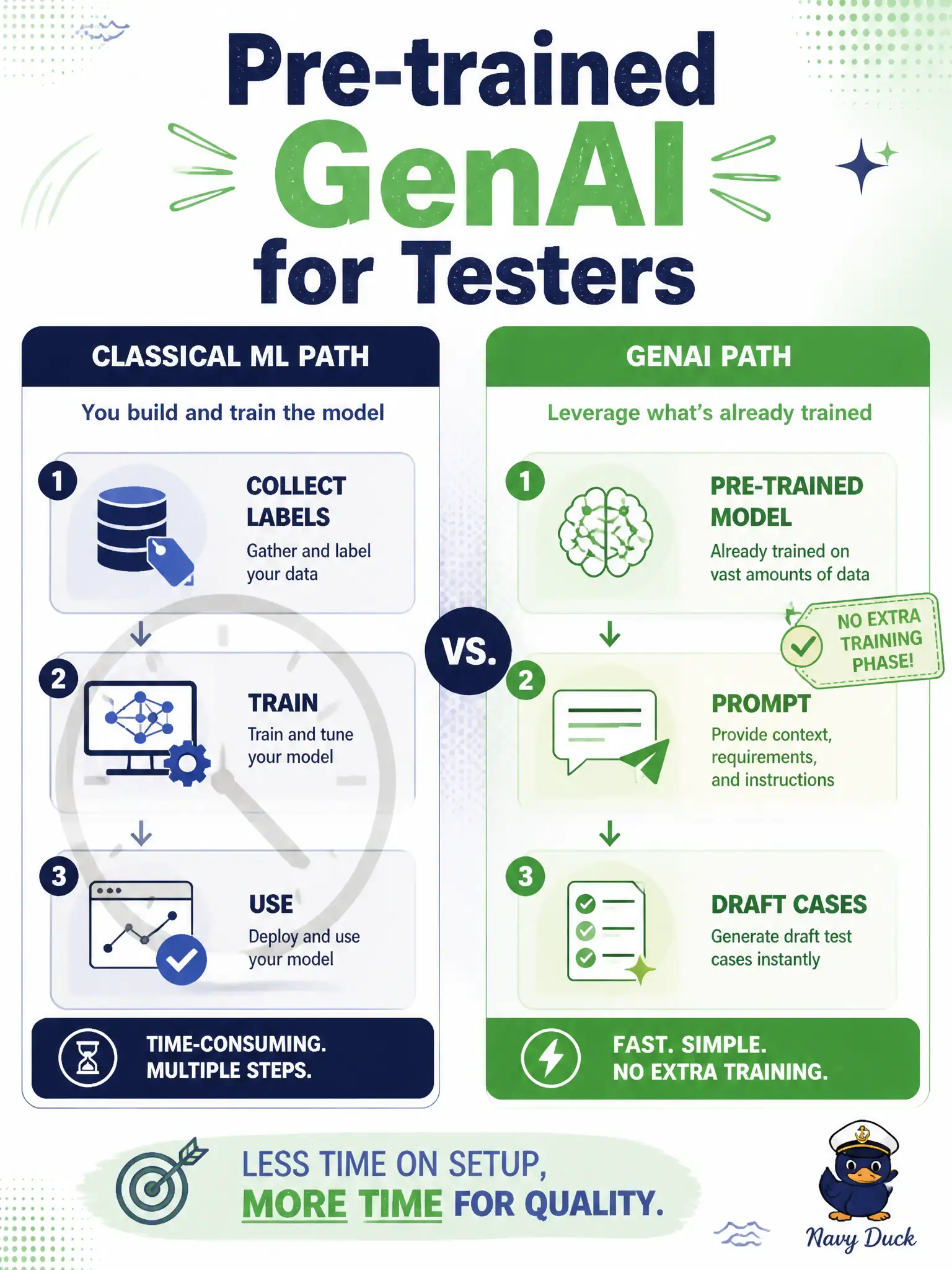
You do not rebuild the oven every time you want toast—you use one that is already heated. Pre-trained GenAI lets testers prompt for drafts without collecting a fresh labeled set first. Risks and review still matter later; the Chapter 1 point is the missing extra training phase.
Full Explanation
A practical Chapter 1 advantage of generative AI for testers is that models arrive pre-trained, so a community-solar billing tester can prompt for drafted test cases without first collecting a new labeled training set. The civic claim that “any AI drafting requires a training pass first” confuses classical ML’s usual preparation with GenAI’s typical tester workflow. Pre-training does not remove review; it removes the mandatory extra training phase before drafting can start.
Claims that GenAI always removes human review fail because syllabus limits keep fluent drafts subject to checking. Claims that GenAI replaces symbolic rule engines so clerks never edit if-then logic again mix content generation with symbolic knowledge representation. Equating GenAI with classical ML that merely “runs faster on the same labeled tickets” erases the pre-trained prompting advantage the item targets.
Exam caveat: pre-trained access ≠ unsupervised acceptance. Later chapters cover risks; Chapter 1’s tester benefit is starting from prompts without a fresh classical-style training job.
Operational check: attempt a prompt-based case draft on the solar-billing story without assembling a labeled set; confirm review gates remain in the municipal process; document that classical predictors on billing tickets still need their own training data when used for categorization.