
Four suppliers pitch a public-library hold system: a readable rule engine, a no-show scorer with hand-picked columns, a photo-spine reader that learned its own features, and a model that writes hold-cancellation notices. Which mapping of pitch to AI type is correct?
Select an answer to reveal the explanation.
Short Explanation
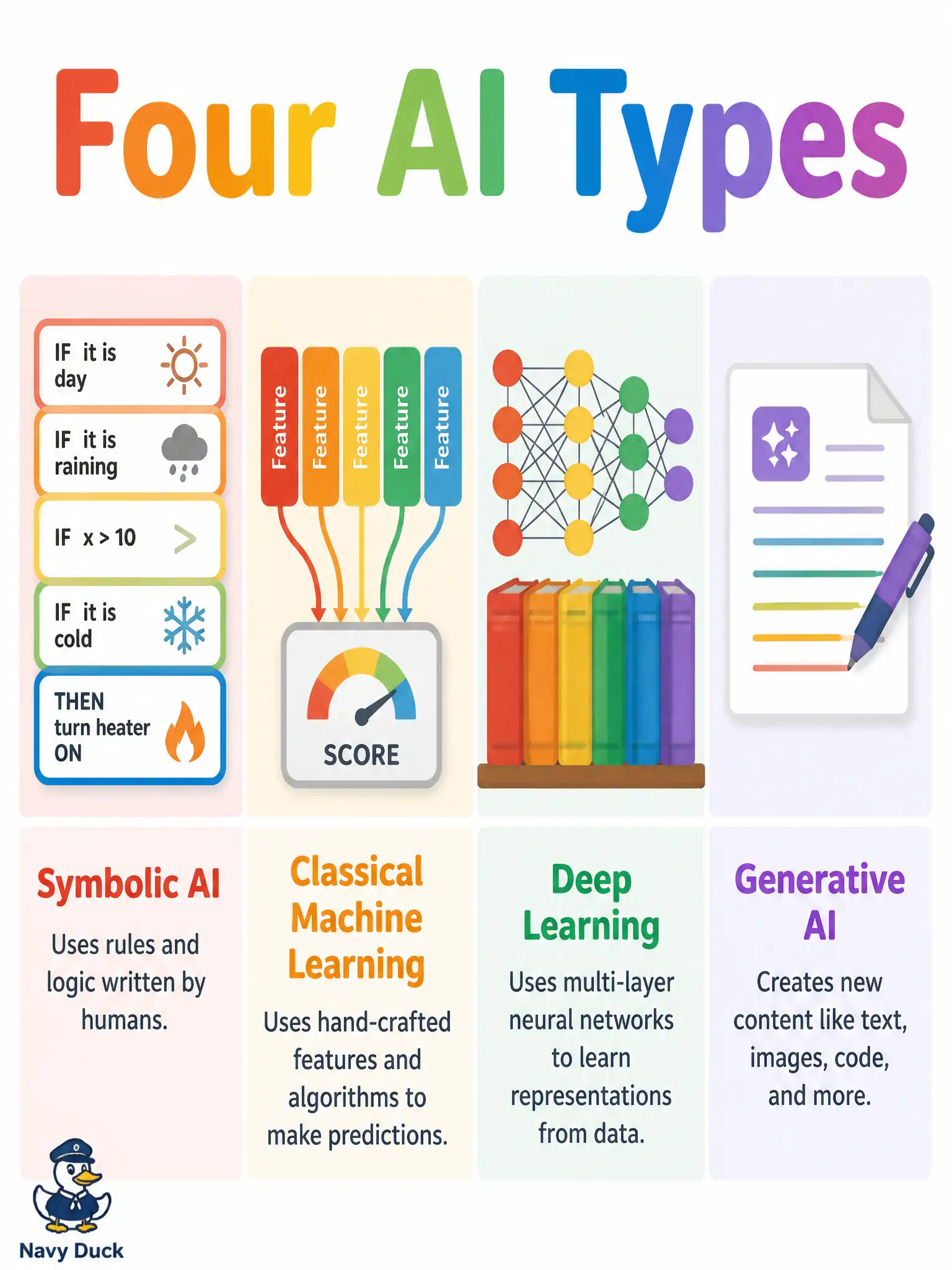
Four different tools, four different labels—like sorting mail into four bins, not one. Readable rules are symbolic AI; hand-picked columns plus training are classical ML; self-learned image features are deep learning; writing new notices is GenAI. They are not swap-in synonyms.
Full Explanation
Chapter 1 keeps four distinct AI types, and the public-library hold-system pitches map one-to-one: a readable rule engine is symbolic AI; a no-show scorer with hand-picked columns is classical ML; a photo-spine reader that learned its own features is deep learning; a model that writes hold-cancellation notices is generative AI. Civic procurement and testing conversations stay clear only when those labels stay attached to the matching mechanism.
Mappings that swap rule engines into classical ML or GenAI collapse inspectable rules with trained scorers or content writers. Treating scorers as symbolic AI ignores the need for chosen features and training. Calling a self-feature photo reader GenAI or a notice writer deep learning mixes creation of text with automatic visual feature learning. Claiming all four pitches are interchangeable GenAI labels erases the syllabus distinctions entirely.
Exam caveat: vendor marketing often blurs these types. The exam expects the mechanism mapping—rules, features+train, automatic features, content generation—not slogan synonyms.
Operational check: for each library vendor pitch, write the mechanism in one sentence; match it to symbolic / classical ML / deep learning / GenAI; reject any slide that uses one GenAI logo for all four; store the mapping in the civic evaluation notes.