
A food-bank inventory app has thousands of photographed shelf labels, and nobody wants to hand-list traits such as font size or glare. Which type of AI is designed to learn features automatically from that kind of large, complex input?
Select an answer to reveal the explanation.
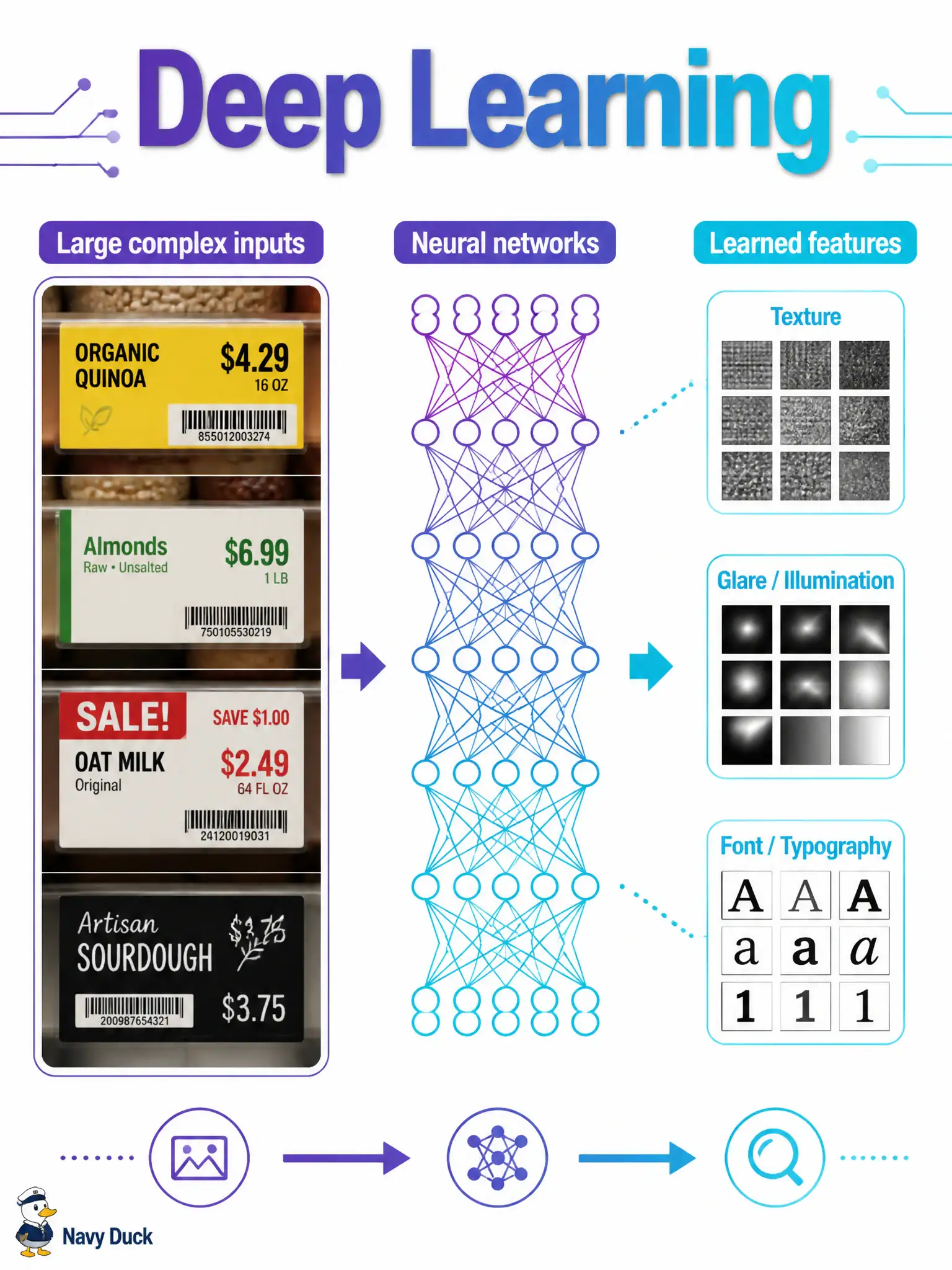
Short Explanation
Imagine teaching a sorter by showing piles of photos instead of writing a checklist of glare and fonts. Deep learning uses neural networks to learn those features from large messy inputs. It is not a rule book, a hand-picked feature table, or a content writer.
Full Explanation
Deep learning is designed for large, complex inputs—images, audio, or text—where neural networks learn features automatically instead of requiring a person to hand-list traits such as font size or glare. A food-bank inventory app with thousands of photographed shelf labels matches that need: manual feature engineering would be impractical at civic scale. Testers should place automatic feature learning from photos under deep learning on the Chapter 1 spectrum.
Symbolic AI fails because shelf rules encoded as if-then statements a clerk edits do not learn visual features from photographs. Classical machine learning fails when every feature column must be chosen by a person—the stem rejects that hand-listing. Generative AI fails because drafting donation thank-you emails creates new text artefacts; it is not the mechanism for learning label-image features.
Exam caveat: deep learning ≠ generative AI. Both may use neural networks, but the syllabus type here is automatic feature learning from complex inputs, not content creation. Classical ML still assumes chosen features.
Operational check: confirm the input is large image (or similar) data; confirm no hand-built feature checklist is required for the classifier path; distinguish any separate GenAI notice-writing job from the shelf-label learner; note the civic benefit as reduced manual feature labor on inventory photos.