
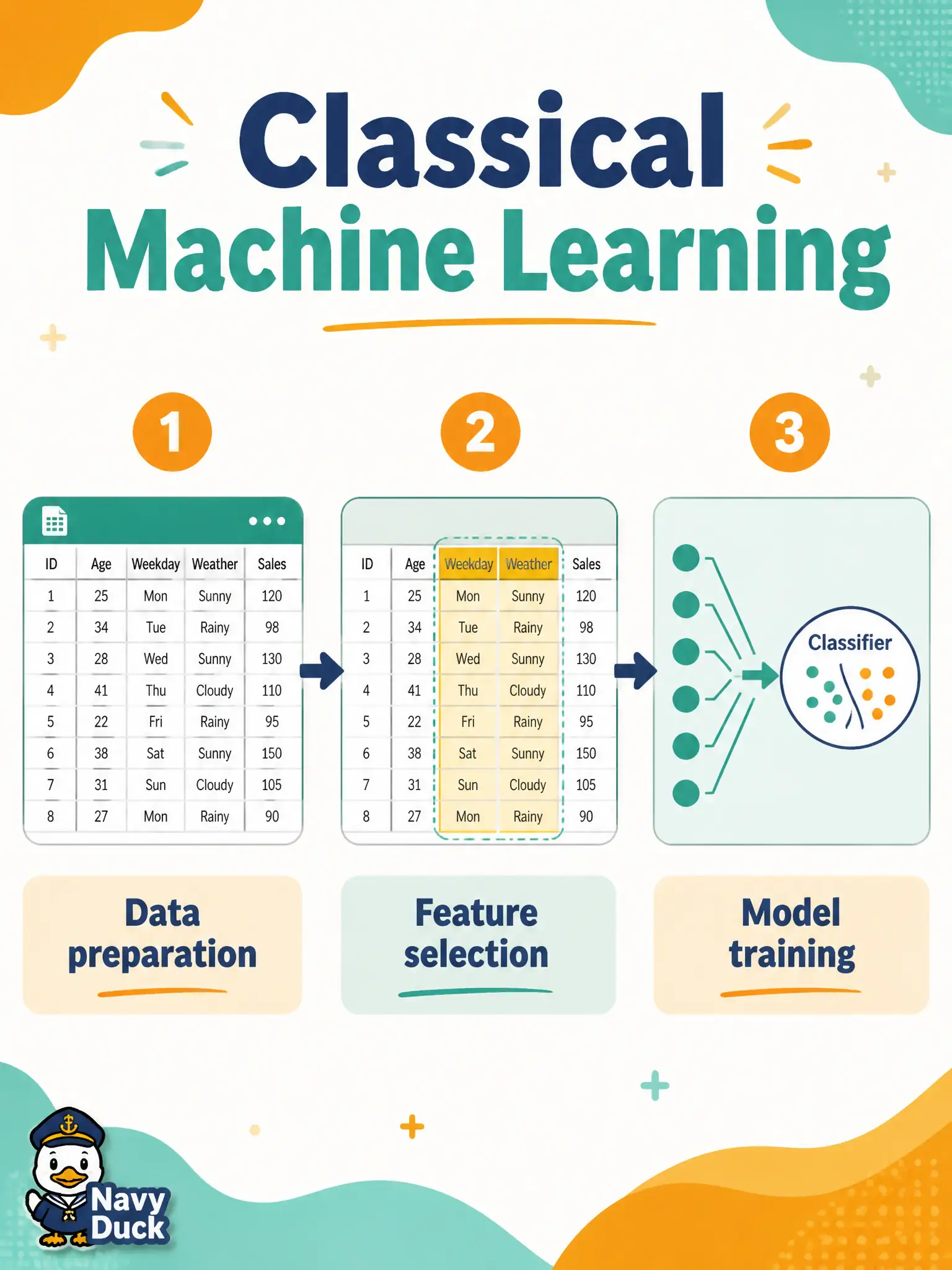
A community-theater box office wants last season’s no-shows sorted into “likely late” versus “likely cancel” after a person picks columns such as weekday and weather. Which AI approach does this describe?
Select an answer to reveal the explanation.
Short Explanation
Picture sorting mail into labeled bins after someone chooses which stamps matter. Classical ML starts with prepared data, hand-picked features, and a training pass. That is different from a rule table, a text generator, or a network that invents its own features.
Full Explanation
Classical machine learning fits the community-theater box-office task when historical no-shows are prepared, features such as weekday and weather are chosen by a person, and a training pass produces categories like “likely late” versus “likely cancel.” The defining pattern is data preparation, hand-selected columns, and supervised learning—not an editable rule card and not content generation. Civic box-office teams should recognize that labeling season history and picking predictive columns is classical ML work.
Symbolic AI fails because it would apply a fixed if-then table a clerk edits by hand rather than train on prepared feature columns. Generative AI fails because writing new reminder scripts from a user story creates content; it does not classify historical no-shows after feature selection. Deep learning fails the scenario’s stated method: the person picks columns, whereas deep learning is designed to learn features automatically from large messy inputs such as raw seat photographs.
Exam caveat: classical ML is identified by prepared data, chosen features, and training—not by the mere presence of a theater or ticket system. Vendor pitches that skip feature selection while claiming classical ML often actually mean deep learning or GenAI.
Operational check: list the selected feature columns; confirm a labeled training set exists; verify the model outputs category scores rather than drafted scripts; record in the municipal test notes that human feature choice was the discriminator versus deep learning.