
A municipal parking-permit desk encodes “resident + one vehicle + no unpaid tickets → approve” as if-then lines a clerk can open and edit. Which type of AI does this approach represent?
Select an answer to reveal the explanation.
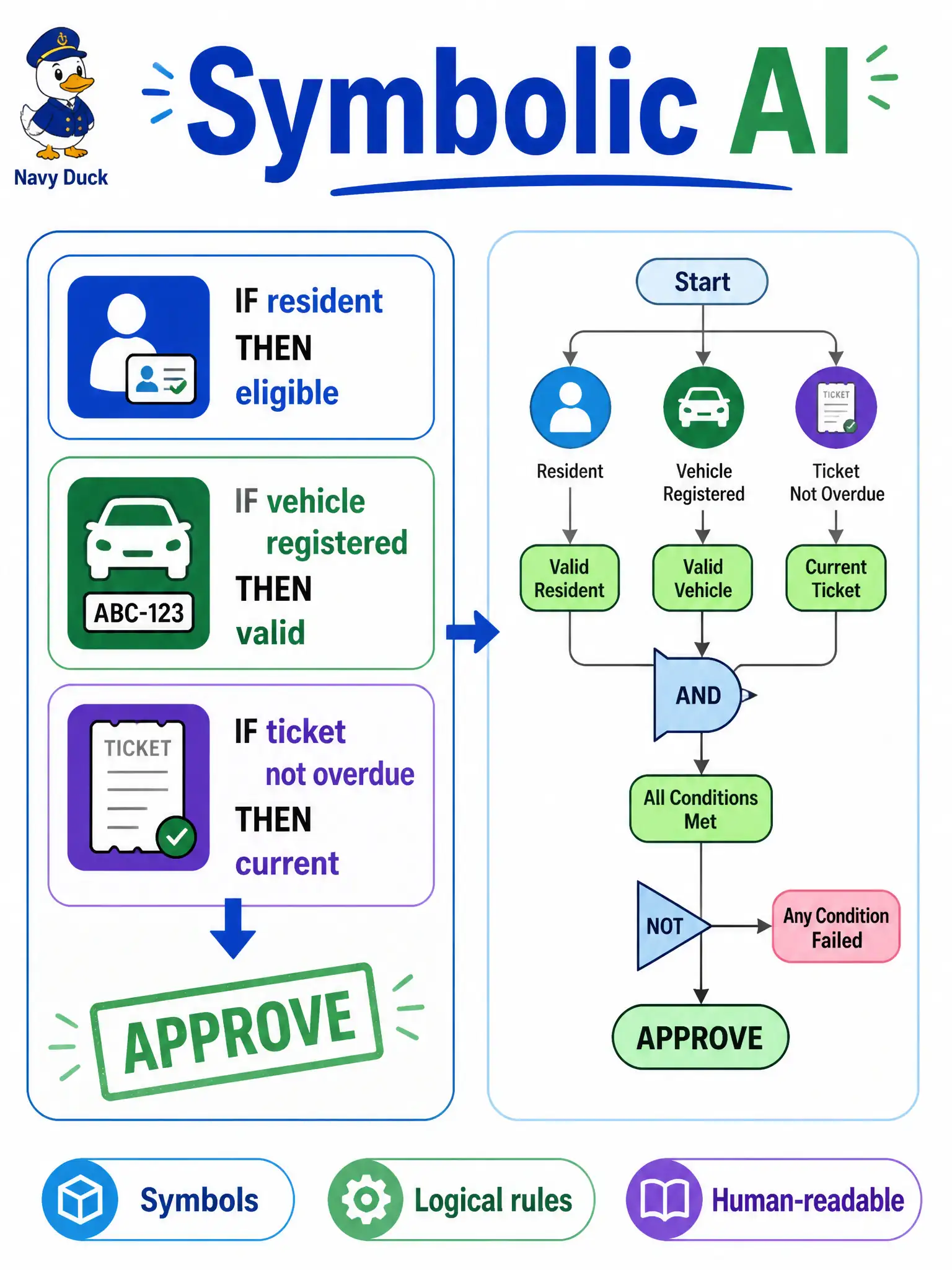
Short Explanation
Think of a recipe card a clerk can read and tweak: if this, then that. Symbolic AI stores knowledge as symbols and logical rules people can inspect. It is not a trained scorer, a neural feature learner, or a content generator.
Full Explanation
In a municipal parking-permit desk, Symbolic AI is the right label when approval logic is encoded as editable symbols and if-then rules a clerk can open and change. The knowledge is explicit—resident status, vehicle count, unpaid-ticket checks—rather than buried in trained weights. Civic desks often need that inspectability so policy changes become rule edits, not opaque retrain cycles. Testers evaluating such systems should classify the approach as symbolic because the decision path remains human-readable and maintainable.
Classical machine learning fails this concept because it scores from labeled examples after feature selection and a training pass; it does not store a clerk-editable if-then table. Deep learning fails because it learns features from large image or text sets through neural networks rather than listing explicit permit rules. Generative AI fails because it drafts new content from training patterns—approval letters, scripts—rather than executing an editable symbolic rule base for the approve decision.
Exam caveat: CT-GenAI Chapter 1 separates symbolic AI, classical ML, deep learning, and generative AI. Readable rules ≠ trained scorers ≠ automatic feature learners ≠ content generators. Do not treat “AI on a civic desk” as one interchangeable label.
Operational check: open the permit rule set; confirm a clerk can edit if-then lines without launching a training job; verify a policy change (for example unpaid-ticket threshold) is expressed as a rule edit; document that the civic control is symbolic inspectability, not model retraining.