
A municipal maple-tap permit instructor wants a Chapter 5 role-shift item that asks how to test the assistant as the product under test. Why is that out of scope for this bank?
Select an answer to reveal the explanation.
Short Explanation
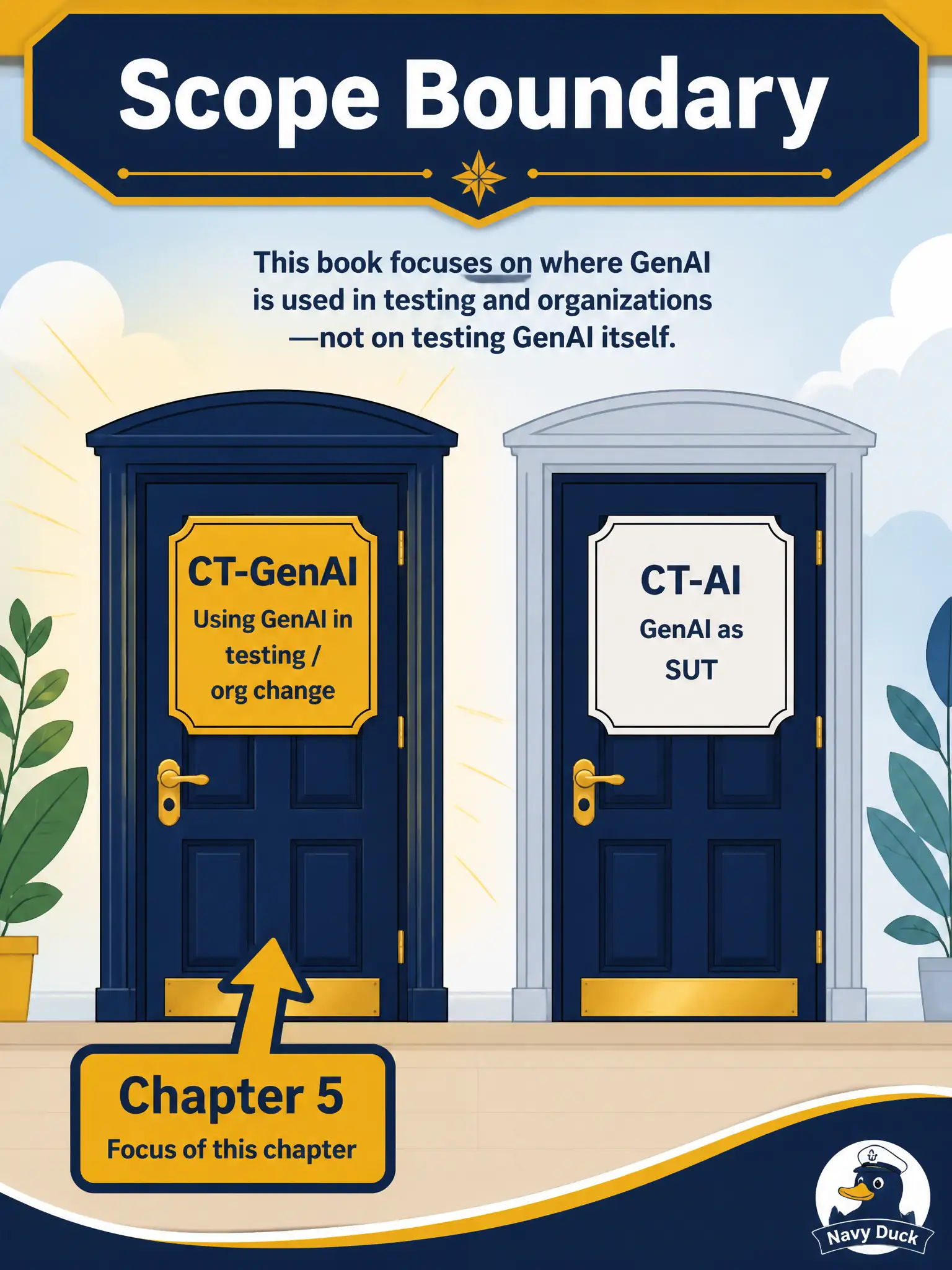
This chapter is about the shop changing because it uses GenAI—not about putting the assistant on the exam table as the product. Testing an LLM as SUT is CT-AI territory. Keep the boundary clear.
Full Explanation
Chapter 5 covers how the test organization changes when it uses GenAI—roles, skills, cultivation, strategy, and management shifts. Testing an LLM or GenAI product as the system under test is CT-AI territory and is out of scope for this CT-GenAI bank. A municipal maple-tap permit instructor who wants a Chapter 5 role-shift item that asks how to test the assistant as the product under test is crossing that boundary. Requiring every Chapter 5 item to include neuron coverage of the assistant imports CT-AI SUT practice incorrectly. Saying role-shift topics only apply when GenAI is never used in testing contradicts the chapter’s purpose. Claiming CT-GenAI and CT-AI are identical syllabi with no scope boundary erases the GenAI-for-testing versus AI-as-SUT distinction. Exam caveat: keep Chapter 5 on organizational change when using GenAI; send model-as-SUT questions to CT-AI. Operational check: rewrite the maple-tap item to ask how tester or manager roles change when GenAI assists testing, not how to test the assistant as the product. Keep civic testware subject to the same review discipline you would apply to human-authored packs. On the written exam, prefer syllabus terminology over vendor marketing language or lab choreography.