
During a credential-stuffing wave across a distributed office network, perimeter firewalls block 12,000 login attempts while only 3 accounts show confirmed unauthorized access. How should the analyst present these numbers in an executive visual summary?
Select an answer to reveal the explanation.
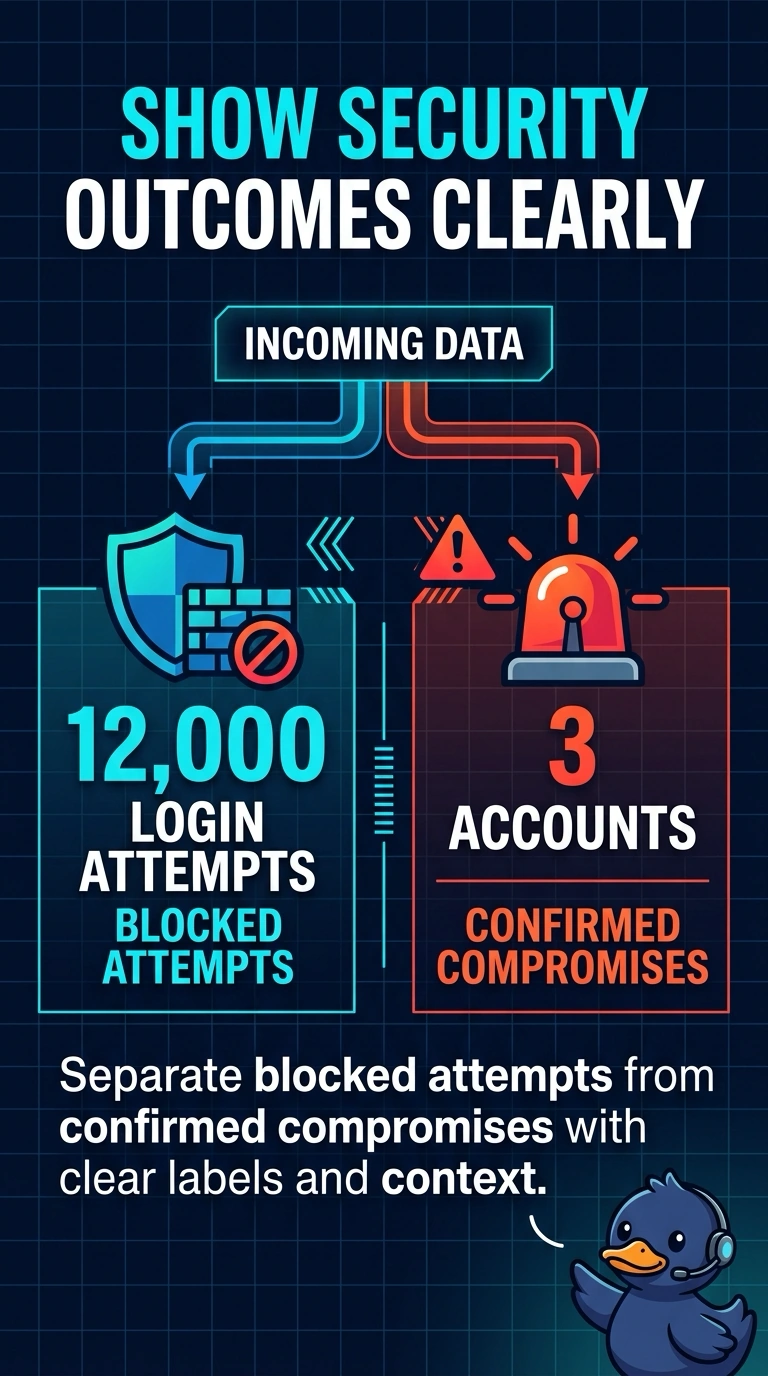
Short Explanation
Lumping blocked attacks together with real breaches is like counting every knock on a locked door as a burglary! When you separate blocked attempts from confirmed compromises in your visual summary, leadership sees both the scale of the attack and the true business impact. Never hide small compromise numbers behind huge block counts.
Full Explanation
Executive stakeholders rely on investigative visual summaries to gauge actual organizational risk and allocate response resources accurately. Choosing to Separate blocked attempts from confirmed compromises with clear labels and context distinguishes defensive successes (12,000 blocked attempts) from real impact (3 compromised accounts), preventing panic while still highlighting the breached identities requiring remediation. By contrast, choosing to Combine all 12,003 events into a single total labeled as confirmed account compromises grossly overstates the breach scope and misleads leadership. Choosing to Exclude the 3 confirmed compromises from the chart because 12,000 is visually larger hides the most critical security finding just because the count is small. Similarly, choosing to Display only raw firewall packet counts without mentioning any affected user accounts omits the confirmed account takeovers that executives need to act on. As an exam caveat, when counts differ by orders of magnitude, consider pairing a summary callout or secondary panel so the 3 compromises remain clearly visible. As an operational check, verify that every confirmed compromise count in the visual matches the closed or active identities documented in the incident case.
Prefer to study offline? Printable PDF study book + test engine ($7.50, unofficial). These questions stay free here.