
A global logistics SOC compiles a post-incident timeline from offices in Tokyo, London, and Chicago, and leadership questions why containment appears to occur before the initial phishing click. What documentation practice prevents this confusion?
Select an answer to reveal the explanation.
Short Explanation
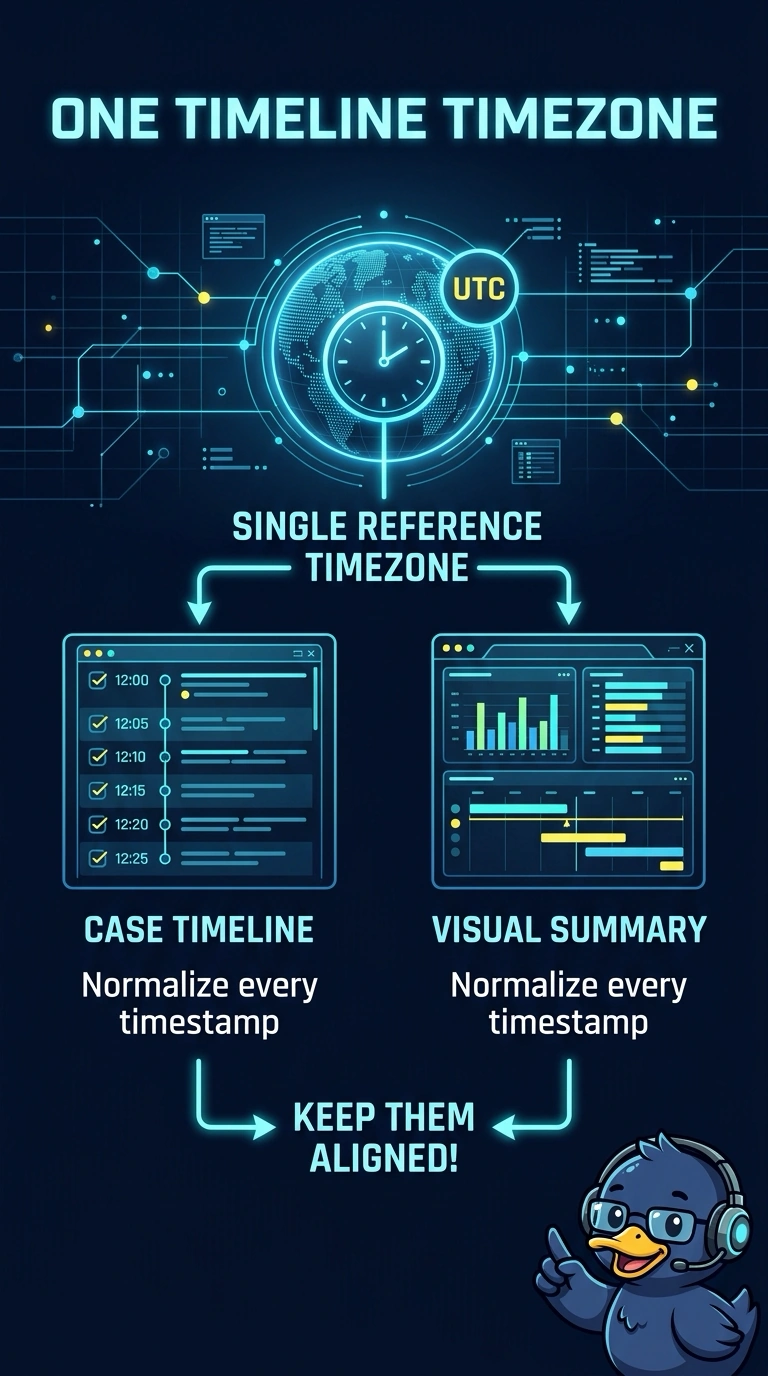
Mixing local time zones in an incident timeline is like reading a flight itinerary without knowing which city each clock belongs to—your cause and effect will look backward. Always anchor multi-region events to one shared clock so you never confuse leadership.
Full Explanation
When analysts paste raw local timestamps from different regional offices into a shared report, events appear out of chronological order and undermine confidence in the investigation. Choosing to Normalize all case timeline and visual summary timestamps to a single reference timezone establishes an unambiguous sequence across every log source and business unit. Selecting Omit exact hours and minutes from the executive visual summary removes critical precision needed to validate response speed and sequence of attacker actions. Opting to Sort the incident timeline alphabetically by office location name breaks chronological storytelling and makes it impossible to follow multi-stage lateral movement. Choosing to Store each office's events in separate unlinked investigation cases fragments a single coordinated incident and hides cross-region scope. As a caveat, if regional stakeholders need local-time context for shift handoffs, list the local offset in parentheses while keeping the primary timeline in one standard such as UTC. For an operational check, audit every milestone timestamp in your case record against the SIEM's normalized UTC view before publishing the summary.
Prefer to study offline? Printable PDF study book + test engine ($7.50, unofficial). These questions stay free here.