
A healthcare clinic SOC analyst investigates an endpoint alert showing a suspicious process making an outbound connection and wants to pivot into perimeter firewall logs in CQL to check whether the traffic passed. Why should the analyst pivot using IP addresses, destination port, and timestamp rather than the endpoint process ID?
Select an answer to reveal the explanation.
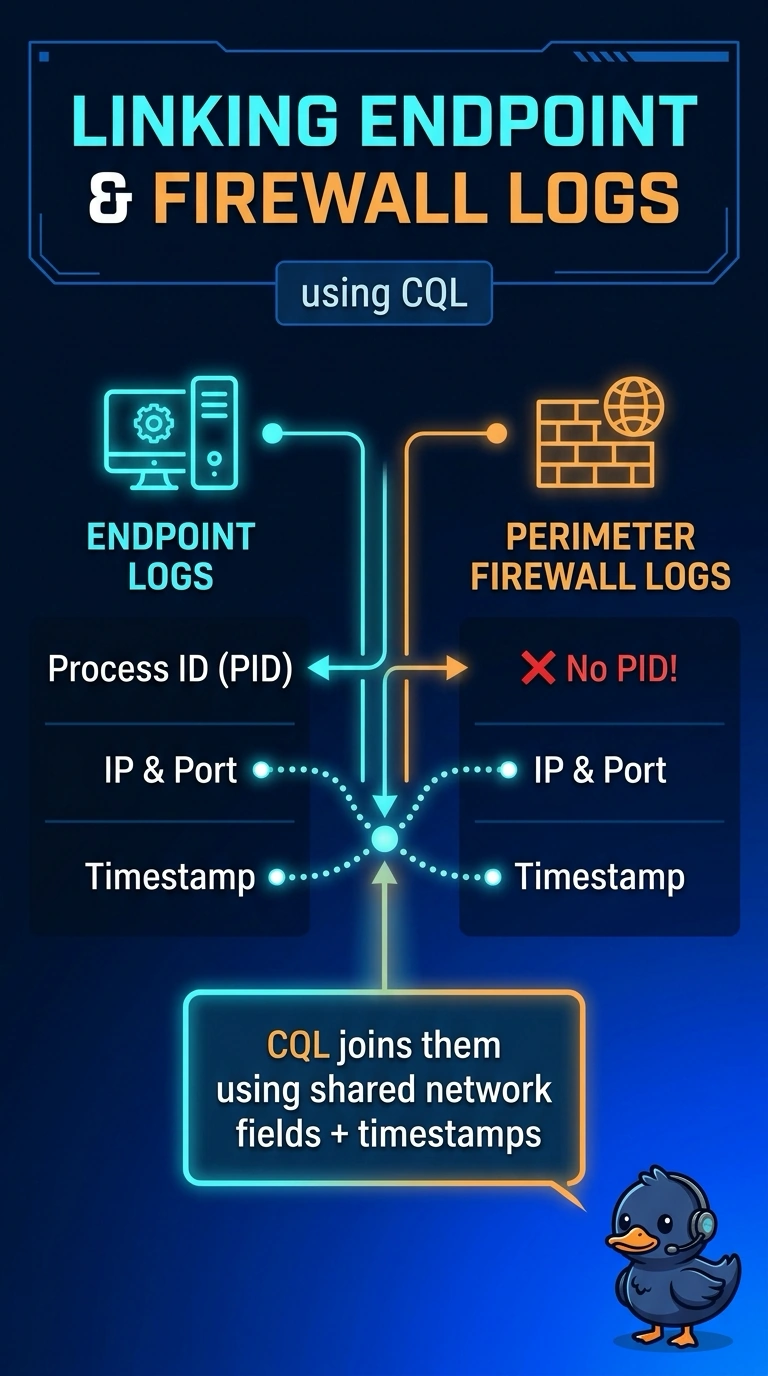
Short Explanation
Trying to look up an endpoint process ID in a perimeter firewall log is like asking a highway tollbooth which app on your phone ordered the trip. You need to pivot on the shared network clues—IPs, port, and time—so your cross-source search actually connects the dots.
Full Explanation
When correlating across different telemetry layers, you must recognize that Perimeter firewall logs lack endpoint process IDs, so shared network fields and timestamps must link them. Operating system process identifiers exist only within host-level telemetry and are never visible to an upstream network firewall inspecting packets on the wire; pivoting on the normalized source IP, destination IP, destination port, and narrow event timestamp bridges the two datasets. Claiming that Perimeter firewall logs automatically map endpoint process IDs into the normalized destination username field fails because firewalls have no native visibility into host process tables and CPS normalization does not invent missing attributes. Arguing that CQL prohibits filtering on numeric process identifiers whenever a query spans more than one dataset fails because CQL allows numeric field filters across any repository, though events lacking that field simply will not match. Asserting that Endpoint process IDs are stripped during SIEM ingestion unless a custom correlation rule preserves them fails because the limitation is in what the firewall logs originally, not in SIEM ingestion. As a caveat, if network address translation (NAT) or a proxy sits between the endpoint and firewall, you must pivot through NAT or proxy logs first. As an operational check, inspect a sample firewall event to confirm the normalized IP and port fields are populated before running the pivot.
Prefer to study offline? Printable PDF study book + test engine ($7.50, unofficial). These questions stay free here.