
At 09:00 UTC, a retail SOC analyst checks a dashboard comparing today's authentication volume against the past seven full days and sees today's bar is 70 percent lower. What should the analyst recognize before escalating a logging outage?
Select an answer to reveal the explanation.
Short Explanation
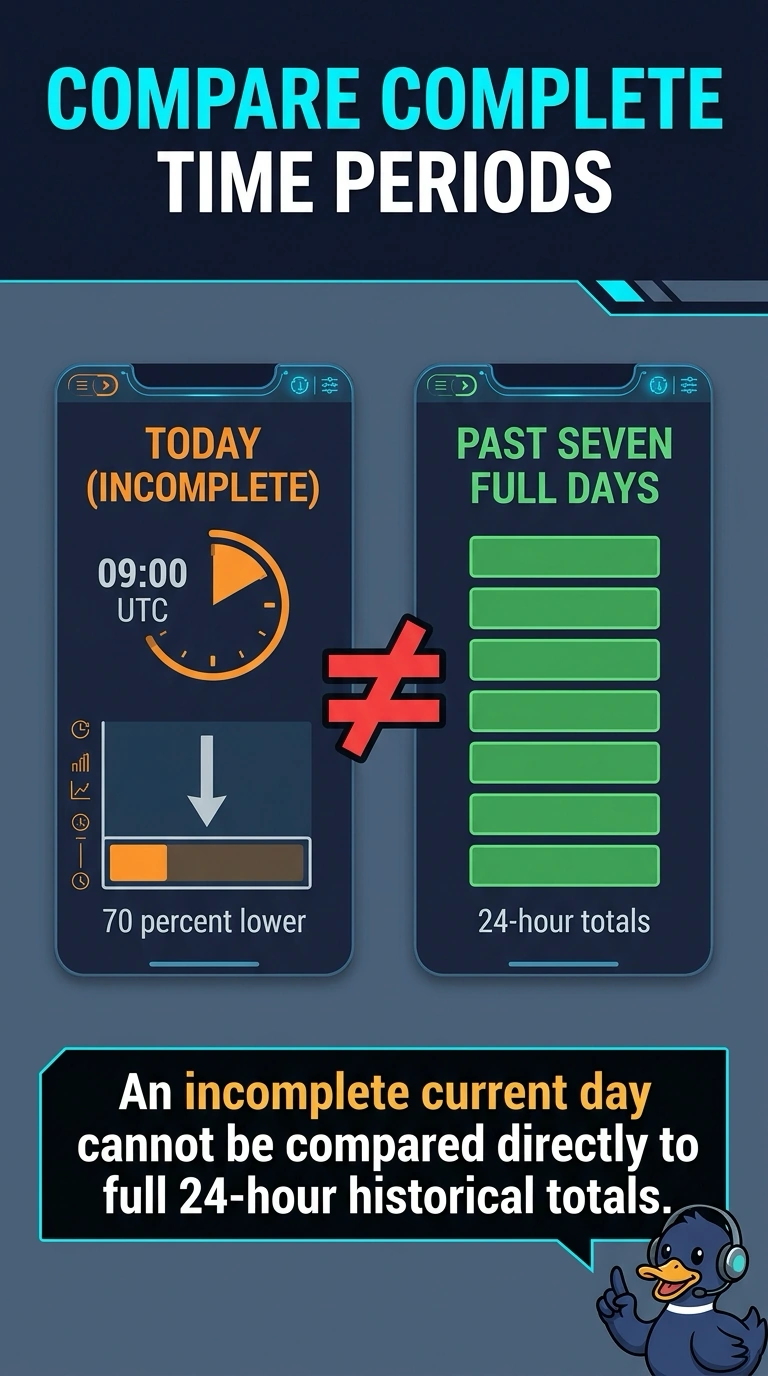
Comparing 9:00 AM today against a full 24-hour yesterday is like judging a marathon runner at mile eight against someone who already finished. Before you sound the outage alarm, align your time windows so you are comparing equal slices of the day. The trap is mistaking an incomplete day's running total for a sudden telemetry drop.
Full Explanation
Daily summary charts often plot completed 24-hour buckets alongside an in-progress current-day bucket, which naturally appears much smaller early in the day. Recognizing that "An incomplete current day cannot be compared directly to full 24-hour historical totals" prevents false outage escalations and focuses the analyst on equivalent time-of-day comparisons. Assuming that "A partial-day drop proves that every regional identity collector stopped sending telemetry at midnight" jumps to an unsupported conclusion without checking recent event timestamps. Believing that "The dashboard automatically scales today's partial count up to a full 24-hour projection by default" invents behavior that standard event-count aggregations do not perform unless explicitly written. Assuming that "Authentication events from retail stores are only ingested into the SIEM after business close" contradicts real-time SIEM ingestion expectations and ignores why 09:00 UTC already shows partial volume. Caveat: an actual ingestion outage can still happen mid-day, so an incomplete bucket never rules out a real drop on its own. Operational check: run a CQL query comparing the exact same morning hour range across today and the previous weekday to verify whether volume is normal.
Prefer to study offline? Printable PDF study book + test engine ($7.50, unofficial). These questions stay free here.