
A software company analyst wants to identify which source IP addresses generated the highest volume of failed logins across cloud and VPN logs over the past week. Which CQL approach best summarizes these results?
Select an answer to reveal the explanation.
Short Explanation
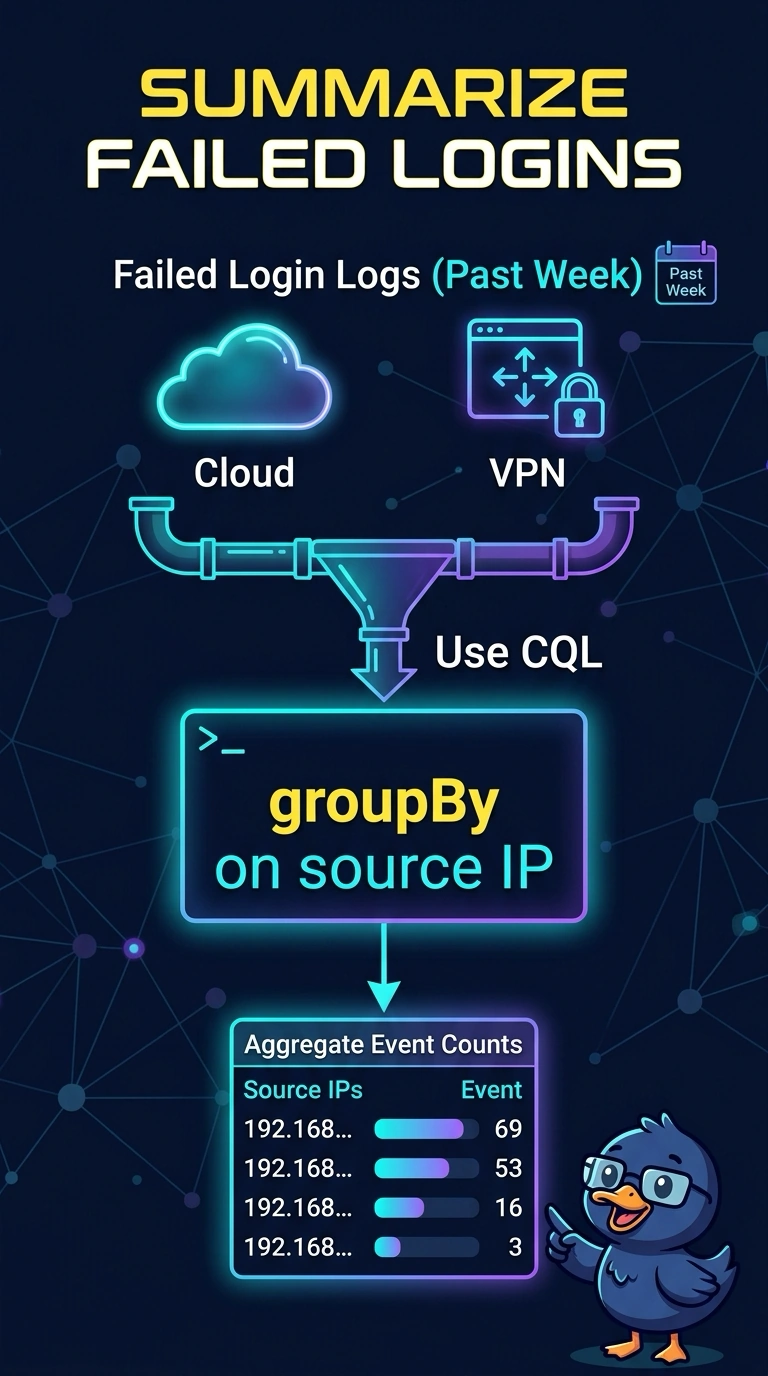
Scrolling through thousands of raw login events one by one is like counting grains of sand when you really just need to weigh the bucket. Using CQL groupBy lets you summarize counts by source IP so the loudest offenders jump right off the screen.
Full Explanation
When an analyst needs to spot top offenders or volume trends across thousands of authentication events, summarizing data with CQL aggregation is far more effective than reading individual records. Choosing to Use the CQL groupBy function on the source IP field to aggregate event counts groups matching events by each source address and calculates totals so outliers stand out immediately. Choosing to Disable CPS normalization so each log source prints unparsed lines removes the common schema that lets cloud and VPN logs share a consistent source IP field for comparison. Choosing to Inspect each raw authentication event individually in chronological order forces manual scrolling through massive event volumes and obscures aggregate frequency patterns across the week. Choosing to Convert the search into a third-party passthrough detection misapplies an external alert ingestion concept instead of summarizing existing SIEM telemetry. As a scope caveat, verify that the chosen time window covers the full week and that both log sources map source addresses into the same normalized field before comparing counts. Run the groupBy aggregation, sort by descending count, and validate top source IP addresses against known corporate NAT gateways.
Prefer to study offline? Printable PDF study book + test engine ($7.50, unofficial). These questions stay free here.